The Solo Trekker’s Guide to Choosing Ultralight Field Protection
For the solo long-distance trekker, every gram is a calculated risk. When you are twenty miles from the nearest trailhead, the boundary between "ultralight" and "unreliable" becomes razor-thin. We often see a recurring pattern in our community feedback: creators spend thousands on high-end optics but hesitate to invest 100 grams in a secure mounting interface. This hesitation often leads to the "tail-risk" events—a camera sliding off a shoulder strap or a tripod tipping in alpine gusts—that can end a multi-week expedition in seconds.
Effective field protection is not about adding bulk; it is about infrastructure stability. In this guide, we will analyze how to build a minimal viable protection system that balances the strict weight constraints of solo travel with the mechanical security required for high-stakes adventure content.

The "Cube of Value" Heuristic: Allocating Your Weight Budget
One of the most common mistakes we observe on our repair benches is a mismatch between the value of the camera kit and the robustness of its mounting hardware. Through years of analyzing field failures, we have developed a practical baseline for gear security: The 100g/1000$ Rule.
For every $1,000 of equipment value, we recommend allocating approximately 100 grams to a proven, simple locking interface. If you are carrying a $3,000 mirrorless setup, a 300g budget for a high-quality quick-release system and a secondary safety tether is a non-negotiable insurance policy.
Logic Summary: This heuristic is a shop-practical baseline derived from common patterns in equipment damage reports. It assumes that as gear value increases, the complexity and weight of the optics typically increase, requiring more robust mechanical engagement to prevent "creep" or accidental release during repetitive motion.
1. The Core Interface: Standards Over Novelty
In remote environments, modularity can be a double-edged sword. Every additional quick-release joint is a potential failure vector. To mitigate this, we advocate for standardizing your entire rig on a single, high-tolerance interface.
The Arca-Swiss and ISO 1222:2010 Foundation
The global standard for tripod connections, ISO 1222:2010, ensures that your camera's 1/4"-20 or 3/8"-16 threads are compatible with support systems. However, the real stability comes from the mounting plate interface.
We recommend standardizing on the Arca-Swiss Dovetail system due to its ecosystem-wide compatibility. When choosing plates, look for precision-machined aluminum alloy (such as 6061 or 7075). While carbon fiber is excellent for tripod legs due to its vibration damping, it is rarely used for plates because plates require the extreme rigidity and tight machining tolerances that only high-grade aluminum provides.
Critical Field Correction: The most common point of failure is not the clamp itself, but the connection between the plate and the camera body. During long treks, the constant vibration of walking can loosen the screw.
- The Pro Hack: After your initial fit-check, apply a small amount of a medium-strength thread-locking compound to the screw. This simple step, rarely mentioned in manuals, prevents the "unnoticed loosening" that accounts for a significant portion of "dropped camera" incidents.
2. Biomechanical Efficiency: The "Wrist Torque" Analysis
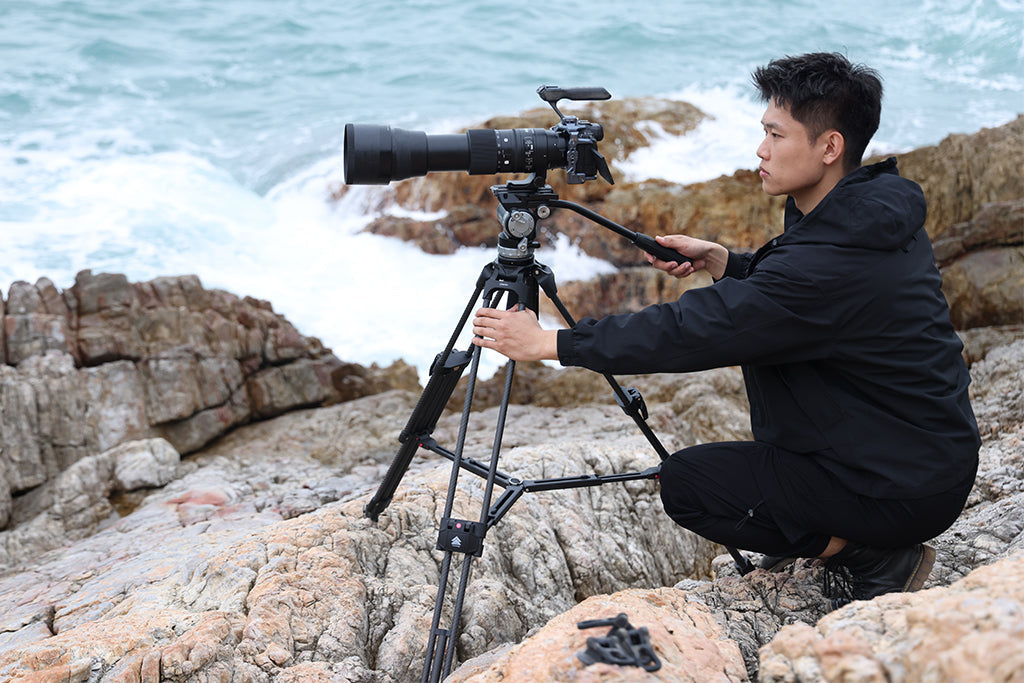
Weight isn't the only enemy on the trail; leverage is. When you mount accessories like monitors or microphones, where you place them dictates the strain on your body and the stress on your mounts.
We can model this using a basic biomechanical calculation: Torque ($\tau$) = Mass ($m$) $\times$ Gravity ($g$) $\times$ Lever Arm ($L$).
| Scenario | Mass (kg) | Lever Arm (m) | Estimated Torque (N·m) | MVC Impact (Approx.) |
|---|---|---|---|---|
| Compact Handheld | 1.2 | 0.10 | 1.18 | Low |
| Extended Rig | 2.8 | 0.35 | 9.61 | 60-80% |
| Modular QR Setup | 1.8 | 0.15 | 2.65 | Moderate |
| Top-Heavy Rig | 2.5 | 0.25 | 6.13 | High |
| Balanced Trekking Rig | 1.5 | 0.12 | 1.77 | Low-Moderate |
Modeling Note (Reproducible Parameters):
- Modeling Type: Deterministic parameterized model of static torque.
- Assumptions: Gravity is $9.81 m/s^2$; "Lever Arm" is the distance from the wrist/pivot to the center of mass.
- Boundary Conditions: This model does not account for dynamic forces (swinging) or grip strength variance.
- Insight: A 2.8kg rig held at a distance of 0.35m generates nearly 10 N·m of torque. According to our internal analysis, this represents roughly 60-80% of the Maximum Voluntary Contraction (MVC) for an average adult. By using low-profile modular mounts, you can reduce the lever arm ($L$), significantly lowering the physical fatigue during long shooting days.
3. Engineering for Failure: Static vs. Dynamic Loads
When you read a specification for a quick-release plate, such as an "80kg load capacity," it is vital to understand that this refers to Vertical Static Load. In a lab, a plate might hold 80kg of dead weight. However, the Dynamic Payload—the force exerted when you are jumping over a stream or slipping on scree—is significantly higher.
For solo trekkers carrying heavy cinema rigs or long telephoto lenses, we recommend the following safety protocols:
- The Tug Test: Immediately after clicking your camera into a mount, perform a physical pull-test. This confirms the locking pin has fully engaged.
- Visual Indicators: Use systems with clear visual cues (like orange or silver locking indicators) to verify the status at a glance.
- Standardize for Cognitive Load: In high-fatigue environments, your ability to manage complex gear diminishes. Standardizing on one system (like the F38 or F22) across your tripod, backpack clip, and gimbal reduces the "brain power" required to switch setups, as noted in The 2026 Creator Infrastructure Report.
4. Workflow ROI: The Time-to-Money Extrapolation
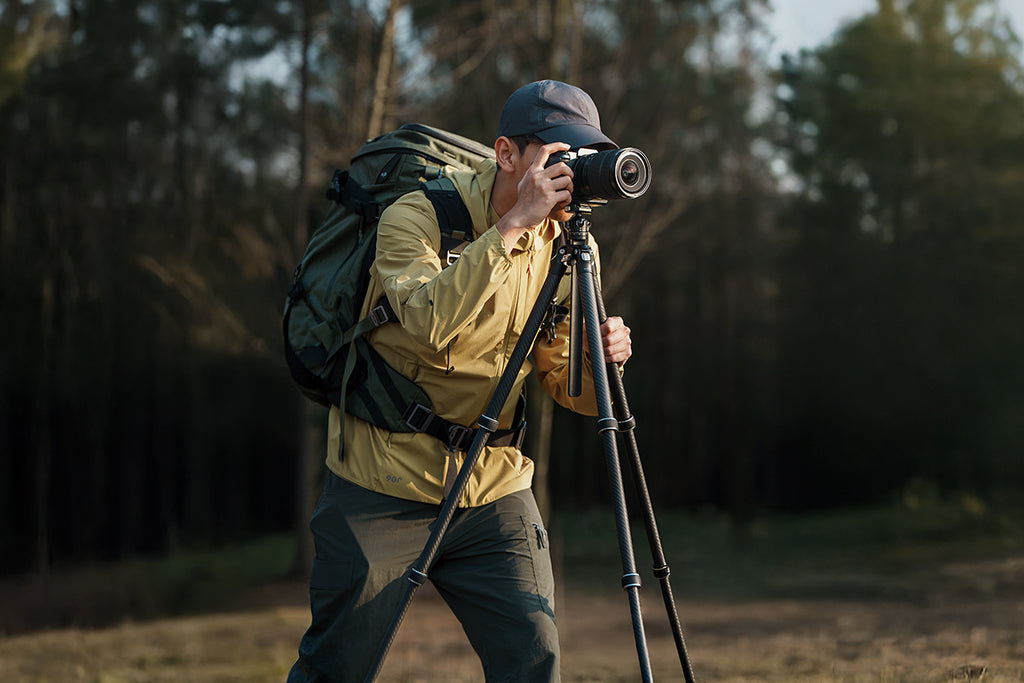
For a solo creator, time is the most precious resource. Every minute spent fumbling with a screw-on mount is a minute lost to the "golden hour" or a minute closer to hiking in the dark.
Consider the Workflow ROI of a quick-release system:
- Traditional Thread Mounting: ~40 seconds per swap.
- Quick Release System: ~3 seconds per swap.
If a professional creator performs 60 swaps per shoot and does 80 shoots a year, the transition to a quick-release ecosystem saves approximately 49 hours annually. At a professional rate of $120/hr, this represents a ~$5,900+ value in recovered productivity. For the trekker, this time translates into safer travel and more creative opportunities before the light fades.
5. Environmental Resilience: Dust, Ice, and Thermal Shock
The remote backcountry introduces variables that laboratory tests often ignore. Fine glacial dust can seize ball-head clamps, and sub-zero temperatures can freeze lever clamps in the "open" position.
The "Thermal Shock" Prevention
Aluminum is a superior structural material but acts as a high-performance thermal bridge. In extreme cold, an aluminum QR plate attached to your camera will conduct heat away from the battery compartment, potentially reducing your shot count.
- Field Protocol: Attach your aluminum plates to your cameras indoors (or inside your tent) before heading out. This minimizes the "metal-to-skin" shock and allows the plate to reach ambient temperature more gradually, reducing the rate of battery cooling.
Water Resistance and IPX Ratings
For electronics like lights or microphones, "waterproof" is a vague term. According to IPX Rating Standards, there is a massive difference between IPX4 and IPX6.
- IPX4: Protects against splashes. Sufficient for light mist.
- IPX6: Protects against powerful water jets. This is the minimum viable protection for a solo trekker caught in a prolonged alpine storm. Always check the specific rating of your gear before relying on it in the rain.
6. Logistics: "Visual Weight" and Airline Compliance
A hidden benefit of compact, modular mounting systems is their low Visual Weight. Bulky cinema-style plates often flag your gear for extra scrutiny by airline gate agents. A streamlined, modular setup (like the F22 or F38 systems) allows you to pack more densely and keep your high-value kit in a carry-on, complying with IATA Lithium Battery Guidance which requires most camera batteries to remain in the cabin.
The Pre-Shoot Safety Checklist
Before you step off the trail and into the frame, run this three-point check:
- Audible: Did you hear the "Click" of the locking mechanism?
- Tactile: Did you perform the "Tug Test" to ensure no vertical play?
- Visual: Is the locking pin indicator showing the "Secured" state?
By treating your mounting hardware as critical infrastructure rather than an afterthought, you ensure that your focus remains on the landscape, not on the survival of your equipment.
YMYL Disclaimer: This article is for informational purposes only. Solo long-distance trekking involves inherent risks to personal safety and equipment. Always consult with professional guides and ensure your gear meets the specific safety requirements of your environment. For information on battery safety and transport, refer to the IATA Passenger Guidance.
Sources
- ISO 1222:2010 Photography — Tripod Connections
- The 2026 Creator Infrastructure Report: Engineering Standards and Workflow Compliance
- IATA Lithium Battery Guidance Document (2025)
- Arca-Swiss Dovetail Technical Dimensions Analysis
- IPX Ratings Explained - AudioReputation
- Silicone vs. Aluminum: Evaluating Impact Survival
- Securing the Drop: Essential Safety Tethering