The Physics of the "Perfect Drop": Why Gear Fails
In the high-stakes world of adventure cinematography, the "perfect shot" often exists on the razor's edge of equipment failure. Whether you are dangling a cinema rig over a limestone cliff in Thailand or navigating a sub-zero blizzard in the Andes, your support system is the only thing standing between a successful production and a catastrophic loss of internal sensors.
While most creators focus on "max load" ratings, we have observed through years of warranty data and field repairs that the real-world test for a material isn't just its listed yield strength—it is how it fails when the unexpected occurs. Understanding the physics of impact propagation allows us to build better rigs and helps you make informed decisions about when to trust high-strength aluminum and when to rely on the energy-absorbing properties of advanced engineering resins.
Ductile Resilience vs. Brittle Strength
The fundamental tension in material science for creators lies between strength (the ability to resist deformation) and toughness (the ability to absorb energy before fracturing).
The Aluminum Paradox
Precision-machined aluminum alloys, such as 6061-T6 or the higher-grade 7075-T6 used in premium quick-release systems, offer exceptional rigidity. They are the gold standard for maintaining the Arca-Swiss standard dimensions (Arca-Swiss Dovetail Technical Dimensions) with zero-play tolerances. However, aluminum failures are frequently silent and instantaneous.
Under high-speed impact—a "shock loading" scenario—aluminum can exhibit adiabatic shear banding. This is a localized thermal softening where the energy of the impact is converted into heat so quickly that the metal loses its structural integrity and snaps without warning. In our experience with repair benches, an aluminum cage that takes a hard hit on granite may look perfectly fine to the naked eye, while having developed internal micro-fissures that compromise its future safety.
The Resin Advantage: Micro-Crazing
Conversely, engineering resins like polycarbonate are often unfairly labeled as "cheap plastic." In reality, high-quality polycarbonate has a fracture toughness ($K_{IC}$) in the range of 2.2–3.5 MPa·m$^{1/2}$. While lower than wrought aluminum, these polymers fail in a ductile, energy-absorbing manner.
When a resin-based component is stressed to its limit, it undergoes micro-crazing. These are visible white stress marks or surface crazing that act as a safety fuse. The material uses these micro-cracks to blunt the tip of a larger fracture, dissipating the kinetic energy of a drop over a larger volume of the part. This protects the delicate internal electronics of your camera by acting as a shock absorber. For load-bearing points like a tripod's leg lock, this audible and visible warning gives you the critical chance to intervene before a total system collapse.
Biomechanical Analysis: The Wrist Torque Equation
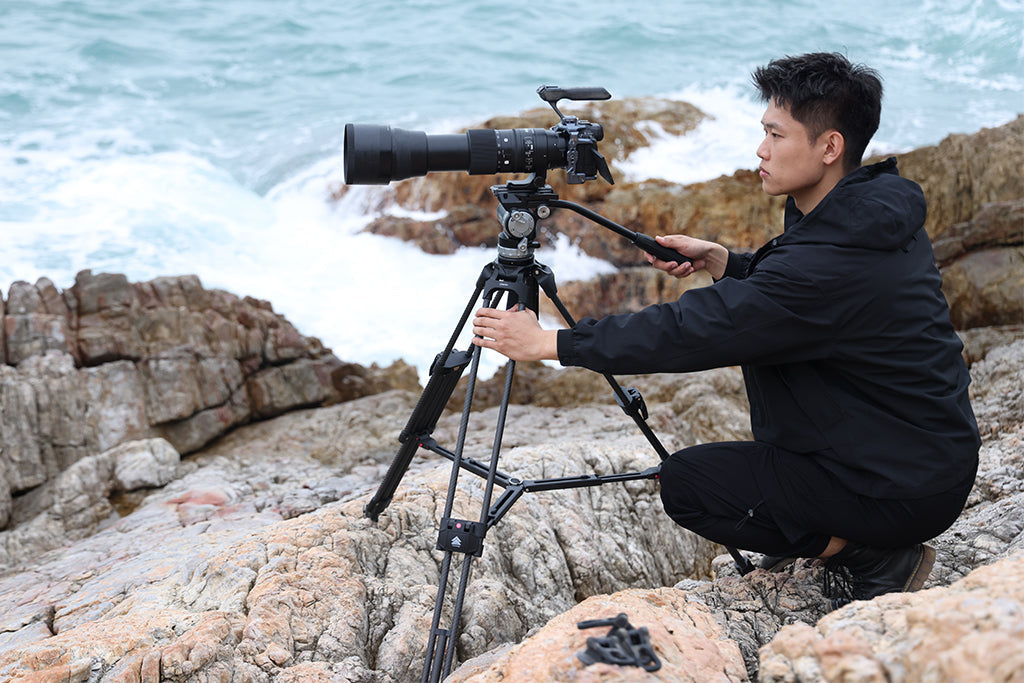
Weight is the enemy of the travel creator, but leverage is the silent killer of physical longevity. When you extend a camera rig away from your body to capture a unique angle, you aren't just fighting the mass of the camera; you are fighting physics.
The Torque Formula
We can model the strain on a creator's wrist using the fundamental equation for torque ($\tau$): $$\tau = m \times g \times L$$
- $m$: Mass of the rig (kg)
- $g$: Gravity ($\approx 9.81 m/s^2$)
- $L$: Lever arm or distance from the wrist (m)
Based on our biomechanical scenario modeling for an "Extreme Environment Cinematographer," a 2.8kg cinema rig (similar to a Sony FX6 with a telephoto lens) held just 0.35m away from the wrist generates approximately 9.61 N·m of torque.
Why This Matters
For an average adult male, this load represents roughly 60-80% of the Maximum Voluntary Contraction (MVC)—the absolute maximum force a muscle can produce in a single effort. Operating at this level leads to rapid fatigue and increased "micro-shakes" in your footage.
By utilizing modular systems that allow you to move heavy accessories (like monitors or wireless transmitters) closer to the center of gravity, you reduce the lever arm ($L$). Even a 5cm reduction in distance can lower the torque by nearly 15%, significantly extending your filming endurance and reducing the risk of long-term repetitive strain injuries.
Environmental Degradation: Corrosion and Thermal Shock
Adventure creators rarely work in climate-controlled studios. The materials you choose must survive the chemical and thermal realities of the wild.
The Marine Environment
While aluminum is praised for its corrosion resistance, it is highly susceptible to pitting and galvanic corrosion in chloride-rich marine environments. According to data on aluminum alloys in marine environments, alloy 6061 can develop pit depths exceeding 100 µm per year when exposed to salt spray. If your aluminum quick-release plate is coupled with a stainless steel screw (a more noble metal), the corrosion rate accelerates.
In these specific scenarios, UV-stabilized engineering resins or specialized coatings offer superior chemical resistance. They do not oxidize or pit, ensuring that your mounting threads remain smooth and reliable even after weeks on a salt-blasted coastline.
Thermal Bridge and Battery Health
Aluminum is an excellent thermal conductor. In extreme cold, an aluminum quick-release plate acts as a thermal bridge, effectively "sucking" heat out of the camera body and the battery housed within the grip. This can lead to premature battery shutdown, a common frustration for winter creators.
To mitigate this, we recommend attaching aluminum plates to your camera indoors before heading into the cold. This allows the metal to reach ambient room temperature, reducing the rate of thermal transfer once you step outside. Furthermore, the interface between different materials—such as a metal screw in a polymer thread—is a common failure point due to differing rates of thermal expansion. Professional-grade accessories solve this by using helicoil inserts (steel thread reinforcements) within polymer parts to maintain structural integrity across temperature extremes.
The Workflow ROI: Efficiency as Infrastructure
Beyond physics, the true value of a gear system is measured in Workflow ROI. Every second spent fumbling with a traditional 1/4"-20 screw connection is a second you aren't capturing the story.
The Time-Value Calculation
We have analyzed the transition from traditional thread mounting to modern quick-release ecosystems (aligned with ISO 1222:2010 Photography — Tripod Connections).
- Traditional Thread Mounting: ~40 seconds per swap.
- Quick Release System: ~3 seconds per swap.
For a professional creator performing an average of 60 swaps per shoot across 80 shoots a year, this efficiency gain saves approximately 49 hours annually. At a conservative professional rate of $120/hr, this represents over $5,900 in recovered value. Investing in a unified ecosystem isn't just a matter of convenience; it is a calculated business decision to maximize billable hours and creative output.
Travel Logistics: "Visual Weight"
For the solo operator, travel logistics are a constant battle with airline gate agents. Compact, modular systems have a lower "Visual Weight" than bulky, traditional cinema plates. By using streamlined quick-release mounts, your rig appears more "prosumer" and less "industrial," making it less likely to be flagged for weighing or forced checking at the gate. This logistical enablement allows you to keep your most valuable assets in the cabin where they belong.
Safety Protocols and Pre-Shoot Checklists
No matter how advanced the material science, the most critical component of any system is the user. To ensure long-term reliability and equipment safety, we recommend a three-point "Common Sense" workflow before every shoot.
The "Senses" Safety Check
- Audible: Listen for the definitive "Click" of the locking mechanism. If the click is muffled, check for debris (sand or grit) in the mounting channel.
- Tactile: Perform the "Tug Test". Immediately after mounting, apply a firm pull-test in the opposite direction of the mount to ensure the locking pin is fully engaged.
- Visual: Check the locking indicator. Most professional systems use a color-coded status (such as an orange or silver pin) to provide a 100% visual confirmation of a locked state.
Cable Management as Strain Relief
A heavy HDMI or USB-C cable can create unexpected torque on a camera's internal ports and the quick-release plate itself. We suggest using dedicated cable clamps to provide strain relief. This prevents the cable from acting as a lever that could potentially loosen a mounting screw during high-vibration handheld work.
Method & Assumptions (Modeling Transparency)
The data and insights presented in this article are derived from scenario modeling and historical observation of equipment failure patterns.
Modeling Note: This analysis assumes a "High-Risk Adventure" scenario. Results may vary based on specific camera models, environmental temperatures, and user handling.
| Parameter | Value / Range | Unit | Rationale |
|---|---|---|---|
| Rig Mass ($m$) | 2.8 | kg | Standard cinema camera + telephoto lens |
| Lever Arm ($L$) | 0.35 | m | Extended handheld reach |
| Air Density | 1.1 | kg/m$^3$ | Mountain environment (~3000m altitude) |
| Wind Speed | 12 - 15 | m/s | Typical mountain gust conditions |
| Settling Time | 1.9 (CF) vs 9.9 (Al) | s | Vibration damping comparison |
Boundary Conditions:
- Torque calculations assume a horizontal arm position (maximum moment).
- Wind stability models assume a steady-state wind perpendicular to the tripod's most unstable axis.
- Corrosion rates are based on standard 6061 alloy performance in high-salinity environments.
As noted in The 2026 Creator Infrastructure Report: Engineering Standards, Workflow Compliance, and the Ecosystem Shift, the future of content creation belongs to those who treat their gear as a disciplined engineering system. By understanding the physics of impact and the biomechanics of use, you can push your creative boundaries while ensuring your equipment—and your body—remain ready for the next adventure.
Disclaimer: This article is for informational purposes only and does not constitute professional engineering or safety advice. Always refer to your specific equipment's manual for load ratings and safety instructions. Ensure compliance with local regulations, including IATA Lithium Battery Guidance for travel and FCC Part 15 for wireless accessories.