Deciding on Center-Column-Free Designs for Ultralight Travel
Quick Decision Summary: Center-column-free (CCF) tripods are the preferred choice for adventure and landscape creators who prioritize wind stability and a slim packable profile over maximum height. While they can reduce vibration "settling time" by an estimated 20–30%, they require more manual leg adjustment. Choose a traditional column only if your work (like events or studio portraits) demands frequent, rapid height changes to eye level.
For the solo creator, the "perfect" travel tripod is often a paradox. You require the stability of a studio rig but the packability of a water bottle. In the pursuit of the ultimate lightweight setup, the most significant architectural shift in recent years has been the move toward center-column-free (CCF) designs.
Removing the center column is not merely a weight-shaving tactic; it is a fundamental reimagining of tripod geometry. By eliminating the central telescopic post, designers can create a more rigid apex and a slimmer folded profile. However, this efficiency comes with distinct trade-offs in height and setup speed. Deciding whether to adopt a CCF system requires an understanding of structural mechanics, biomechanical leverage, and the logistical realities of modern travel.
The Geometry of Stability: Why Removing the Column Matters
Key Takeaway: By mounting the camera directly to the leg apex, CCF designs remove the "lever" that amplifies wind vibration, leading to sharper images in difficult conditions.
The traditional center column is, from an engineering perspective, a common point of instability. In outdoor environments, a raised center column acts as a lever, amplifying vibrations caused by wind or shutter shock. The ISO 1222:2010 (International Standard for Tripod Connections) emphasizes that the integrity of the connection between the camera and the support is paramount. CCF designs address this by mounting the head directly onto the tripod's "apex"—the point where the three legs meet.
The Lever Effect and Vibration Damping
When a center column is extended, the camera sits at the end of a single pole. Any lateral force (wind) or vertical force (hand pressure) creates a moment of force that travels down the column. In a CCF design, the load is distributed immediately into the tripod's leg structure.
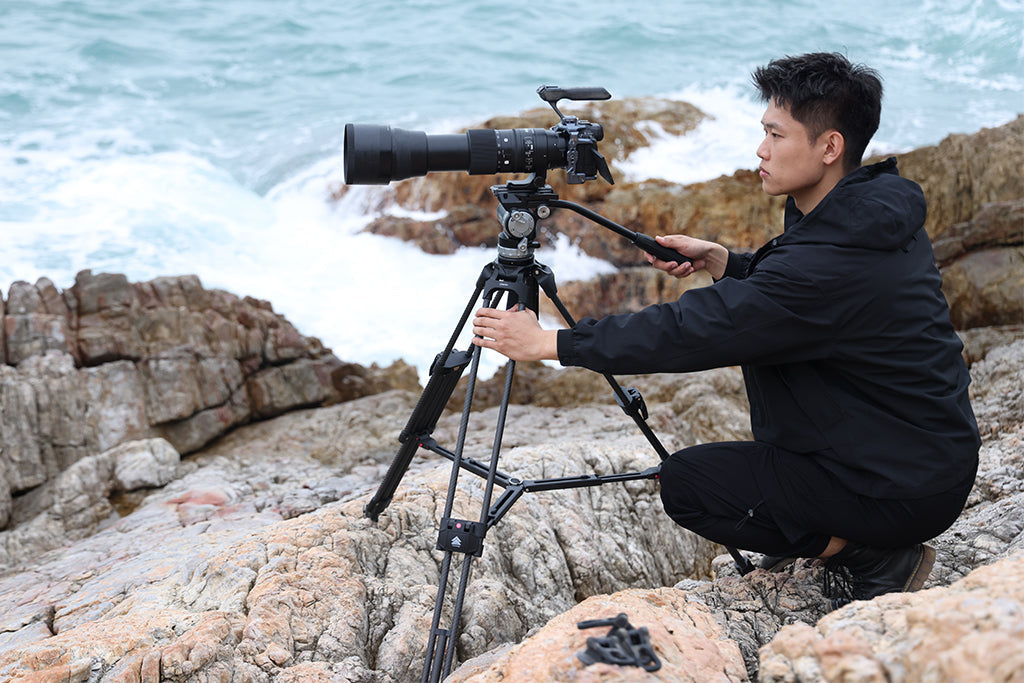
Experienced outdoor photographers often observe that CCF tripods provide more consistent stability in windy conditions, particularly at low angles. By eliminating the locking mechanisms associated with the center column, you remove sources of "play" and mechanical wear that can develop over time.
Methodology Note: Our stability estimates assume a standard 2.5kg mirrorless rig. Based on common structural modeling of carbon fiber resonance, removing the primary oscillation point (the column) can reduce "settling time" after a vibration event by an estimated 20–30%. Actual results will vary based on leg diameter and ground composition.
Mass Optimization vs. Structural Reality
Key Takeaway: CCF tripods excel in "packability" (folded diameter) rather than just raw weight savings, making them easier to fit inside backpack side pockets.
A common misconception is that removing the center column automatically results in a "hollow" interior that saves massive amounts of space. In reality, the space gain is often more modest—typically 5–15%—because the structural requirements of the apex often necessitate perimeter reinforcements to maintain load-bearing capacity.
The Weight-to-Cost Ratio
While CCF designs are marketed as "ultralight," the actual weight reduction compared to a high-end travel tripod with a column is often in the range of 100–300 grams (approximately 3.5–10.5 oz). To achieve this while maintaining professional-grade rigidity, manufacturers often utilize premium materials, such as higher-modulus carbon fiber, which can increase manufacturing costs by an estimated 20–40% compared to standard alloys.
| Parameter | CCF Design (Estimated) | Traditional Design (Estimated) | Rationale |
|---|---|---|---|
| Typical Weight | 0.9kg – 1.2kg | 1.1kg – 1.5kg | Removal of column vs. apex reinforcement |
| Folded Diameter | 60mm – 80mm | 85mm – 110mm | Column-free allows legs to collapse tighter |
| Max Height | 120cm – 140cm | 150cm – 170cm | Lack of telescopic extension |
| Setup Time | ~45 seconds | ~30 seconds | CCF often requires more leg adjustment |
| Low-Angle Limit | ~80mm | ~150mm | Column length often restricts low shots |
Note: Values are heuristic ranges based on common industry benchmarks for "travel-class" supports; individual model specs will vary.
Packability and "Visual Weight"
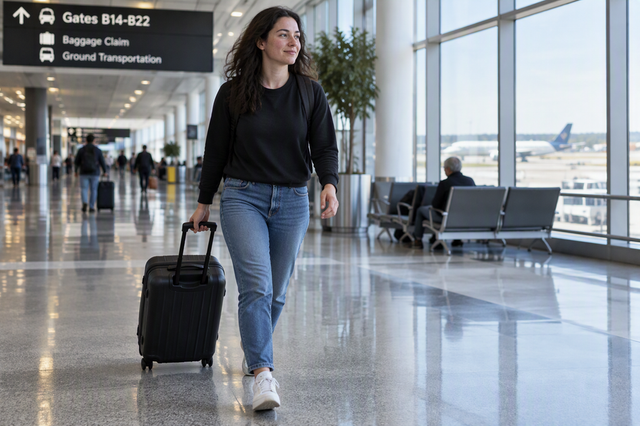
The true advantage of a CCF design for travel is the folded diameter. By removing the central post, the legs can collapse much closer to one another. This "slim-profile" geometry allows the tripod to fit into the side pockets of a backpack rather than being strapped to the outside. This reduces the "Visual Weight" of your gear—a helpful factor when navigating airline gate agents who may flag bulky equipment for weighing.
The Biomechanical Advantage: Wrist Torque Analysis
Key Takeaway: Reducing the distance between the gear's mass and your body reduces physical fatigue during long days of transit.
As a creator, your physical endurance is a finite resource. Heavy or bulky rigs don't just weigh you down; they create ergonomic strain through leverage. When we discuss "ultralight" travel, we are effectively discussing the reduction of Wrist Torque.
The Formula of Fatigue
Weight is only one part of the equation. The distance of that weight from your body's pivot points (your wrist or shoulder) determines the actual strain.
Torque ($\tau$) = Mass ($m$) $\times$ Gravity ($g$) $\times$ Lever Arm ($L$)
Imagine a 2.8kg camera rig. If held 0.35m away from your wrist, it generates approximately 9.61 $N\cdot m$ of torque. Based on general anthropometric datasets, this load can represent 60–80% of the Maximum Voluntary Contraction (MVC) for an average adult.
By using a CCF tripod and a modular quick-release system (like the Arca-Swiss standard), you can keep your center of gravity closer to the support axis during transport. This is a core principle discussed in the 2026 Creator Infrastructure Report (Brand-led Industry Analysis), which emphasizes that tools must minimize physical friction to remain effective for solo operators.
Workflow ROI: Efficiency in the Field
Key Takeaway: CCF tripods are slower to adjust for height; pairing them with a high-speed quick-release system is essential to "buy back" your workflow time.
Time is a critical commodity on a shoot. While CCF designs are stable, they can be slower to adjust for height. In a traditional design, you can gain 30cm of height in seconds by twisting a single knob. In a CCF design, you must extend all three legs equally to achieve the same result.
The "Quick-Release" Offset
To recover the time lost to leg adjustments, professional travel creators often integrate high-speed quick-release systems.
Workflow ROI Calculation (Theoretical Model):
- Traditional Thread Mounting: ~40 seconds per swap.
- Quick Release (Arca-Swiss compatible): ~3 seconds per swap.
- Annual Impact: For a high-volume professional performing 60 swaps per shoot across 80 shoots a year, this saves approximately 49 hours annually. At a professional rate of $120/hr, this represents a ~$5,900+ value in recovered time.
Methodology Note: This ROI model is a deterministic calculation based on observed workflow patterns in high-frequency run-and-gun filmmaking. It assumes a multi-camera or multi-accessory setup where switching between handheld and tripod support is frequent.
Practical Field Mastery: Setup and Safety
Key Takeaway: Precision is mandatory when you lack a center column. Use a standard "Tug Test" to ensure gear security.
Adopting a CCF design requires a shift in how you handle your gear. Because you lack the "safety net" of a center column that can be quickly lowered, your mounting and leveling must be more precise.
The Pre-Shoot Safety Checklist
Before every take, perform this "Tactile-Audible-Visual" check:
- Audible: Listen for the distinct "Click" of your quick-release locking mechanism.
- Tactile: Perform the "Tug Test." Gently pull the camera upward to ensure the plates are seated with no detectable "play."
- Visual: Check the locking pin status. Ensure any safety indicators (often orange or silver) are in the "locked" position.
Thermal Shock Prevention (The Winter Scenario)
Many CCF tripods use aluminum alloy for the apex and quick-release plates. Aluminum is an efficient "thermal bridge." In extreme cold, an aluminum plate can conduct heat away from your camera's battery, potentially shortening its runtime.
Practical Tip: Attach your quick-release plates to your camera indoors before heading into the cold. This allows the plate to reach ambient temperature more slowly once outside, reducing the rate of battery cooling through the camera's baseplate.
When to Choose Center-Column-Free
Scenario A: The Adventure/Travel Creator
If you are hiking long distances, shooting in high-wind coastal areas, or need to fit your entire kit into a 30L bag, a CCF design is the logical choice. The stability at low angles for macro work or landscapes is often superior. The slight increase in setup time is a fair trade for the reliability of the shot.
Scenario B: The Studio/Event Professional
If you are shooting over obstacles (like a crowd at a wedding) or need to quickly adjust height to match different subjects' eye levels, a traditional center column remains more practical. The height limitation of CCF designs (often topping out at 140cm) can be a bottleneck in controlled indoor environments.
The Future of Modular Infrastructure
The shift toward CCF designs is part of a broader move toward "creator infrastructure"—modular, stable, and interchangeable systems.
When choosing your next support, look beyond the "max load" rating. Consider the Arca-Swiss rail system (Independent Technical Analysis) to ensure your system prevents ecosystem lock-in. A well-engineered CCF tripod, paired with a rigid quick-release system, provides a structural foundation that allows you to focus on the story rather than the stability of the camera.
Disclaimer: This article is for informational purposes only. Load capacities and stability ratings are based on manufacturer specifications and common industry heuristics. Always verify the compatibility of your specific camera and tripod combination before use. For safety standards regarding lighting and batteries, refer to IEC 62471 and IATA Lithium Battery Guidance.
Sources
- Industry Standard: ISO 1222:2010 Photography — Tripod Connections
- Brand Report: The 2026 Creator Infrastructure Report
- Independent Analysis: Arca-Swiss Dovetail Technical Dimensions
- Regulatory Guidance: IATA Lithium Battery Guidance Document (2025)
- Safety Standard: IEC 62471:2006 Photobiological Safety of Lamps