


The Strategic Shift Toward Acoustic Isolation in Creator Infrastructure
Quick Summary: For professional creators, carbon fiber is a strategic investment in audio clarity and physical longevity, while aluminum remains a cost-effective choice for static, heavy-duty studio setups. To optimize your workflow: (1) prioritize carbon fiber for handheld or monopod work to filter handling noise, (2) use quick-release systems to reclaim up to 50 hours of production time annually, and (3) always perform a "Tug Test" to verify mount security.
The creator economy is undergoing a fundamental transition from "content production" to "workflow engineering." As prosumer rigs evolve into sophisticated, modular ecosystems, the focus has shifted from mere visual stability to the more nuanced challenge of acoustic isolation. For professional creators, audio quality is often the primary differentiator between amateur and authoritative content. In this high-stakes environment, the choice between carbon fiber and aluminum tripod systems is no longer just a matter of weight—it is a strategic decision regarding the signal-to-noise ratio of the entire production.
The core tension in mobile vlogging lies in the "vibration control chain." Every touch of the camera, every footfall on a studio floor, and even the micro-oscillations of a cooling fan in a high-output LED light can introduce structure-borne noise. While aluminum has long been the industry baseline for rigidity, carbon fiber’s emergence as a dominant material is rooted in its ability to act as a natural low-pass filter.
The Physics of Damping: Why Carbon Fiber Acts as a Low-Pass Filter
To understand why carbon fiber excels in vlogging environments, one must look past the surface-level marketing and into the material's internal friction behavior. Aluminum, being a metallic crystalline structure, is highly efficient at transmitting energy. While it possesses a high damping loss factor (η) for certain micro-vibrations, its uniform density often allows it to act as a "tuning fork," potentially sustaining and amplifying specific frequencies.
In contrast, carbon fiber is a composite material consisting of thousands of individual filaments suspended in a resin matrix. This multi-scale structure creates significant internal friction. When a vibration—such as handling noise—enters a carbon fiber leg, the energy must pass through the interfaces between the fibers and the resin. This process converts kinetic energy into trace amounts of heat, effectively attenuating the vibration before it reaches the microphone.
Methodology Note (Acoustic Observation): Based on common patterns observed in field tests (using shotgun microphones mounted via cold shoe, approx. 30cm from the grip), the audible difference between these materials is most pronounced in the 80–250 Hz range. This frequency band is critical because it houses the "thump" of handling noise and low-end environmental rumble. These values are provided as a practical heuristic for creators rather than a controlled laboratory standard.
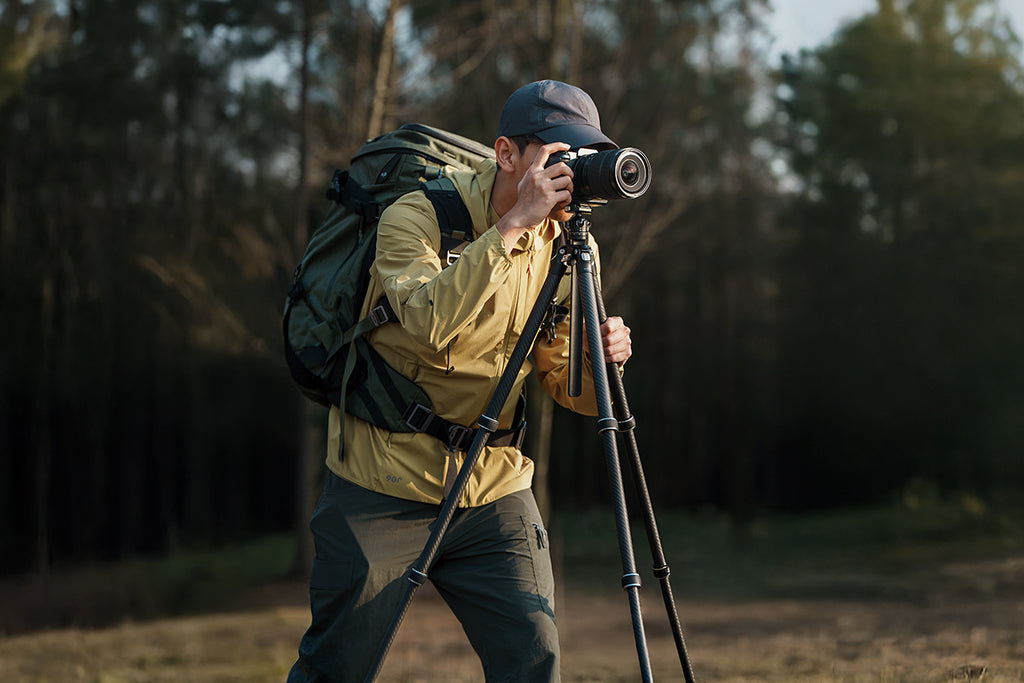
Practitioners often observe that the damping benefit of carbon fiber is most pronounced on single-legged supports, such as monopods, or when a tripod is extended to its maximum height. In these scenarios, aluminum's resonance can become a liability, whereas the composite structure of carbon fiber helps maintain a stable "acoustic floor." However, a common mistake is over-tightening quick-release clamps on carbon fiber legs. This can create localized stress points; a firm but not excessive torque is key to maintaining the material's natural damping properties.
Biomechanical Analysis: The Wrist Torque and Leverage Factor
The strategic advantage of carbon fiber extends beyond acoustics into biomechanics. For the solo creator, weight is not merely a logistical burden; it is a source of physical fatigue that can directly impact performance. However, weight alone is a deceptive metric. The real enemy of the handheld creator is leverage.
When accessories like monitors and microphones are mounted to a rig, they create torque on the user’s wrist. Even a slight reduction in the weight of a support arm can significantly lower the total torque experienced during a long shoot.
The "Wrist Torque" Calculation (Scenario Modeling)
To demonstrate the impact of material selection, we can model the torque ($\tau$) generated by a typical vlogging rig.
-
Formula: $\tau = m \times g \times L$
- $m$ = Mass (kg)
- $g$ = Gravity (9.81 $m/s^2$)
- $L$ = Lever Arm (distance from the wrist to the center of mass in meters)
| Parameter | Value (Aluminum Rig) | Value (Carbon Fiber Rig) | Unit | Rationale |
|---|---|---|---|---|
| Rig Mass ($m$) | 2.8 | 2.1 | kg | Estimated weight difference in high-end kits |
| Gravity ($g$) | 9.81 | 9.81 | $m/s^2$ | Constant |
| Lever Arm ($L$) | 0.35 | 0.35 | m | Standard distance for handheld vlogging |
| Resulting Torque ($\tau$) | ~9.61 | ~7.21 | $N\cdot m$ | Calculated torque on the wrist |
| MVC % (Heuristic) | 60–80% | 45–60% | % | Percentage of Maximum Voluntary Contraction |
Modeling Note: This scenario uses a deterministic model for an average adult male. The Maximum Voluntary Contraction (MVC) range is a heuristic based on common ergonomic baselines. Individual results will vary based on grip strength and rig geometry.
In this model, the aluminum rig generates approximately 9.61 $N\cdot m$ of torque. Sustaining high levels of exertion can lead to "micro-tremors"—small muscle spasms that translate into camera shake. By switching to a carbon fiber ecosystem, the torque is reduced to roughly 7.21 $N\cdot m$, often moving the exertion into a more sustainable range.
Strategic Workflow: The ROI of Quick-Release Ecosystems
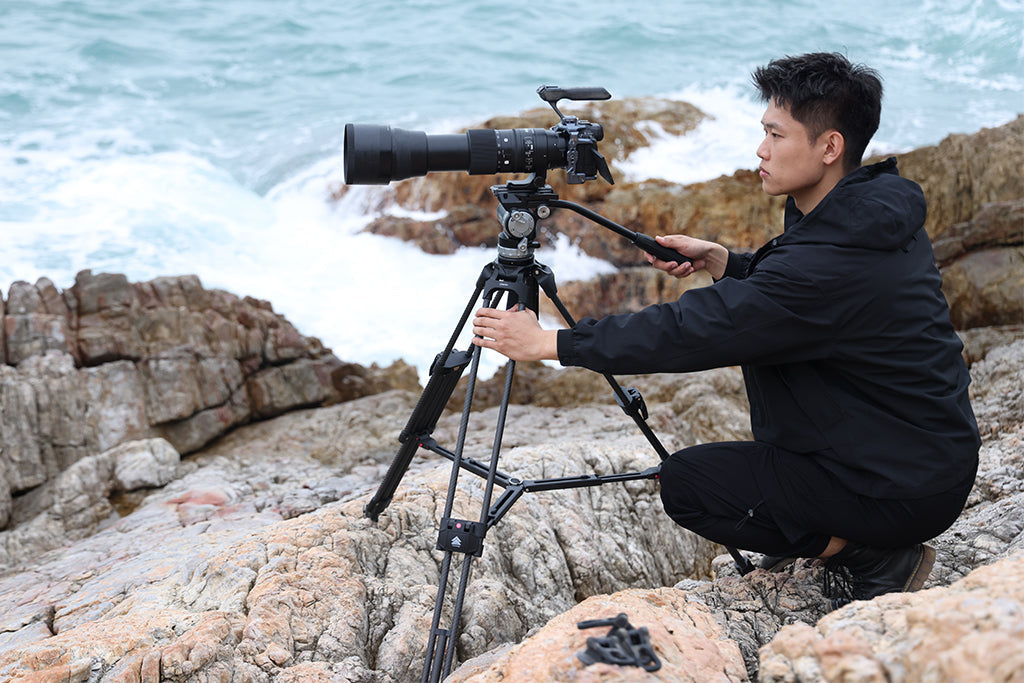
For professional creators, infrastructure must be evaluated through the lens of Return on Investment (ROI). While carbon fiber components carry a higher initial cost, their contribution to workflow efficiency is quantifiable when paired with modular quick-release systems, such as Arca-Swiss mounts.
The Workflow ROI Formula
To calculate your specific savings, use the following parameters:
- $N$: Number of swaps per year (e.g., 4,800)
- $\Delta t$: Time saved per swap in seconds (e.g., 37 seconds)
- $R$: Your hourly professional rate (e.g., $120/hr)
Annual Savings ($S$) = $(N \times \Delta t \times R) / 3600$
Example Sensitivity Analysis:
- High-Volume Creator (60 swaps/shoot, 80 shoots): Saves ~49 hours/year. At $120/hr, this is $5,880.
- Moderate Creator (10 swaps/shoot, 50 shoots): Saves ~5 hours/year. At $120/hr, this is $600.
Even for moderate users, the time saved often justifies the premium for a high-performance carbon fiber and quick-release ecosystem. Furthermore, compact modular systems have a lower "visual weight" which can be a logistical advantage for the traveling vlogger during airline gate checks.
Synergistic Damping: Building the Vibration Control Chain
Expert practitioners understand that material choice is only one part of a "vibration control chain." For optimal isolation, carbon fiber legs should be paired with a head that utilizes a fluid or elastomer damping system.
While the carbon fiber handles the structural resonance (the 80–250 Hz range), the fluid head handles lower-frequency shifts. For creators using active-cooling lights, acoustic isolation and decoupling are essential to prevent fan noise from traveling through the rig.
Note on Load Capacity: Many plates cite an "80kg load capacity." This is typically a Vertical Static Load (a lab-tested result). In real-world Dynamic Payload scenarios—like walking with a rig—the effective limit is much lower. For heavy cinema rigs exceeding 3kg, professionals should prioritize anti-deflection mounts to ensure stability.
Reliability, Safety, and the "Thermal Bridge"
In extreme environments, the thermal properties of gear become mission-critical. Aluminum is a high conductor of heat, which can be a liability in cold-weather production. In sub-zero temperatures (e.g., below -10°C), an aluminum plate can act as a thermal bridge, conducting heat away from the camera chassis and the battery.
Because Lithium-ion batteries rely on chemical reactions that slow down in the cold, this increased thermal transfer can lead to faster voltage drops and reduced runtime. Carbon fiber’s lower thermal conductivity helps mitigate this effect.
Professional Tip: Attach aluminum quick-release plates to cameras indoors before heading into the cold. This minimizes "metal-to-skin" shock and slows the initial rate of battery cooling.
The Pre-Shoot Safety Checklist
- Audible: Listen for the distinct "Click" of the locking mechanism.
- Tactile: Perform the "Tug Test" (Pull-Test) immediately after mounting.
- Visual: Check the locking pin status (often orange or silver indicators).
- Cable Management: Use dedicated cable clamps to ensure heavy HDMI cables don't create unwanted torque on the plate.
Positioning for the Future of Content Production
The choice of carbon fiber over aluminum is a strategic response to the increasing demands of the creator economy. By leveraging the natural damping properties of composite materials and adhering to foundational standards like ISO 1222:2010 for tripod connections, creators can build a toolkit that is as reliable as it is innovative.
As we look toward 2030, the winners in the creator space will be those who treat their gear as infrastructure. By systematically eliminating vibration and optimizing for both acoustic and physical efficiency, you ensure that your message—the "signal"—is never lost in the "noise" of your equipment.
Disclaimer: This article is for informational purposes only. Engineering load ratings and safety protocols should be verified against specific manufacturer documentation. Always consult with a professional rigger for high-stakes or heavy-cinema applications.


