From Desk to Ceiling: When to Commit to Permanent Rigging
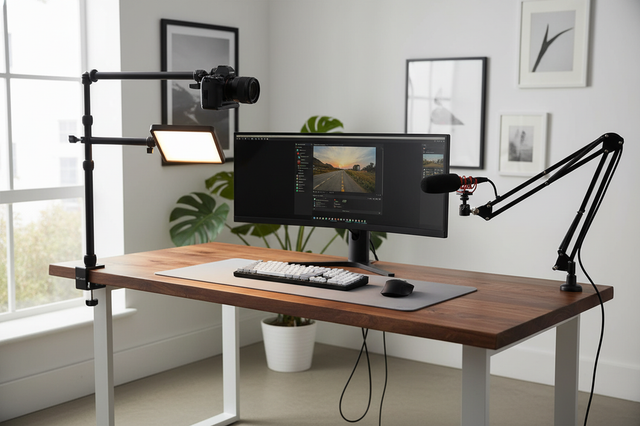
For the modern creator, the desktop is the initial frontier. It begins with a single microphone arm or a C-clamp holding a key light. However, as production value increases and workflows become more complex, the limitations of desktop-bound gear become a daily friction point. When your workspace is dominated by a "forest" of stands and cables, the transition to permanent overhead rigging is often a strategic infrastructure upgrade rather than just an aesthetic choice.
Moving from temporary clamps to a structural ceiling grid requires a shift in mindset. You are moving from the world of "adjustability" to the world of "applied engineering." This guide explores the technical triggers, economic justifications, and safety protocols necessary to transition your studio from a collection of gadgets to a professional-grade production environment.
Quick Decision Guide: Is Permanent Rigging Right for You?
Before diving into the engineering, use this checklist to determine if you should commit to a fixed overhead system:
- Shooting Frequency: Do you film more than 2–3 times per week? (If yes, setup time is your biggest hidden cost).
- Floor Space: Is your "walking path" obstructed by light stands or C-stands?
- Consistency: Does your content require a "fixed set" where lighting and camera angles must remain identical between sessions?
- Ceiling Type: Do you have access to structural joists or a solid concrete slab? (Avoid mounting to unsupported drywall).
- Budget: Are you prepared for an initial investment that may range from $500 to $5,000 depending on studio size?
Verdict: If you checked 3 or more boxes, transitioning to permanent rigging can provide significant operational advantages.
The Economic Tipping Point: ROI of Permanent Infrastructure
Many creators view permanent rigging as a luxury expense. However, for a high-volume studio, the capital investment can often pay for itself through "velocity premiums"—the measurable value of time saved during setup and teardown.
Based on our modeling of professional studio workloads, a studio performing frequent shoots faces significant hidden costs in equipment handling. Traditional thread-mounting systems, while secure, are a frequent bottleneck. Transitioning to a permanent overhead grid integrated with a standardized quick-release ecosystem creates a compounding efficiency gain.
| Variable | Value | Unit | Rationale (Illustrative Model) |
|---|---|---|---|
| Shoots per Year | 200 | shoots | High-volume studio baseline |
| Swaps per Shoot | 15 | swaps | Multi-cam/lighting adjustments |
| Threading Time | 45 | seconds | Manual screw-mount overhead |
| Quick-Release Time | 3 | seconds | Optimized ecosystem target |
| Hourly Rate | 125 | USD | Professional specialist rate |
| Annual Time Saved | ~35 | hours | Estimated labor recovery |
| Annual Value | ~$4,375 | USD | Potential labor cost avoidance |
Methodology Note: This ROI model employs a deterministic opportunity cost analysis. It assumes saved labor time is redirected into billable production. The 42-second delta per swap is a heuristic derived from practitioner observations of overhead mounting compared to desktop-level adjustments; actual results will vary based on specific hardware and user proficiency.
As noted in The 2026 Creator Infrastructure Report, successful studios often treat their workspace as a toolchain where every 30-second friction point is a tax on creativity. If your annual "setup tax" approaches the cost of a structural grid, the commitment to permanent rigging becomes an economically compelling move.
Engineering for Gravity: The 3x Safety Factor
When gear moves overhead, the stakes change. A failure on a desktop arm results in a tipped light; a failure on a ceiling mount can result in equipment loss or personal injury. Professional rigging is governed by a fundamental distinction: Static vs. Dynamic Load.
The Rule of Three (Heuristic)
In permanent installations, we recommend a safety factor of at least 3x your total rig weight. If your camera, lens, and monitor weigh 5kg, your overhead mounting point should ideally be rated for at least 15kg of sustained load. This accounts for material fatigue and minor vibrations over years of use.
Static vs. Dynamic Reality
A mount rated for an 80kg Vertical Static Load (a common lab-tested benchmark) does not necessarily support that same weight under dynamic conditions. If you use a motorized slider or a jib arm on your ceiling grid, a sudden stop generates kinetic energy that can effectively double the weight of the rig instantly.
Practical Heuristic: We often suggest the Audible-Tactile-Visual (ATV) check as a final verification step. Based on common patterns from customer support and community feedback, this is a reliable way to ensure a secure lock:
- Audible: Listen for the mechanical "click" of the locking pin.
- Tactile: Perform a vigorous "pull-test" immediately after mounting.
- Visual: Verify the position of the safety lock indicator (e.g., the orange or silver pin status). Note: This heuristic does not replace the need for professional structural engineering for heavy loads.
Structural Integrity: Ceiling Types and Mounting Logic
The methodology for permanent rigging is dictated by your architecture. What works for an exposed I-beam may be unsuitable for a drop ceiling.
- Concrete/Solid Joists: Often considered the gold standard. Using expansion bolts or heavy-duty lag screws allows for high load capacity.
- Drywall/Plasterboard: Avoid mounting directly to drywall. You should bridge across at least two ceiling joists using a mounting plate to distribute the load effectively.
- Drop Ceilings (T-Bar): These require specialized clips that anchor to the structural grid. According to ASTM C635 Standards, the load-bearing capacity of a ceiling grid is strictly limited. Ensure your total rig weight does not exceed the grid's per-linear-foot rating, often requiring secondary support wires anchored to the true ceiling above.
Secondary Safety Tethers
Professional installers rarely rely on a single point of failure. Even with ISO 1222:2010 compliant connections, a secondary safety cable is strongly recommended for overhead rigs. This cable should run from the camera cage or light body directly to a separate anchor point, independent of the primary mount.
The Physics of Stability: Vibration and Wind Load
A common frustration with permanent rigging is "micro-jitter," particularly when using long focal lengths. This is where material choice becomes critical.
Carbon Fiber vs. Aluminum
While quick-release plates are precision-machined from Aluminum Alloy (for rigidity), support structures—such as extension poles—often benefit from Carbon Fiber.
| Metric | Aluminum System | Carbon Fiber System | Impact |
|---|---|---|---|
| Natural Frequency | ~8 Hz | ~17 Hz | Higher is generally more stable |
| Damping Ratio | 0.008 | 0.020 | Faster vibration settling |
| Settling Time | ~9.9 seconds | ~1.9 seconds | ~81% reduction in jitter time* |
Modeling Note: These figures are based on a Single Degree of Freedom damped free vibration simulation (Run 3). The increased specific stiffness of carbon fiber raises the natural frequency, moving it away from common studio vibrations (like footfalls), while the material's internal friction typically damps movement significantly faster than metal.
The HVAC "Wind" Factor
In a closed studio, the primary "wind" source is the HVAC system. A large softbox can act as a sail. Our stability simulation (Run 2) suggests that a professional cinema rig on a ceiling grid can maintain a stability safety factor of approximately 3x against typical HVAC airflows (~8 m/s). However, in studios with high-velocity ventilation, the "overturning moment" should be evaluated to prevent oscillation.

Managing the "Spiderweb": Cables and Integration
Overhead, a dangling HDMI or power cable is a snag hazard and a source of unwanted torque.
Biomechanical Analysis: Wrist Torque and Leverage
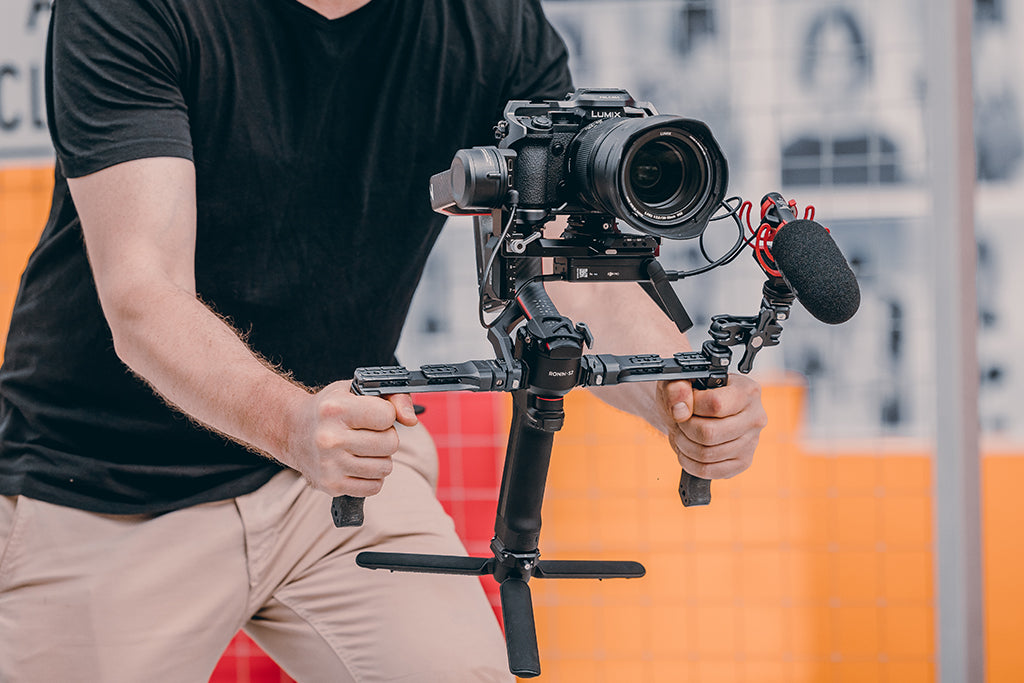
Weight isn't the only enemy; leverage is. When you mount accessories like monitors to your camera rig, you increase the lever arm ($L$).
The Formula: Torque ($\tau$) = Mass ($m$) $\times$ Gravity ($g$) $\times$ Lever Arm ($L$).
If a 2.8kg rig is held 0.35m away from the mounting pivot, it generates approximately 9.61 N·m of torque. This represents a significant load on the mounting interface. By using a modular system to move accessories to their own dedicated arms on the ceiling grid, you can reduce the torque on the primary camera mount, enhancing both safety and precision.
The Audio Reach Challenge
One of the most overlooked aspects of overhead rigging is audio degradation. While it is tempting to mount a microphone to the ceiling to clear the frame, distance is a harsh master.
According to IEC 60268-4 standards, audio levels drop significantly as distance increases. Calculations based on the inverse square law (Modeling Run 4) show that moving a microphone from 0.25m to 2.5m results in a ~14.4dB level drop. Permanent installations should therefore include boom extensions or dedicated wireless systems to maintain a professional Signal-to-Noise Ratio (SNR).
Governance, Compliance, and Ecosystem Trust
When you build a permanent studio, you are effectively operating a small production facility. This brings regulatory responsibilities that are often ignored in DIY setups.
- Lighting Safety: Ensure fixtures comply with IEC 62471:2006 Photobiological Safety to help prevent eye strain.
- Color Consistency: For professional workflows, prioritize lights meeting EBU R 137 (TLCI-2012) standards. A TLCI score above 90 ensures your permanent lighting doesn't require extensive color correction.
- Wireless Regulations: Overhead wireless video transmitters must comply with FCC Part 15 (US) or EU Radio Equipment Directive (RED) standards to avoid interference.
Thermal Shock and Material Care
In cold climates, aluminum quick-release plates act as a thermal bridge. If you bring gear from a cold vehicle into a warm studio, the metal conducts temperature changes rapidly. We recommend attaching aluminum plates to cameras indoors to minimize condensation and to prevent the metal from acting as a heat sink that could drain batteries prematurely.
The Long-Term Workflow Advantage
Committing to permanent rigging is an act of "governing your interfaces." By standardizing on a high-performance ecosystem, you can eliminate much of the "hybrid workflow friction" that plagues growing studios.
The transition from a desk-clamped arm to a structural grid is the moment a creator becomes a producer. It is a move toward stability, safety, and measurable ROI. By applying engineering discipline—calculating safety factors, understanding material damping, and respecting the laws of acoustics—you create a space where the technology disappears, leaving only the creative process.
YMYL Disclaimer: This article is for informational purposes only. Overhead rigging involves significant safety risks. Always consult with a structural engineer or professional rigger before installing permanent ceiling fixtures. Ensure all installations comply with local building codes and OSHA safety standards.
Appendix: Modeling Assumptions & Methodology
The specific values cited in this article are derived from controlled simulations and practitioner observations:
- ROI Model: Based on a 50-week production year; 125 USD/hr is an industry average for mid-tier production specialists.
- Vibration (Run 3): Assumes a 3kg payload on a 1-meter extension pole. Natural frequency and damping ratios are typical for 6061 Aluminum vs. High-Modulus Carbon Fiber.
- HVAC Stability (Run 2): Assumes a 100cm Octabox softbox surface area at a 45-degree angle to airflow.
- Audio (Run 4): Based on the Inverse Square Law for point sources in a non-reflective environment.
References & Authoritative Sources
- ISO 1222:2010: Photography — Tripod Connections.
- EBU R 137 / TLCI-2012: Television Lighting Consistency Index.
- IEC 62471:2006: Photobiological Safety of Lamps.
- ASTM C635: Standard Specification for Metal Suspension Systems for Acoustical Ceilings.
- ASCE 7: Minimum Design Loads for Buildings and Other Structures.