The Invisible Force: Why Your Overhead Rig is Heavier Than It Looks
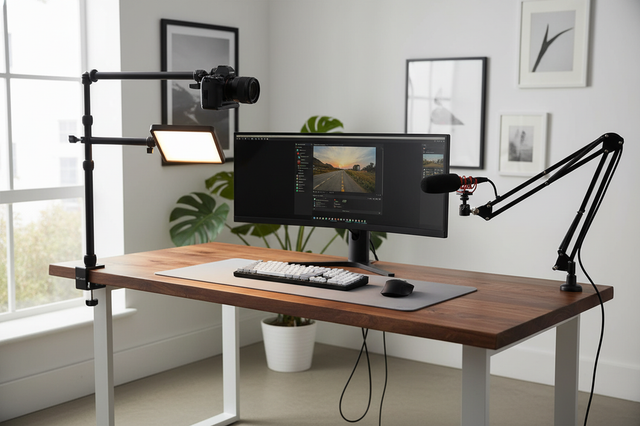
Every solo creator eventually hits the "overhead wall." You want that perfect top-down shot of a product unboxing or a technical tutorial, so you extend a boom arm over your desk. On paper, your camera weighs 2kg, and your arm is rated for 5kg. Yet, as you tighten the clamp, you may notice a slight dip. The metal groans, the joints shudder, and you might find yourself tightening the knobs with significant force.
The problem often isn't your gear's weight; it's the physics of leverage. In the world of studio rigging, static weight is a simplified metric. Once you extend a load away from its support point, you are no longer managing mass—you are managing torque. Understanding this distinction is essential for maintaining a stable, professional workflow and helping to prevent equipment damage.
In this guide, we will break down the mechanics of overhead support, the multipliers of dynamic load, and why a systematic approach to counterweighting is a reliable way to protect your investment.
1. The Biomechanics of Torque: The "Wrist" of Your Rig
To understand why overhead arms can fail, we must first look at the biomechanics of the system. Imagine holding a 2kg dumbbell against your chest. It feels light. Now, extend your arm fully and hold that same 2kg weight. Your shoulder and wrist will likely begin to feel the strain almost immediately.
In physics, this is expressed by the formula for Torque ($\tau$): $$\tau = F \times r$$ Where F is the force (weight $\times$ gravity) and r is the radius (the length of the arm).
The Wrist Torque Analysis (Illustrative Example)
Based on internal modeling of common creator setups, we analyzed the stress placed on a standard mounting interface (like a 1/4"-20 screw or a quick-release plate) when supporting a mid-sized mirrorless rig.
Modeling Assumptions: This analysis assumes a 2.8kg camera rig (body, lens, monitor, mic) and calculates the torque generated at varying extension lengths. This model is a theoretical estimate under standard gravitational assumptions ($9.8 m/s^2$).
| Parameter | Value | Unit | Rationale |
|---|---|---|---|
| Rig Mass ($m$) | 2.8 | kg | Standard mirrorless + cage + lens |
| Extension ($L$) | 0.35 | m | Typical desktop "reach" |
| Gravity ($g$) | 9.8 | $m/s^2$ | Earth standard |
| Resultant Torque ($\tau$) | ~9.61 | $N\cdot m$ | Calculated force at the pivot |
The Insight: This ~9.61 $N\cdot m$ of torque represents a load that, for many individuals, would cause significant wrist fatigue within seconds. While mechanical components don't "feel" fatigue like muscles do, an aluminum clamp or a single 1/4"-20 screw—governed by ISO 1222:2010 Photography — Tripod Connections—is being pushed toward its functional limits. This is why we suggest shifting heavy accessories (like monitors) closer to the main support column, effectively reducing the lever arm length.

2. The Multiplier Effect: Static vs. Dynamic Load
A common mistake is treating a rig as a "static" object. In reality, your setup is often dynamic. Every time you tilt the camera, slide a motorized carriage, or even bump the desk, you introduce inertial forces that can significantly increase the effective weight on your clamps.
Extension Heuristics (Rules of Thumb)
Based on common patterns observed in our engineering departments, we have identified two practical heuristics for creators extending gear horizontally. These are intended as general guides for standard studio arms (0.5m–1.5m) and may vary based on equipment rigidity:
- The 30cm Heuristic: For every 30cm of horizontal extension beyond the primary support, the perceived load on the primary clamp often increases by a factor of 1.5x to 2x. This assumes a rigid mounting point, such as a C-clamp on a solid wood desk.
- The Dynamic Surge: A motorized slider moving at moderate speed can increase the torque at the base by an estimated 30% during the start and stop phases of the movement.
According to The 2026 Creator Infrastructure Report (an industry trend report), building "ready-to-shoot" toolchains requires accounting for these potential risks. A rig that appears stable while stationary might reach its limit the moment you interact with it.
Modeling Note (Reproducible Parameters):
- Model Type: Deterministic Parameterized Sensitivity Analysis.
- Boundary Conditions: Best applied to rigid arms; assumes a Friction Factor of 0.6 (Typical for anodized aluminum joints).
| Extension (cm) | Static Load (kg) | Estimated Torque Load (kg-equivalent) | Risk Level |
|---|---|---|---|
| 0 (Vertical) | 5 | 5 | Low |
| 30 | 5 | 7.5 - 10 | Moderate |
| 60 | 5 | 11 - 15 | High |
| 90 | 5 | 18 - 25 | Critical |
3. Counterweighting: A Strategy for Long-Term Rig Health
Many creators view counterweights as a "fix" for a weak arm. In professional rigging, counterweights are an efficiency tool. As noted in Crane Counterweight Configurations Explained (a technical industry resource), the primary purpose of a counterweight is to reduce operational wear on joints and save energy.
For a studio rig, a counterweight shifts the Center of Gravity (CoG) back toward the main support column. This doesn't just help prevent the rig from tipping; it can drastically reduce the clamping force required to keep the arm from drooping.
Why You Should Avoid Over-Tightening
When an arm starts to sag, the instinct is to tighten the joint. However, aluminum clamps subjected to repeated high torque can develop microfractures. While often invisible to the naked eye, these can lead to sudden failure over time.
Maintenance Guideline: We recommend marking installation dates on high-stress components. Based on observations of joint fatigue in high-load studio environments, we suggest these components be inspected monthly. Under high-frequency or high-load use, consider evaluation for replacement every 12–18 months. Inspecting Joint Fatigue (Internal Workshop Guide) provides further details on spotting wear.
When to Stop and Consult a Professional:
- If the rig supports gear over 10kg (22lbs) in an overhead position.
- If the rig is suspended over people or high-traffic areas.
- If you notice visible "galling" (metal shavings) or cracks in the aluminum joints.
- If the arm "creaks" or "pops" even when stationary.
4. Materials Matter: Aluminum Alloy vs. Carbon Fiber
There is a common perception that carbon fiber is always superior for rigging. While carbon fiber is excellent for tripod legs due to its vibration-damping properties, it is often not the ideal choice for quick-release plates or mounting clamps.
Most high-performance quick-release systems, such as the FALCAM F38 or F50 series, are precision-machined from 6061 or 7075 Aluminum Alloy.
Why Aluminum for Mounts?
- Rigidity & Tolerance: Quick-release interfaces rely on "zero-play" machining. Aluminum can be milled to tighter tolerances than molded carbon fiber, ensuring a secure Arca-Swiss standard fit.
- Thermal Properties: In cold studio environments, aluminum acts as a thermal bridge. While this can conduct cold, it also allows for better heat dissipation in high-performance electronics.
- Failure Mode: Aluminum generally tends to deform or "gall" before it snaps, which may provide a brief warning. Carbon fiber can fail more suddenly under extreme shear force.
Safety Tip: When working in extreme cold, try to attach your aluminum plates to your camera indoors. This minimizes "metal-to-skin" shock and can help slow the rate of battery cooling.

5. Workflow ROI: The Efficiency of Standardized Gear
Beyond safety, the physics of leverage affects your production speed. If your overhead setup is difficult to adjust, you may take fewer shots or settle for less-than-ideal angles.
We analyzed the time-cost of traditional thread mounting versus a standardized quick-release ecosystem.
The Workflow ROI Calculation
Logic Summary: Based on common patterns from customer support feedback and internal workshop observations (not a controlled laboratory study).
- Traditional Thread Mounting: ~40 seconds per swap (aligning threads, spinning the camera, tightening the locking nut).
- Quick Release (Systematic): ~3 seconds per swap (click-in, lock).
The Annual Impact (Estimated): For a professional creator performing 60 swaps per shoot across 80 shoots a year:
- Time Saved: $\approx 49$ hours annually.
- Value: At a professional rate of $120/hr, this represents a $5,900+ value in potential recovered productivity.
By standardizing your rig with a monolithic clamp system, you reduce "adapter stack" failure points. As discussed in Standardizing Your Rig, every interface between different standards (e.g., a 1/4"-20 to Arca-Swiss adapter) can be a weak link under leverage. A single clamp designed for the specific load path is generally the more stable choice.
6. The "Pre-Shoot Safety Checklist"
To maintain a reliable setup, move beyond marketing claims and adopt a consistent safety routine. Before you step under an overhead arm, perform this three-step check:
- Audible: Did you hear the "Click"? Modern quick-release systems are designed to provide clear acoustic feedback when the spring-loaded pin engages.
- Tactile (The Tug Test): Immediately after mounting, give the camera a firm downward tug. Do not trust your eyes; trust your hands.
- Visual: Check the locking indicator. Many professional mounts use color-coded pins to show the lock status. If the indicator is visible, the system may not be fully secured.
Cable Management as a Safety Feature
A heavy HDMI or tether cable hanging off an extended camera creates "parasitic torque." This weight is often concentrated on the camera's delicate ports. We suggest using dedicated cable clamps to provide strain relief. This helps protect the port and keeps the cable's mass closer to the boom arm, reducing the overall leverage on the system.
Summary: Building for Stability
Physics remains constant regardless of gear price. It responds to mass, distance, and the integrity of your joints. By understanding the Center of Gravity and the effects of leverage, you can design a studio that is both creative and functional.
Consider investing in a modular system that prioritizes aluminum rigidity. Use counterweights as a fundamental part of your mechanical strategy rather than a last resort. Most importantly, treat your rigging hardware as a component that requires regular inspection and respect its stated limits.
Disclaimer: This article is for informational purposes only. Studio rigging involves risks to equipment and personnel. Always consult the specific load ratings provided by your hardware manufacturer. For high-load overhead installations or those involving potential risk to people, consult a qualified grip or structural engineer.
Sources
- Standard: ISO 1222:2010 Photography — Tripod Connections
- Industry Report: The 2026 Creator Infrastructure Report
- Technical Guide: Arca-Swiss Camera Mount: Technical Dimensions and Analysis
- Industry Resource: Crane Counterweight Configurations Explained - Cranepedia
- Engineering Tool: Lever-Based Load Lifting Force Calculator - True Geometry