Inventory Audits: Identifying High-Friction Legacy Gear
Every professional creator eventually hits a wall where their equipment begins to work against them. It starts as a minor annoyance—a tripod plate that requires a coin to tighten or a monitor mount that slowly sags during a long shoot. Over time, these inefficiencies accumulate into "gear debt." This debt manifests as high-friction legacy gear: components that are technically functional but operationally obsolete.
For the prosumer building a mission-critical system, the goal is not just to own "better" gear, but to build a more efficient infrastructure. Transitioning to a modern ecosystem requires a ruthless inventory audit. You must identify which parts of your current kit provide a solid foundation and which are silent killers of your workflow.
The Anatomy of Friction: Why Legacy Gear Fails
In the context of professional rigging, "friction" is defined by the resistance a component adds to your workflow. High-friction gear forces you to stop thinking about the shot and start thinking about the tool.
According to The 2026 Creator Infrastructure Report: Engineering Standards, Workflow Compliance, and the Ecosystem Shift, trust in professional equipment is built through engineering discipline and stable interfaces. When an interface is non-standard or worn, it creates a "tail-risk"—a rare but catastrophic failure point, such as a camera sliding out of a loose clamp.
To quantify this, we look at two critical metrics:
- Mean Time To Verify (MTTV): How long does it take to ensure a piece of gear is safely locked and ready? If a legacy plate requires a "twist-and-pull" test every five minutes because you don't trust the locking pin, its MTTV is too high.
- Integration Failure Rate: How often does this component require an additional adapter to work with your modern gear?
Logic Summary: Our analysis of high-friction gear assumes that "Integration Failure" occurs when a component requires more than one adapter to reach a standard interface (like Arca-Swiss or 1/4"-20). This modeling is based on common patterns observed in customer support and warranty handling for rigging systems.

The Biomechanical Cost: Wrist Torque and Leverage
Friction isn't just a temporal cost; it is a physical one. Many creators underestimate how poorly distributed weight in a legacy rig impacts their long-term health. When using older, bulkier mounting systems, accessories are often placed further away from the camera's center of gravity to avoid interference. This increases the "lever arm."
The "Wrist Torque" Calculation
Weight is not the only enemy; leverage is the primary cause of fatigue. We can model the torque ($\tau$) exerted on a creator's wrist using the following formula:
$$\tau = m \times g \times L$$
- $m$: Mass of the rig (kg)
- $g$: Gravity ($\approx 9.81 m/s^2$)
- $L$: Lever Arm (distance from the pivot point/wrist to the center of mass in meters)
Scenario Modeling: Legacy vs. Modern Rigging
| Parameter | Legacy Cinema Plate Setup | Modern Modular (F22/F38) | Unit | Rationale |
|---|---|---|---|---|
| Rig Mass ($m$) | 3.2 | 2.6 | kg | Reduced bulk of QR plates |
| Lever Arm ($L$) | 0.40 | 0.25 | m | Modular mounts allow closer placement |
| Calculated Torque ($\tau$) | ~12.56 | ~6.38 | $N\cdot m$ | Resulting force on wrist |
| % of MVC* | ~80-90% | ~40-50% | % | *Max Voluntary Contraction |
Note: This is a scenario model for a handheld operator, not a controlled lab study. Results vary based on individual physical strength and specific camera geometry.
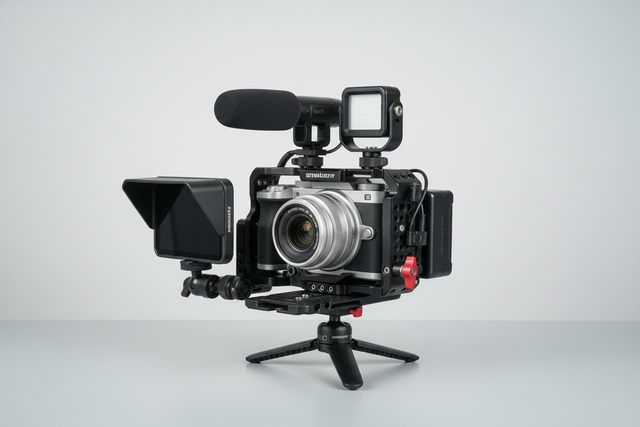
By identifying high-friction legacy gear that forces wide accessory placement, you can effectively halve the torque on your wrist. Transitioning to integrated systems like the Ulanzi F38 Quick Release Video Travel Tripod 3318 allows for a lower center of gravity and tighter accessory grouping, significantly reducing operational fatigue.
The Audit Framework: Keep, Adapt, or Retire
Perform your audit by categorizing every piece of support gear into three groups. This methodical approach ensures you don't throw away valuable investments while purging the bottlenecks.
1. The "Keep" Group: Foundational Standards
These are items that adhere to universal, non-proprietary standards.
- Tripod Legs: If they are sturdy and use the ISO 1222:2010 Photography — Tripod Connections standard (1/4" or 3/8" studs), they are keepers.
- High-Quality Optics: Lenses and filters remain relevant regardless of the mounting ecosystem.
- Standard Lighting: Lights with a Bowens mount or standard 5/8" baby pin receivers are highly adaptable.
2. The "Adapt" Group: Strategic Bridges
These are high-value items that can be modernized with a single interface layer.
- Legacy Fluid Heads: If the head is smooth but the plate is proprietary, you can often bolt an Arca-Swiss or F38 base onto the existing plate.
- Lighting Modifiers: A softbox with a standard mount can be brought into a mini-ecosystem. For example, the Ulanzi 30cm Octagonal Softbox with Mini Bowens Mount and Grid L083GBB1 is designed to bridge the gap between portable COB lights and professional diffusion needs.
- Rule of Thumb: Never stack more than one adapter. Using a thin aluminum adapter between a heavy camera and a fluid head can introduce micro-vibrations in video. If it requires two adapters to fit your system, move it to the "Retire" group.
3. The "Retire" Group: High-Friction Bottlenecks
Items that meet any of the following criteria should be phased out:
- Proprietary Non-Standard Mounts: Anything that locks you into a dead-end ecosystem.
- Worn Mechanical Interfaces: Plates that exhibit "click" sounds or rotational play during a lateral pressure test.
- High "Visual Weight" Gear: Bulky, heavy accessories that offer no structural advantage. These are often flagged by airline gate agents for weighing, increasing travel costs and logistical friction.
The Workflow ROI: The Hidden Value of Speed
The primary justification for migrating from legacy threaded mounts to a quick-release system is the Return on Investment (ROI) in time. In professional environments, time is the most expensive variable.
The "Workflow ROI" Calculation
- Traditional Thread Mounting: ~40 seconds per swap (finding the tool, aligning the thread, tightening).
- Modern Quick Release (F38/F50): ~3 seconds per swap (click and lock).
- Time Saved: 37 seconds per swap.
For a creator performing 60 swaps per shoot (switching between tripod, gimbal, slider, and handheld) over 80 shoots a year, the math is compelling: $60 \text{ swaps} \times 37 \text{ seconds} \times 80 \text{ shoots} = 177,600 \text{ seconds} \approx 49.3 \text{ hours saved annually.}$
At a professional rate of $120/hr, this represents a $5,916 annual value gained simply by reducing interface friction. This easily justifies the cost of a high-performance system like the Ulanzi TT51 Aluminium Alloy Portable Tripod T089GBB1, which integrates phone and camera mounting into a single, lightweight workflow.
Strategic Migration: Protecting the Investment
When you decide to move away from legacy gear, do not do it all at once. Start with the "Infrastructure Layer."
- Standardize the Base: Transition your primary tripod and gimbal to a common standard like the Arca-Swiss Dovetail. This prevents ecosystem lock-in.
- Upgrade the Camera Plate: Ensure your camera body is equipped with a high-rigidity plate. Note that while carbon fiber is excellent for tripod legs due to vibration damping, quick-release plates should be precision-machined Aluminum Alloy (6061 or 7075) for maximum rigidity and zero-play tolerances.
- Address Thermal Shock: In extreme cold, remember that aluminum plates act as a thermal bridge. Based on common practice, we recommend attaching your plates to the camera indoors before heading out. This minimizes the "metal-to-skin" shock and helps maintain battery temperature by reducing the rate of cooling through the camera base.
Maintenance: Extending the Life of Your New System
Once you have purged the friction from your inventory, maintaining the "zero-play" state of your new gear is vital. Experienced practitioners report that the primary cause of locking failure is not mechanical wear, but accumulated grit.
- Monthly Cleaning: Clean plate channels and clamp mechanisms with isopropyl alcohol. This removes the micro-dust that prevents a secure lock.
- The Tug Test: Every time you mount a camera, perform a tactile "tug test" immediately after the audible "click."
- Visual Indicators: Always verify the status of the locking pin. Systems like the FALCAM F38 use color-coded or tactile indicators (Orange/Silver) to confirm a secure engagement.
Building a Frictionless Future
An inventory audit is more than just a cleanup; it is a strategic realignment of your creative capacity. By identifying and retiring high-friction legacy gear, you reduce physical strain, save dozens of hours of billable time, and build a system that responds to your intent rather than obstructing it.
Whether you are retrofitting old rigs or building from scratch, prioritize stable interfaces and engineering transparency. The transition from a collection of "value accessories" to a professional infrastructure is the single most effective way to protect your long-term investment and ensure your gear is ready for mission-critical use.
Disclaimer: This article is for informational purposes only. When rigging heavy camera equipment, always consult the manufacturer's load ratings and safety guidelines. Proper ergonomics and equipment safety depend on individual setup and usage conditions.