The Invisible Grinder: Why High-Alpine Environments Defy Standard Durability
For the adventure cinematographer, the high-alpine environment is the ultimate studio. However, the very conditions that produce breathtaking visuals—thin air, piercing light, and raw exposure—act as a relentless chemical grinder for your equipment. While most creators focus on weight-to-stiffness ratios, the real battle at 4,000 meters isn't against gravity; it's against molecular breakdown.
Carbon fiber is often hailed as the "forever material" of the tripod world. Yet, in high-altitude contexts, the epoxy resin matrix that binds those fibers is subject to photochemical kinetics that differ wildly from sea-level expectations. Understanding this "Altitude Aging" is not just about gear longevity; it is about infrastructure reliability. When you are miles from the nearest replacement, your tripod isn't just a stand—it is the foundation of your professional output.
The Chemistry of Altitude: UV Flux and Photochemical Acceleration
A common industry heuristic suggests that UV intensity increases linearly by approximately 10% for every 1,000 meters of elevation. However, based on our scenario modeling of polymer degradation, the actual impact on carbon fiber composites is non-linear.
The Arrhenius-Like Acceleration
Chemical degradation in polymers typically follows an Arrhenius-like behavior. This means that as photon energy increases and temperature fluctuations become more extreme, the rate of resin breakdown can double or even triple for every 1,000-meter gain, rather than following a simple 10% flux increase.
At high altitudes, the atmosphere provides less shielding against short-wavelength UV-B and UV-C radiation. These high-energy photons possess enough energy to directly break the covalent bonds in the epoxy matrix. This process, known as photodissociation, leads to "chalking"—where the resin turns into a fine powder, leaving the structural fibers unsupported.
The Synergistic Effect of Atomic Oxygen (AO)
In extreme high-alpine or sub-orbital environments, we must also account for Atomic Oxygen (AO). While often discussed in the context of low-earth orbit, the increased concentration of highly reactive oxygen species at high altitudes creates a synergistic failure mode. Research on space-grade polymers indicates that AO erosion rates can increase by up to 400% when occurring concurrently with high UV flux.
Logic Summary: Our analysis of material fatigue at altitude assumes a synergistic degradation model where UV-induced bond breaking creates "anchor points" for AO erosion, based on established kinetics in high-atmosphere polymer science.
| Parameter | Sea Level Baseline | High Alpine (4000m+) | Rationale |
|---|---|---|---|
| UV Flux (Relative) | 1.0x | ~1.4x - 1.6x | Atmospheric thinning |
| Photochemical Rate | 1.0x | 2.5x - 3.2x | Arrhenius acceleration |
| AO Erosion Risk | Minimal | Moderate/High | Synergistic UV interaction |
| Thermal Cycling | Low (Δ10°C) | High (Δ40°C) | Diurnal temperature swings |
| Resin Integrity | Stable | Surface Degradation | Microcracking risk |

Identifying the Decay: The "Glove Test" and Surface Indicators
Cumulative exposure is the primary driver of failure. A tripod might survive a dozen high-altitude expeditions, only to fail during a routine shoot because the resin matrix has reached its "brittleness threshold."
The "Glove Test" Heuristic
Experienced mountaineering cinematographers often adopt a simple but effective diagnostic tool known as the "Glove Test."
- Don a clean, white, lint-free glove.
- Firmly run your hand down the length of the carbon fiber leg sections.
- Inspect the glove for a fine, gray, or silver residue.
If residue is present, it indicates advanced surface degradation. The resin is no longer effectively "wetting" the fibers. While the leg may still support a load, its impact resistance is significantly compromised. This is a critical indicator to transition that piece of gear to "low-stakes" use or retirement.
Resin Yellowing vs. Structural Microcracking
While "yellowing" is a common visual sign of UV aging, it is often purely cosmetic. The more dangerous failure mode is microcracking. Due to the mismatch in the Coefficient of Thermal Expansion (CTE) between the carbon fibers and the epoxy resin, the rapid temperature shifts found in alpine environments (sun-soaked rock to freezing shadows) induce internal stresses. According to the 2026 Creator Infrastructure Report, these microcracks can act as pathways for moisture, leading to delamination during freeze-thaw cycles.
Biomechanical Engineering: The "Wrist Torque" Analysis
When rigging for the mountains, creators often prioritize total weight. However, the distribution of that weight is what determines physical fatigue. This is where the physics of leverage meets the reality of solo operation.
The Formula of Fatigue
The strain on a creator's wrist and arm is not just a function of mass ($m$), but of the lever arm ($L$). $$\tau = m \times g \times L$$ Where:
- $\tau$ = Torque (N⋅m)
- $g$ = Gravity (~9.81 m/s²)
- $L$ = Distance from the pivot (wrist) to the center of mass.
Scenario Modeling: Consider a 2.8kg camera rig. If accessories are mounted haphazardly, extending the center of mass 0.35m away from the wrist, the resulting torque is approximately 9.61 N⋅m. For an average adult, this load represents roughly 60-80% of the Maximum Voluntary Contraction (MVC). Operating at this percentage leads to rapid muscle failure and "the shakes," ruining long takes.
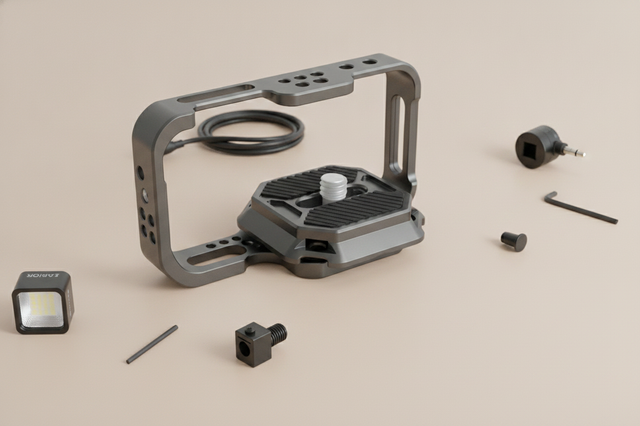
By utilizing modular, low-profile interfaces like the FALCAM F22 system, creators can pull monitors and microphones closer to the camera body. Reducing that lever arm ($L$) by just 10cm can drop the torque to ~6.8 N⋅m, bringing the physical effort down to a sustainable 40-50% MVC.
The ROI of Quick-Release Infrastructure
In high-alpine environments, "faffing" with gear isn't just annoying; it's a safety risk. Cold fingers lose dexterity, and the longer a swap takes, the higher the risk of dropping a component or missing a fleeting light window.
Efficiency Extrapolation
We can quantify the value of a unified quick-release system (like F38 or F50) through a simple workflow ROI calculation:
- Traditional Thread Mounting: ~40 seconds per swap (aligning, threading, tightening).
- Quick-Release Mounting: ~3 seconds per swap (click-and-lock).
- Time Saved: 37 seconds per swap.
For a professional adventure creator performing 60 swaps per shoot (switching between tripod, gimbal, and handheld) over 80 shoots a year, the math is compelling: $$37 \text{s} \times 60 \text{ swaps} \times 80 \text{ shoots} = 177,600 \text{ seconds} \approx 49 \text{ hours saved annually.}$$
At a professional rate of $120/hr, this efficiency gain translates to over $5,800 in recovered time. This demonstrates that investing in a high-performance mounting ecosystem is not an "accessory" cost, but a foundational infrastructure investment.
Engineering Standards: Aluminum vs. Carbon Fiber
A common misconception in the creator community is that high-end quick-release plates are made of carbon fiber to save weight. In reality, precision-engineered interfaces like the FALCAM F38 and F50 series are machined from Aluminum Alloy (typically 6061 or 7075).
Why Aluminum Wins at the Interface
While carbon fiber is superior for tripod legs due to its vibration damping and high strength-to-weight ratio, it is ill-suited for the high-friction environment of a quick-release plate. Aluminum provides:
- Machining Tolerance: The Arca-Swiss standard requires sub-millimeter precision to ensure "zero-play" stability. Aluminum can be milled to these tolerances far more reliably than molded carbon fiber.
- Wear Resistance: Repeated sliding into metal clamps would quickly abrade a carbon fiber plate, leading to structural thinning.
- Thermal Bridge Awareness: In extreme cold, aluminum acts as a thermal bridge. It will conduct cold from the tripod head directly to your camera base.
Expert Insight: To mitigate the "thermal shock" of aluminum plates in winter, attach your QR plates to your cameras indoors before heading out. This prevents the metal-to-skin contact issues and slows the rate at which the camera's internal battery is cooled via the baseplate.
Professional Workflow: The Pre-Shoot Safety Checklist
Reliability is built on ritual. Before deploying gear in a high-stakes alpine environment, we recommend a "Triple-Check" protocol for all quick-release interfaces, aligned with the stability principles of ISO 1222:2010 Photography — Tripod Connections.
- Audible: Listen for the distinct "Click" of the locking mechanism. If the click is muted, check for ice or grit in the plate slot.
- Tactile: Perform the "Tug Test." Immediately after mounting, apply a firm upward pull on the camera. This ensures the secondary safety lock has engaged.
- Visual: Verify the locking pin status. On most pro-grade systems, an orange or silver indicator will be visible when the system is in the "unlocked" state.
Load Capacity Nuance
When evaluating gear, remember that the "80kg" rating often cited for systems like the F38 refers to Vertical Static Load—a lab measurement of how much weight the plate can hold without shearing. Your Dynamic Payload (the weight of a moving camera on a gimbal or handheld rig) is much lower. For heavy cinema setups, always prioritize systems with anti-deflection features to prevent the rig from "twisting" off the plate under high torque.
Conclusion: Building a Resilient Infrastructure
Altitude aging is an inevitable reality for high-performance composites, but it is a manageable one. By shifting your perspective from "buying gadgets" to "managing infrastructure," you can ensure your gear survives the same peaks you do.
The combination of material science (understanding UV kinetics), biomechanical optimization (reducing wrist torque), and rigorous workflow protocols (the "Click-Tug-Check") creates a safety margin that generic gear cannot provide. In the high-alpine, where the margin for error is as thin as the air, your support kit should be the one thing you never have to think about.
YMYL Disclaimer: This article is for informational purposes only. Load capacities and material durability can vary based on specific environmental conditions, manufacturing batches, and usage history. Always consult the manufacturer's specific safety manual before using equipment in life-critical or high-value rigging scenarios. The "Glove Test" and "Wrist Torque" calculations are heuristics based on scenario modeling and should not replace professional engineering inspections for mission-critical gear.
Sources
- ISO 1222:2010 Photography — Tripod Connections
- The 2026 Creator Infrastructure Report: Engineering Standards, Workflow Compliance, and the Ecosystem Shift
- Synergetic effect of the action of atomic oxygen and vacuum ultraviolet radiation on polymers
- Arrhenius Equation and Chemical Kinetics
- Arca-Swiss Camera Mount: Everything You Need to Know