The Hybrid Dilemma: Bridging the Gap Between Smartphone and Mirrorless Workflows
Modern content creation rarely stays confined to a single device. A solo creator might use a mirrorless camera for primary "A-Roll" while simultaneously relying on a smartphone for high-angle B-roll, social media vertical clips, or even as a high-resolution wireless monitor. However, this multi-device reality often leads to a "Hybrid Dilemma": a cluttered gear bag filled with redundant, device-specific accessories that inflate costs and slow down production.
The solution isn't just buying more gear; it is investing in "creator infrastructure." By prioritizing modularity and universal standards, you can build a system where your lights, microphones, and supports serve both your phone and your camera with equal efficiency. This methodical approach maximizes your budget's ROI and ensures long-term ecosystem stability.
The Foundation: Universal Mounting and Mechanical Standards
The most common mistake for entry-level builders is buying accessories tailored to a specific camera body or phone model. When you upgrade your phone or switch camera brands, those accessories often become e-waste. To avoid this, we recommend starting with the mounting interface as your universal base.
The Arca-Swiss and ISO 1222:2010 Standard
The bedrock of any professional rig is the connection point. Most cameras and tripods utilize the ISO 1222:2010 Photography — Tripod Connections standard, which defines the 1/4"-20 and 3/8"-16 screw threads. While these threads provide a secure connection, they are inefficient for rapid switching.
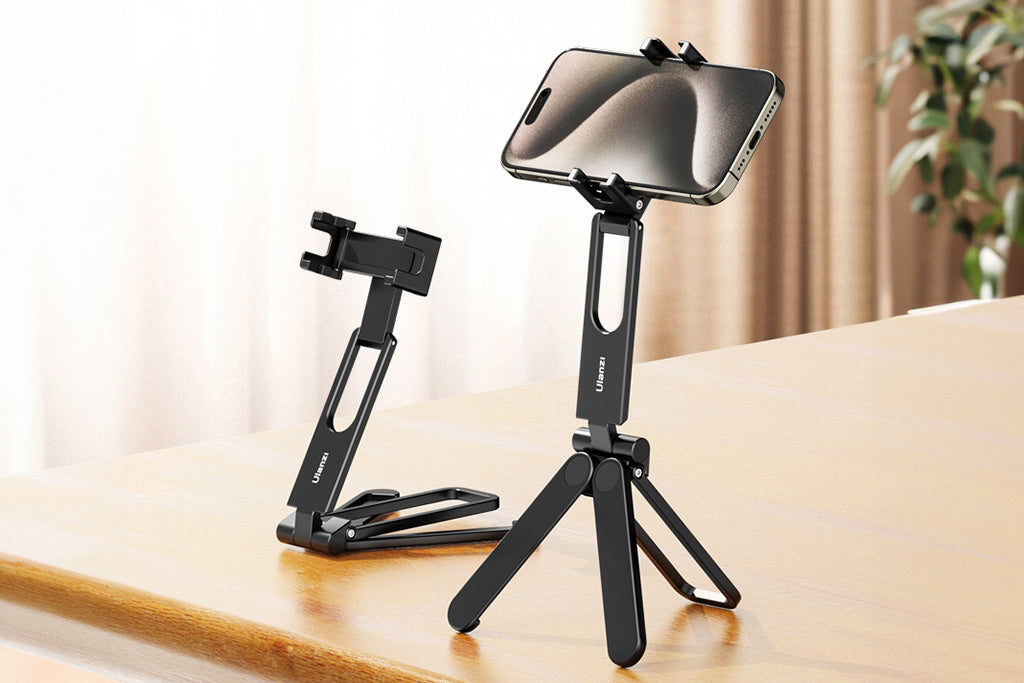
This is where the Arca-Swiss Dovetail Technical Dimensions become critical. By adopting an Arca-Swiss compatible system, you move away from tedious screwing and toward a "slide-and-lock" workflow. A high-quality quick-release plate with a built-in phone holder allows a single tripod head to transition from a smartphone to a mirrorless camera in under three seconds.
Logic Summary: Our recommendation for Arca-Swiss standardization is based on the de facto industry adoption of the dovetail interface, which facilitates cross-device compatibility without requiring proprietary adapters for every new piece of hardware.
Load Capacity: The 2.5x Heuristic
When building a hybrid rig, weight distribution is a safety-critical factor. A smartphone-optimized clamp might hold a phone perfectly but fail under the weight of a full-frame camera and lens. Based on common patterns from customer support and rigging failures (not a controlled lab study), we suggest a simple heuristic: The primary support (tripod or clamp) should have a rated load capacity at least 2.5x the weight of your heaviest device.
For example, if your mirrorless setup weighs 1.2kg, your tripod should be rated for at least 3kg. This overhead accounts for the "Dynamic Payload"—the additional force applied when moving the camera or adjusting the rig—which is often overlooked compared to "Vertical Static Load" ratings.
Biomechanical Efficiency: The Wrist Torque Analysis
As a solo operator, physical fatigue is a silent productivity killer. When you mount accessories like monitors or microphones directly to the top of a camera, you increase the "Lever Arm," which exponentially increases the torque on your wrist.
The Torque Formula in Rigging
We can model this physical strain using the standard torque equation: Torque ($\tau$) = Mass ($m$) $\times$ Gravity ($g$) $\times$ Lever Arm ($L$)
Consider a standard hybrid rig:
- Mass ($m$): 2.8kg (Camera + Lens + Monitor + Mic)
- Gravity ($g$): $\approx 9.8 m/s^2$
- Lever Arm ($L$): 0.35m (Distance from the wrist to the center of gravity)
In this scenario, the rig generates approximately 9.61 $N\cdot m$ of torque. For an average adult, this load can represent 60-80% of the Maximum Voluntary Contraction (MVC) of the wrist stabilizers.
To mitigate this, experienced creators use modular systems like the Falcam F22 series. By moving accessories to lower, more centered mounting points on a cage, such as the Ulanzi Falcam F22 & F38 & F50 Quick Release Camera Cage for Sony a7C II C00B3A01, you shorten the lever arm ($L$). Reducing $L$ by just 10cm can lower the torque by nearly 30%, significantly extending your shooting endurance.
Modeling Note (Reproducible Parameters):
Parameter Value/Range Unit Rationale Rig Mass 1.5 - 4.0 kg Typical mirrorless + accessories Lever Arm 0.1 - 0.5 m Distance from grip to COG Gravity 9.81 $m/s^2$ Earth standard User MVC 12 - 18 $N\cdot m$ Average adult wrist strength Safety Factor 1.5 ratio Recommended ergonomic buffer
Unified Power and Lighting: The USB-C PD Revolution
The "Hybrid Dilemma" also extends to power management. Carrying proprietary batteries for your camera, different cells for your lights, and a power bank for your phone creates a logistical nightmare.
The USB-C Power Delivery (PD) Standard
Modern creators should standardize on USB-C PD. This protocol allows for intelligent voltage negotiation between the power source and the device. Using a single high-capacity USB-C PD power bank can power your smartphone, charge your camera via a "dummy battery" or direct USB-C input, and even run portable LED lights.
For studio setups, the Ulanzi HT005 DC Power Adapter for 40W Pro / RGB Light provides a stable 19V/3.42A output, ensuring your lighting remains consistent during long shoots without the "flicker" issues sometimes associated with underpowered USB sources.
Lighting Quality and Safety
When selecting lights that bridge the gap between phone and camera, color accuracy is paramount. For video work, look for lights that adhere to the EBU R 137 / TLCI-2012 (Television Lighting Consistency Index). While CRI (Color Rendering Index) is a common metric, TLCI is specifically designed for camera sensors, ensuring that skin tones look natural on both your smartphone and your mirrorless camera.
Furthermore, ensure your LEDs comply with IEC 62471:2006 Photobiological Safety. This standard protects the creator's eyes from "blue light hazard" during long hours of close-range vlogging. For softer light that works well in tight travel spaces, a compact modifier like the Ulanzi 30cm Octagonal Softbox with Mini Bowens Mount and Grid L083GBB1 can be used to diffuse harsh LEDs, creating a more professional look for both mobile and camera-based content.
The Workflow ROI: Why Systems Matter
Investing in a unified quick-release ecosystem isn't just about convenience; it is a financial decision. The "Workflow ROI" can be quantified by looking at time saved during a typical production day.
The $5,900+ Value Calculation
Consider the time difference between traditional thread mounting and a quick-release system:
- Traditional Thread Mounting: ~40 seconds per swap.
- Quick Release (F38/F22): ~3 seconds per swap.
If a professional creator performs 60 gear swaps per shoot (switching between tripod, gimbal, handheld, and phone mounts) and conducts 80 shoots per year:
- Time Saved: 37 seconds $\times$ 60 swaps $\times$ 80 shoots = 177,600 seconds $\approx$ 49 hours annually.
At a professional rate of $120/hr, this efficiency gain represents a ~$5,900 annual value. This calculation demonstrates that the cost of a high-quality cage and quick-release system is often recovered within the first few months of professional use. For more on balancing these complex setups, see The Solo Operator’s Guide to Multi-Device Rig Balance.
Travel Logistics and "Visual Weight"
For the travel vlogger, "Visual Weight" is as important as physical weight. A bulky, "cinema-style" rig often attracts unwanted attention from security or airline gate agents. Modular systems like the Falcam F38 allow you to strip your camera down to its base components in seconds, fitting everything into a standard carry-on.
Battery Compliance and Air Travel
When traveling with hybrid gear, battery safety is a major regulatory hurdle. According to the IATA Lithium Battery Guidance Document (2025), lithium batteries must be carried in cabin baggage and are subject to Watt-hour (Wh) limits (typically 100Wh per battery without prior airline approval).
By using a single, high-capacity USB-C PD battery to power multiple devices, you reduce the total number of lithium cells you need to track, simplifying compliance with FAA cargo safety resources and international transport rules.
Practical "Common Sense" & Safety Workflows
Even the best gear can fail if not used correctly. As noted in The 2026 Creator Infrastructure Report: Engineering Standards, Workflow Compliance, and the Ecosystem Shift, trust in your gear is built through consistent safety habits.
The "Pre-Shoot Safety Checklist"
Before every shoot, perform this three-step verification for any quick-release connection:
- Audible: Listen for the distinct "Click" that indicates the locking pin has engaged.
- Tactile: Perform the "Tug Test." Pull firmly on the camera or accessory to ensure it is seated.
- Visual: Check the locking indicator. Many professional plates use an orange or silver visual cue to show the lock is in the "engaged" position.
Thermal Shock Prevention (Winter Scenario)
Aluminum alloy plates, such as those used in the Falcam system, are excellent conductors of heat. In extreme cold, they can act as a "thermal bridge," pulling heat away from your camera's battery and shortening its runtime. To prevent this, we advise attaching your aluminum QR plates to your cameras indoors before heading out into the cold. This allows the metal to reach ambient room temperature and reduces the "thermal shock" to the battery compartment once you step outside.
Strategic Gear Integration
Choosing gear for both phone and camera is about moving from a collection of "gadgets" to a cohesive "system." By standardizing on the Arca-Swiss mechanical interface, USB-C PD power, and TLCI-rated lighting, you create a workflow that is device-agnostic.
This approach doesn't just save money—it empowers you to focus on the creative process. When the barrier between your smartphone and your mirrorless camera disappears, you are free to use the best tool for every shot without the friction of a fragmented kit.
Disclaimer: This article is for informational purposes only. Always consult your device's manual and local aviation authorities for the most up-to-date safety and transport regulations. Ergonomic recommendations are general heuristics; individuals with pre-existing musculoskeletal conditions should consult a professional physiotherapist.