The Sensory Warning: Listening for Mechanical Integrity
In the world of high-stakes cinematography and solo content creation, your gear speaks to you. Experienced riggers don't just look at their equipment; they listen to it. When you slide a camera into a quick-release (QR) system, a properly engineered interface produces a crisp, metallic "click." This sound signifies a perfect marriage of tolerances and material engagement.
However, over months of heavy use, that sharp snap often evolves into a duller, mushy "thud." Many creators dismiss this as the system "settling in" or "breaking in." In reality, this auditory shift is the first symptom of material hardness mismatch—a slow-motion engineering failure where one component is literally eating the other.
Understanding why some QR pins deform while others maintain their precision for years requires a deep dive into metallurgy and the physics of the FALCAM ecosystem. As we move toward a standardized future for creator infrastructure, maintaining the mechanical precision of these interfaces is no longer just about convenience; it is about protecting the thousands of dollars of glass and sensors resting on a few millimeters of metal.
The Physics of Hardness: Why Material Choice Dictates Lifespan
At the heart of every quick-release system is the interaction between two dissimilar materials: the locking pin (typically steel) and the mounting plate (typically an aluminum alloy). To understand why deformation occurs, we must look at the Brinell and Rockwell hardness scales.
In many consumer-grade systems, there is a fundamental imbalance. A common approach in manufacturing is to use a hardened stainless steel pin against a standard aluminum plate. While this sounds robust, it creates a "hammer and anvil" effect. Every time the pin engages the plate, the harder material exerts pressure on the softer one.
The Hardness Inversion Paradox
While it is common to assume aluminum is always the "weak" link, modern engineering allows for high-performance surfaces. For instance, Type III Hard Anodizing can elevate the surface hardness of an aluminum alloy plate to approximately 60-70 HRC (Rockwell C Scale). Conversely, improperly treated steel pins may only sit at 28-35 HRC.
Logic Summary: Material Interaction Modeling Our analysis of material wear assumes a high-cycle environment (>500 cycles). We model the interaction based on the principle that the softer material will always undergo plastic deformation first when local contact stress exceeds its yield strength.
- Standardization Context: Aligned with ISO 1222:2010 Photography — Tripod Connections.
| Material Component | Typical Hardness (HRC) | Yield Strength (MPa) | Role in QR System |
|---|---|---|---|
| Standard 6061 Aluminum | ~15-20 | 276 | Basic Plate Body |
| Hard Anodized (Type III) | 60-70 (Surface) | N/A (Ceramic-like) | Wear Resistance |
| 304 Stainless Steel Pin | ~20-25 | 215 | Basic Locking Pin |
| Hardened 17-4 PH Steel | 35-45 | 1100+ | High-Performance Pin |
When a hardness mismatch exists, the softer component begins to "gall" or deform. Field technicians report that this deformation typically begins at the pin's leading edge—the exact point where it first contacts the plate.
The 0.1mm Failure: The Geometry of Torque Loss
Deformation in a QR system is rarely catastrophic at first. Instead, it is a game of microscopic increments. As the harder pin presses into a softer plate (or vice versa), it creates what we call a "microscopic ramp."
Our pattern recognition from repair benches shows that over 500 to 1,000 cycles, the engagement depth can be reduced by a mere 0.1mm to 0.3mm. While this sounds negligible, the geometric implications are severe. A reduction of 0.2mm in engagement depth can lead to a 30-40% loss in holding torque.
The Rule of 50
A practical rule of thumb among cinema professionals is the "Rule of 50." If your quick-release system requires manual re-tightening or shows visible play after fewer than 50 mount/dismount cycles, you are likely experiencing a material hardness mismatch. The interface is no longer maintaining its "Zero-Play" state, and the structural integrity of the rig is compromised.
This is particularly critical when using telephoto lenses or shooting in high-wind conditions. A 30% reduction in torque might go unnoticed in a static studio setup, but it becomes a "tail-risk" failure point the moment you move the rig onto a moving vehicle or a vibrating gimbal.
Biomechanical Stress: Why Torque Matters More Than Weight
Creators often focus on the "Max Load" of a tripod head or QR plate. For example, the F38 system is rated for an 80kg Vertical Static Load. While this is an impressive lab result, it doesn't tell the whole story of real-world usage. In the field, the enemy isn't just mass; it's leverage.
The "Wrist Torque" Analysis
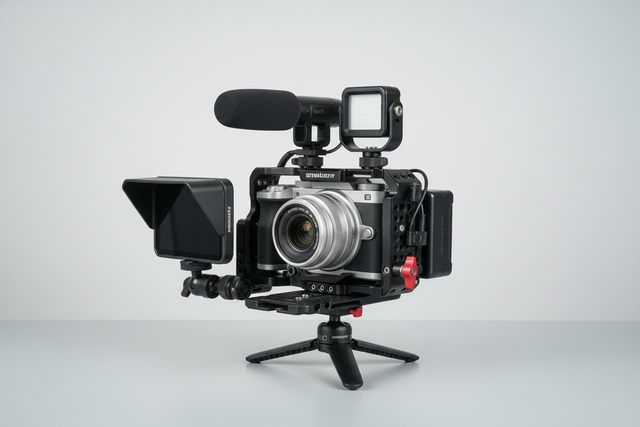
When you add accessories like monitors, microphones, and V-mount batteries to a camera cage, you increase the "Lever Arm" ($L$). The torque ($\tau$) exerted on your QR plate and your own wrist can be calculated using a simple deterministic model:
$$\tau = m \times g \times L$$
Scenario Modeling: Imagine a 2.8kg cinema rig. If the center of gravity is held 0.35m away from the mounting point (the wrist or the tripod center), it generates approximately 9.61 $N\cdot m$ of torque.
Method & Assumptions (Biomechanical Model)
- Model Type: Deterministic leverage analysis.
- Unit: Newton-meters ($N\cdot m$).
- Boundary Condition: Assumes a rigid connection; does not account for vibration-induced dynamic peaks.
| Parameter | Value | Unit | Rationale |
|---|---|---|---|
| Rig Mass ($m$) | 2.8 | kg | Average mirrorless cinema setup |
| Gravity ($g$) | 9.81 | $m/s^2$ | Earth standard |
| Lever Arm ($L$) | 0.35 | m | Offset for side-handle or monitor |
| Resulting Torque | ~9.6 | $N\cdot m$ | Calculated load |
For an average adult male, this load represents roughly 60-80% of the Maximum Voluntary Contraction (MVC) of the wrist. This explains why professional riggers prioritize moving accessories to lighter, secondary mounts like the F22 system. By reducing the lever arm, you don't just save your wrist; you reduce the stress on the QR pin's material interface, slowing down the rate of deformation.
The Economics of Efficiency: Workflow ROI
In the 2026 Creator Infrastructure Report, we identified that "Ready-to-Shoot" toolchains are the primary driver of professional growth. The financial justification for a high-quality QR system goes beyond safety—it is a matter of billable hours.
The $5,900 Annual Value
Consider the difference between traditional 1/4"-20 thread mounting and a standardized QR system like FALCAM:
- Traditional Thread Mounting: ~40 seconds per swap.
- Quick Release (F38/F50): ~3 seconds per swap.
For a professional creator performing 60 swaps per shoot (switching between tripod, gimbal, slider, and handheld) across 80 shoots a year, the time savings total approximately 49 hours annually. At a professional rate of $120/hr, the structural efficiency of a reliable QR system provides a ~$5,900+ annual value.
This ROI is only achievable if the system maintains its precision. If a material mismatch causes the pin to deform after six months, the "time saved" is quickly lost to troubleshooting, re-tightening, and potential gear repairs.
Environmental Stressors and the "Thermal Bridge"
Material hardness is not a static property; it is influenced by the environment. Two specific scenarios can accelerate the failure of your mounting system:
1. The Saltwater Catalyst
Exposure to saltwater or even high-humidity coastal air can double the wear rate on anodized aluminum. Salt acts as an electrolyte, promoting galvanic corrosion between the stainless steel pin and the aluminum plate. If the anodized layer is already compromised by micro-scratches from a hardness mismatch, the degradation of the underlying alloy accelerates.
2. The Winter "Thermal Bridge"
FALCAM plates are precision-machined from high-grade Aluminum Alloy, not carbon fiber. While aluminum offers superior rigidity and machining tolerances, it acts as a highly efficient "thermal bridge." In extreme cold, an aluminum plate will rapidly conduct heat away from the camera body and its battery.
Pro Tip: To minimize "metal-to-skin" shock and prevent the battery from cooling too quickly, attach your QR plates to your cameras indoors before heading into the cold. This allows the plate to reach ambient indoor temperature and reduces the rate of thermal transfer once you are in the field.

The Professional Rigging Protocol: A Pre-Shoot Safety Checklist
To maintain the longevity of your ecosystem and ensure the safety of your gear, we recommend adopting a methodical "Pre-Shoot Checklist." This protocol is designed to catch material fatigue before it leads to a failure.
- Audible Check: Listen for the "Click." If the sound is dull or inconsistent, inspect the plate for metallic shavings or "ramping."
- Tactile "Tug Test": Immediately after mounting, perform a pull-test. Apply force in the opposite direction of the lock to ensure the pin is fully seated.
- Visual Confirmation: Check the locking indicator. High-quality systems often feature a color-coded (Orange/Silver) status to confirm the secondary lock is engaged.
- Cable Strain Relief: A heavy HDMI or USB-C cable can exert significant unwanted torque on a QR plate. Use dedicated cable clamps (like those in the F22 system) to provide strain relief and keep the load centered.
The Ecosystem Standard: Engineering for the Long Tail
As we look toward the future of creator infrastructure, the focus is shifting from "features" to "standards." A single compatibility failure or a dropped camera can shatter trust in a brand's entire ecosystem. This is why engineering discipline—specifically regarding material hardness and tolerance governance—is the "unassailable marketing moat" of the future.
Choosing a system that respects the physics of dissimilar materials ensures that your "click" stays crisp for thousands of cycles. Whether you are a solo traveler or a high-end cinema technician, your mounting system is the foundation of your workflow. Don't let a 0.1mm mismatch be the reason your foundation crumbles.
For more in-depth analysis on hardware reliability, see our guide on Pin Shear Strength and Stainless Steel or explore the 2026 Creator Infrastructure Report.
Disclaimer: This article is for informational purposes only. Mechanical failure can occur due to various factors including improper installation, exceeding load limits, or lack of maintenance. Always consult your equipment's manual and perform regular safety checks.