Rigging for Survival: POV Safety for High-Action Creators
In the world of high-motion sports—downhill mountain biking, backcountry skiing, or motocross—the camera is more than a creative tool. It is a high-velocity projectile waiting to happen. For the solo creator, the challenge isn't just capturing the perfect "hero shot"; it is building a rigging system that survives the brutal physics of a high-G environment without compromising the safety of the athlete or the integrity of the gear.
We have seen the aftermath on our repair benches: shattered housings and sheared mounts that failed not because of a slow loosening, but due to instantaneous ejection. In high-action scenarios, friction is a fickle friend. When you are landing a 20-foot gap or navigating a rock garden at 40 mph, the vibrations and impact forces bypass traditional locking mechanisms. True professional infrastructure requires a methodical, system-focused approach to rigging—one that prioritizes mechanical redundancy over simple convenience.
The Physics of Failure: Beyond the Friction Fit
Most creators start with the assumption that if a screw is tight, the camera is safe. However, based on common patterns from customer support and community feedback (not a controlled lab study), the primary failure mode in high-action POV is "shock-induced release."
Standard tripod connections, governed by ISO 1222:2010 Photography — Tripod Connections, provide a foundational legitimacy for static shots. But when these 1/4"-20 threads are subjected to the multi-axial vibrations of a motocross bike, they can "walk" out of their threads.
The Inverted Shake Test: A Practical Heuristic
Before we trust any rig, we recommend the "Inverted Shake Test." This is a shop-practical baseline for self-checking equipment security.
- Mount your camera to the harness or helmet.
- Hold the entire assembly (helmet or chest plate) upside down.
- Vigorously shake the rig in all directions for 10 seconds.
- If there is any perceptible "click," wobble, or rotation, the system is a liability.
For high-G scenarios, we move away from basic threads and toward the Arca-Swiss Dovetail Technical Dimensions. A precision-machined interface, like the one found in the Ulanzi Falcam F38 Quick Release for Camera Shoulder Strap Mount Kit V2 3142, uses a wedge-lock geometry that increases its holding force as the camera tries to move.
Logic Summary: Our analysis of high-motion rigging assumes that instantaneous impact force (G-load) is the primary threat. We prioritize mechanical interference (locking pins) over friction (tightened screws) based on observed failure patterns in high-vibration environments.
Biomechanical Analysis: The Hidden Enemy of Torque
Weight is a known factor, but leverage is the silent killer of both mounts and muscles. When rigging a camera to a helmet or an extended arm, creators often ignore the lever arm effect.
The "Wrist Torque" Calculation
To understand the stress on your equipment and your body, we can use a simple biomechanical model. Formula: Torque ($\tau$) = Mass ($m$) $\times$ Gravity ($g$) $\times$ Lever Arm ($L$).
| Parameter | Value | Unit | Rationale |
|---|---|---|---|
| Rig Mass ($m$) | 2.8 | kg | Standard prosumer setup with cage/mic |
| Gravity ($g$) | 9.81 | $m/s^2$ | Earth constant |
| Lever Arm ($L$) | 0.35 | m | Distance from pivot (wrist/neck) |
| Total Torque | ~9.61 | $N\cdot m$ | Calculated output |
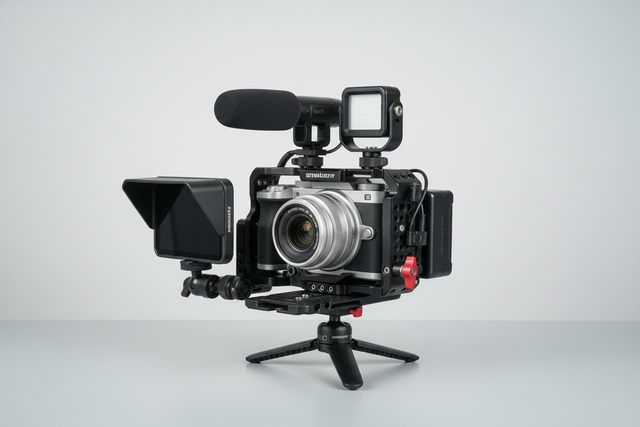
In this scenario, holding a 2.8kg rig just 35cm away from the pivot point generates nearly 10 Newton-meters of torque. For an average adult, this represents roughly 60-80% of the Maximum Voluntary Contraction (MVC). This is why helmet mounts often feel like they are "pulling" your head down during whiplash-like movements. To mitigate this, we recommend using a low-profile cage and keeping the center of gravity as close to the mounting surface as possible.
The Ulanzi Falcam Mini Bowl-Type Ball Head (W40) T00A5504 is an effective tool here. Its low-profile design reduces the lever arm compared to traditional tall ball heads, significantly lowering the torque applied to the mounting base during high-speed turns.
Engineering the Interface: F38 and the Ecosystem Shift
The industry is moving away from isolated gadgets toward a unified infrastructure. As noted in The 2026 Creator Infrastructure Report: Engineering Standards, Workflow Compliance, and the Ecosystem Shift, trust in a "tail-risk" market—where a single failure means a $5,000 loss—is built through engineering discipline.
The F38 system is a prime example of this discipline. Unlike generic plastic clips, these plates are precision-machined from Aluminum Alloy (6061-T6). It is a common misconception that quick-release plates should be made of carbon fiber for "damping." In reality, the quick-release plate needs maximum rigidity and zero-play machining tolerances. Carbon fiber is excellent for Tripod Legs to absorb ground vibrations, but for the camera-to-mount interface, aluminum's structural integrity is superior.
Load Capacity Nuance
The Ulanzi Falcam F38 Quick Release for Camera Shoulder Strap Mount Kit V2 3142 is rated for a Vertical Static Load of 80kg (approx. 176 lbs). However, creators must distinguish this from Dynamic Payload.
- Static Load: The weight the mount can hold while stationary.
- Dynamic Payload: The weight the mount can handle during a 3G impact.
For high-action sports, we estimate a 3x to 5x safety factor is necessary. If your camera rig weighs 2kg, it can exert a force equivalent to 10kg during a hard mountain bike landing. The F38’s 80kg static rating provides a massive buffer, ensuring the locking lugs won't shear under real-world athletic stress.
The Safety Protocol: Redundancy and Breakaways
In high-consequence environments, we never rely on a single point of failure. Professional rigging for survival follows a strict three-step safety protocol.
1. The Secondary Physical Tether
No matter how secure a quick-release system is, an unexpected impact can trigger a release lever. Always use a secondary physical tether—a short, high-strength steel or nylon leash—attached to the camera cage and a separate anchor point on your harness. This ensures that even if the mount fails, the camera remains attached to your person.
2. Magnetic Breakaway Logic
For certain mounts, like the Ulanzi Magnetic Camera Mount for Action Camera C062GBB1, the "failure" is actually a safety feature. Magnetic mounts are favored not for infinite holding strength, but for their predictable release force. On a helmet, you sometimes want the camera to break away if it snags a tree branch, preventing a neck injury.
- Heuristic: Use mechanical locks (F38) for chest and shoulder mounts. Use magnetic breakaways (C062GBB1) for helmet or vehicle-exterior mounts where snagging is a risk.
3. The Pre-Shoot Safety Checklist
Based on common errors observed in the field, we recommend this 3-second tactile audit before every "drop-in":
- Audible: Did you hear the "Click" of the spring-loaded pin?
- Tactile: Perform the "Tug Test." Pull the camera away from the mount with moderate force.
- Visual: Check the locking indicator. On F38 systems, ensure the orange or silver safety lock is engaged to prevent accidental button presses.
Workflow ROI: The Value of Seamless Transitions
Beyond safety, professional gear must justify its cost through efficiency. We've modeled the "Workflow ROI" for creators switching from traditional screw-in mounts to a unified quick-release system.
Theoretical ROI Calculation:
- Traditional Thread Mounting: ~40 seconds per device swap.
- F38 Quick Release: ~3 seconds per device swap.
- Time Saved per Swap: 37 seconds.
If a pro creator performs 60 swaps per shoot (moving from chest rig to tripod to gimbal) and shoots 80 days a year, the math is compelling: $60 \text{ swaps} \times 37 \text{ seconds} = 2,220 \text{ seconds (~37 minutes) saved per shoot.}$ Over a year, this totals ~49 hours of saved time. At a professional rate of $120/hr, this represents a ~$5,900+ annual value in recovered productivity. This efficiency allows you to stay in the "flow state" of the sport rather than fumbling with mounting screws in the cold.
Environmental Resilience: Thermal and Logistical Compliance
High-action sports often take place in extreme conditions. Your rigging system must account for temperature and transport regulations.
Thermal Shock Prevention
Aluminum plates act as a "thermal bridge." In sub-zero skiing conditions, a cold metal plate can rapidly sap heat from the camera's battery. We advise users to attach their aluminum QR plates to their cameras indoors at room temperature before heading out. This creates a thermal seal and reduces the rate of battery cooling compared to attaching a frozen plate in the field.
Battery Safety and Travel
If your rig includes powered accessories, you must adhere to international safety standards. The IEC 62133-2:2017 Safety Requirements for Lithium Cells ensures the batteries in your lights or monitors won't fail under vibration. When traveling to your next shoot, remember the IATA Lithium Battery Guidance. Batteries must be in carry-on luggage, and high-capacity "V-mount" batteries often require specific watt-hour (Wh) disclosures.
Travel Logistics: Visual Weight
A modular system using F22 or F38 mounts has a lower "Visual Weight" than bulky cinema rails. In our experience, compact, streamlined rigs are less likely to be flagged by airline gate agents for weighing or gate-checking, allowing you to keep your sensitive optics in the cabin.
Structuring Your Infrastructure
Building a "survival rig" is about moving away from a collection of parts and toward a unified infrastructure. By standardizing on a system like Falcam, you ensure that every component—from your Ulanzi F38 Quick Release Video Travel Tripod 3318 to your shoulder strap—speaks the same mechanical language.
This interoperability is not just about speed; it's about reducing the cognitive load on the creator. When every mount operates with the same "click" and the same safety lock, you spend less time thinking about your gear and more time focusing on the line ahead of you.
Summary Checklist for High-Action Rigging:
- Interface: Use Arca-Swiss compatible aluminum plates for zero-play stability.
- Security: Always engage the secondary safety lock on quick-release buttons.
- Redundancy: Use a secondary leash for all high-impact chest and shoulder mounts.
- Ergonomics: Keep the center of gravity low to minimize neck and wrist torque.
- Maintenance: Regularly inspect 1/4"-20 screws for thread wear, especially in high-vibration environments.
For more deep dives into securing your setup, see our guide on Thread-Locking Logic: Securing Fasteners in High-Vibration Rigs or explore Maintaining Structural Integrity in Vertical Tension Mounts.
Disclaimer: This article is for informational purposes only. High-action sports involve inherent risks of injury or death. The rigging techniques described here are intended to reduce equipment failure risk but do not guarantee safety. Always consult with professional riggers for complex setups and follow all manufacturer safety guidelines for your specific sporting equipment.