The Shift to Unified Power: Why USB-C PD Matters for Your Rig
For years, the "creator tax" wasn't just about the price of gear; it was the weight of proprietary power bricks. Every light, monitor, and camera required a specific AC adapter, often leading to a "cable spaghetti" nightmare that complicated setup times and increased the risk of gear failure. The transition to USB-C Power Delivery (PD) represents a significant shift in creator infrastructure toward a more unified, efficient ecosystem.
USB-C PD allows a single cable to negotiate power levels from 5W to 100W (and up to 240W in PD 3.1 specifications). For solo creators, this means a laptop charger can often power a key light, and a V-mount battery can charge a phone. However, this interoperability introduces a new layer of technical responsibility. Understanding the "invisible handshake" between your power source, your cable, and your light is essential for building a system that avoids throttling or unexpected shutdowns during critical shoots.
In this guide, we will break down the mechanics of PD lighting, identify the critical bottlenecks in your power chain, and provide a system-focused approach to building a reliable, modular workflow.
The Anatomy of the PD Handshake: 20W, 30W, and 65W
When you plug a PD-compatible light into a power source, a digital negotiation occurs. Unlike old DC barrels that simply "dump" voltage, USB-C PD devices communicate using a serial protocol. The light requests a specific voltage/amperage profile, and the power source responds with its available capabilities.
Decoding Power Requirements
- 20W - 30W (Pocket Lights & Small Panels): Typically used for fill lights or mobile vlogging. These often utilize 9V or 12V profiles.
- 65W (Mid-Range COB & Pro Panels): A common "sweet spot" for high-output portable lighting, usually requiring a stable 20V/3.25A supply.
- 100W+ (High-Output Cinema Lights): These push the limits of PD 3.0. Based on internal manufacturer specifications and community benchmarks, professional-grade LED panels drawing 100W at maximum output leave very little headroom for conversion losses, making power stability critical.
A common issue reported to our technical support team involves lights flickering or failing to reach 100% brightness despite being connected to a "65W charger." This often occurs because the charger supports 65W total across multiple ports, but may only provide 45W on a single port. Practical Tip: Always verify the "Single Port Output" rating on the charger's spec label before integrating it into your rig.

The E-Marker Bottleneck: Why Your Cable is the Weakest Link
Based on patterns observed in our technical support and repair logs, the most frequent point of failure for PD-powered lights isn't the light or the charger—it’s the cable. Many creators assume any USB-C cable is a "dumb pipe," but for sustained high-power delivery, the cable must be "smart."
The 3A vs. 5A Heuristic
Standard USB-C cables are often rated for 3A (up to 60W at 20V). To safely draw more than 60W, the cable must contain an E-Marker chip. This chip communicates to the devices that the cable's internal wire gauge (typically 20-22 AWG for 5A current) is rated to handle the heat and current without significant voltage drop.
If you connect a 65W light to a 65W charger using a 3A cable, the system will typically negotiate down to 60W. While this 5W deficit might seem negligible, it can cause the light's internal circuitry to throttle brightness or behave unpredictably. According to USB-IF technical specifications, using underspecified cables for high-draw devices increases the risk of port overheating.
Workshop Rule of Thumb: We suggest a "5A-Only" policy for all professional lighting rigs. You can identify these cables by looking for "100W" or "5A" markings on the connector housing. Labeling your cables with high-visibility tags helps prevent the accidental use of 60W phone cables in high-draw scenarios.
Modeling the Documentary Workflow: Real-World Runtime vs. Theoretical Math
To provide a practical benchmark, we modeled a Documentary Field Producer scenario. This model assumes a producer traveling with a 98Wh V-mount battery—the maximum capacity generally allowed by IATA Lithium Battery Guidance for air travel—to power a PD-capable COB light.
Scenario Model: 120W-Class Light at 70% Brightness
The following calculation provides an estimate of runtime based on standard electrical formulas.
| Parameter | Value | Rationale / Source |
|---|---|---|
| Light Load (70%) | ~84W | Derived from 120W Max Rating × 0.70 |
| Battery Capacity | 98Wh | IATA air travel limit (Standard 99Wh battery) |
| Conversion Efficiency | 85% | Estimated DC-DC efficiency (Industry standard range) |
| Calculated Runtime | ~59 Minutes | Formula: (98Wh × 0.85) ÷ 84W |
| Field Observed Runtime | 45-50 Minutes | Ulanzi Tech Support observations (Accounts for battery aging/heat) |
Note on Discrepancy: The gap between the calculated ~60 minutes and the field-reported ~45 minutes is often due to "voltage sag" as the battery nears depletion and the non-linear power draw of high-intensity LED drivers. For sustained shoots, we recommend the Ulanzi HT005 DC Power Adapter for 40W Pro / RGB Light. It delivers a consistent 19V/3.42A (approx. 65W) output from AC power, bypassing the variables of battery negotiation for studio-style reliability.
Biomechanical Efficiency: Reducing "Wrist Torque" in Mobile Rigs
When building a mobile rig, weight is only one factor; leverage is often the hidden cause of fatigue. Mounting a heavy PD power bank at the top of a camera cage creates rotational force (torque) on the operator's wrist.
The Torque Heuristic
In rig building, we use a simplified torque formula to estimate physical strain: Torque ($\tau$) = Mass ($m$) × Gravity ($g$) × Lever Arm ($L$).
If you mount a 500g battery 20cm (0.2m) away from your handgrip, you generate roughly 1.0 N·m of torque. Over a multi-hour shoot, this can lead to "shaky cam" and muscle fatigue.
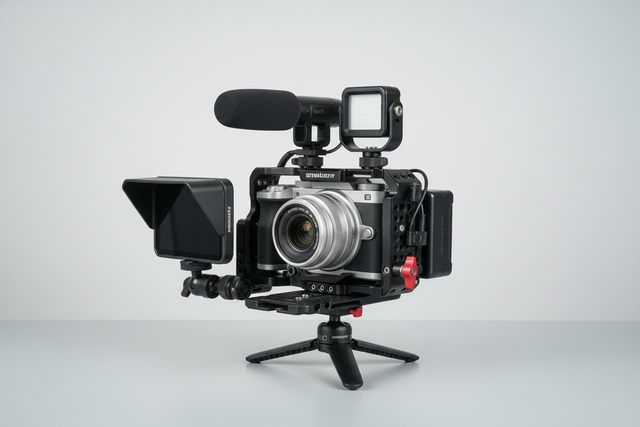
The Solution: Use a modular system like the Ulanzi Falcam F22 & F38 & F50 Quick Release Camera Cage V2. By using F22 mounting points to keep accessories like the Ulanzi CO17 Super Clamp with Dual Ballhead Magic Arm closer to the camera’s center of gravity, you reduce the lever arm ($L$), significantly lowering the physical strain on your wrist.
Workflow ROI: The Value of Quick Release Ecosystems
Efficiency in rigging directly impacts production costs. If a creator spends 40 seconds screwing in a light and 40 seconds unscrewing it, and performs this 60 times during a complex shoot, they have spent 80 minutes on mechanical tasks rather than creative ones.
Illustrative ROI Calculation:
- Traditional Threading: ~80 seconds per swap.
- Quick Release (F38/F22): ~3 seconds per swap.
- Estimated Time Saved: ~77 seconds per swap.
- Annual Impact (Example): For a professional doing 80 shoots/year with 60 swaps each, this saves approximately 49 hours. At a hypothetical professional rate of $120/hr, this represents a $5,880 value in recovered production time.
Note: Actual ROI depends on individual workflow frequency and local labor rates. Integrating a system like the Ulanzi Falcam F38 Quick Release Kit V2 allows you to move your PD-powered gear from a cage to a tripod in seconds, which is a major advantage for solo creators.
Safety and Reliability: The "Pre-Shoot Safety Checklist"
When handling high-capacity lithium batteries and high-wattage PD systems, safety is the priority. Aluminum quick-release plates are durable but act as "thermal bridges." In extreme cold, they can conduct heat away from the camera battery, potentially shortening its immediate runtime.
Actionable Safety Workflow (Field Best Practices)
- Audible Confirmation: Always listen for the "Click" when using Falcam F38 or F22 mounts to ensure the locking mechanism is engaged.
- The "Tug Test": Perform a firm, controlled pull-test immediately after mounting any PD-powered accessory to verify the seat.
- The Service Loop: When mounting a PD light, always leave a small "service loop" (slack) in the cable. A taut cable can fatigue the internal solder joints of the USB-C port over time.
- Thermal Prep: In cold environments, attach aluminum plates to your gear indoors to minimize "metal-to-skin" shock and rapid battery cooling.
For those managing complex studio setups, referring to internal guides like High-Angle Logic: Wall and Ceiling Mounts for Small Studio Lights can provide additional insights into permanent power routing.
Building Your Infrastructure for 2026 and Beyond
The move toward a unified PD infrastructure is a clear industry trend. As highlighted in our 2026 Creator Infrastructure Report (Company Technical Analysis), creators who prioritize tools backed by transparent engineering and stable interfaces are better positioned to scale their productions.
By choosing PD-compliant lighting and pairing it with a robust quick-release ecosystem like Falcam, you are building a toolchain designed for modularity. Whether you are a solo documentary producer or a studio builder, the goal remains the same: spend less time managing gear and more time telling your story.
YMYL Disclaimer: This article is for informational purposes only. When handling high-power electrical equipment or lithium-ion batteries, always refer to the manufacturer's safety manual. Improper use of lithium batteries can pose a fire risk. For air travel, consult the latest FAA or IATA regulations regarding battery watt-hour limits and transport requirements.