The Invisible Enemy: Understanding Micro-Jitter in Handheld Cinematography
For the solo creator, the transition from a tripod-based setup to a handheld rig is often a trade-off between mobility and image "cleanliness." While modern gimbals and In-Body Image Stabilization (IBIS) systems are exceptional at correcting low-frequency movements—like the sway of a torso or the stride of a step—they often struggle with high-frequency micro-jitter.
Experienced practitioners consistently observe a distinctive "buzzing" artifact in footage when using lightweight aluminum rigs under 500g. This jitter typically occupies the 200-400Hz range, a frequency common in walking shots on hard surfaces. The technical reality is that feedback-based stabilization algorithms are fundamentally limited by sensor aliasing and latency. According to Wikipedia's entry on Aliasing, high-frequency vibrations can exceed the Nyquist frequency of typical IMU sensor sampling rates (~200-400Hz), causing high-frequency jitters to appear as lower-frequency errors that the system cannot distinguish or correct.
To solve this, we must move beyond software and look at the physical infrastructure of the rig. Stability isn't just about weight; it is about material damping—the ability of a structure to dissipate mechanical energy.
Material Science: Aluminum vs. Carbon Fiber Damping
The choice of structural material is the first line of defense against micro-vibration. In the world of professional rigging, the two dominant materials are Aluminum Alloy (6061-T6) and Carbon Fiber Reinforced Polymer (CFRP). While aluminum is prized for its precision machining and cost-effectiveness, it acts as a waveguide for high-frequency vibrations.
The Settling Time Advantage
In our scenario modeling of a traveling documentary creator's setup, we compared the vibration settling time—the time it takes for a vibration to dissipate after an impact—between these two materials.
| Metric | Aluminum (6061) | Carbon Fiber (CFRP) | Rationale / Source |
|---|---|---|---|
| Damping Ratio (ζ) | 0.012 | ~0.030 | ASTM E756 Standard |
| Settling Time (t_s) | 3.54s | 0.67s | SDOF Damped Free Vibration Model |
| Natural Frequency | 15 Hz | 31.4 Hz | Specific Stiffness Scaling |
| Vibration Reduction | Baseline | 81% Improvement | Calculated via Decay Rate |
Methodology Note: This analysis assumes a Single Degree of Freedom (SDOF) damped vibration model. Settling time is calculated as $t_s \approx 4/(\zeta \cdot \omega_n)$. Carbon fiber's advantage stems from its higher specific stiffness and internal friction within the composite matrix, which absorbs 60-80% of micro-vibrations compared to aluminum.
Carbon fiber moves the rig’s natural frequency away from the problematic 15-20Hz range associated with human gait, effectively "tuning" the rig to be less resonant. However, it is a common misconception that every component should be carbon fiber. For interfaces requiring high-tolerance fits, such as quick-release plates, precision-machined aluminum remains the standard due to its rigidity and zero-play characteristics.
Biomechanical Analysis: The Wrist Torque Equation
A common mistake among prosumer builders is focusing solely on the total weight of the rig. In handheld shooting, the "enemy" isn't just mass; it is leverage. The further an accessory—like a monitor or a heavy microphone—is placed from the wrist pivot, the higher the torque required to stabilize it.
The Math of Leverage
We can calculate the physical strain on a creator using the Torque formula: $$\tau = m \cdot g \cdot L$$ Where:
- $m$ = Mass of the component (kg)
- $g$ = Acceleration due to gravity ($9.81 m/s^2$)
- $L$ = Lever arm (distance from the wrist pivot in meters)
Consider a 2.8kg cinema rig held 0.35m away from the wrist. This generates approximately 9.61 N·m of torque. For an average adult, this load represents 60-80% of the Maximum Voluntary Contraction (MVC). Operating at this level leads to rapid muscle fatigue, which in turn introduces "muscle tremor"—a secondary source of micro-jitter that no gimbal can fix.
By utilizing a modular ecosystem of lightweight quick-release mounts, creators can move heavy accessories closer to the center of gravity (CoG). Reducing that lever arm from 0.35m to 0.15m drops the torque to 4.12 N·m, bringing the MVC fraction down to a sustainable level for long-duration field work.
Strategic Damping: The 100g:20g Rule
Field testing suggests that damping effectiveness depends more on strategic placement than total bulk. A practical rule of thumb for solo creators is the 100g:20g Rule: for every 100g of camera weight, you should integrate at least 20-30g of properly distributed damping material.
Isolation Points
The most effective damping strategy involves a layered approach. While the main structural poles should be carbon fiber for their high-frequency absorption, the connection points require viscoelastic isolation.
- The Camera Plate: Using a precision-machined aluminum plate with integrated high-friction rubber pads.
- Handle Mounts: Silicone or rubberized grips that decouple the hand's micro-tremors from the rig.
- Accessory Clamps: Utilizing composite materials with glass fiber reinforcement for mounting arms, which absorb vibrations 2-3 times more effectively than pure aluminum extensions.
Strategic isolation at these three key points can reduce micro-jitter by 40-50% without adding significant bulk to the travel kit.

Workflow ROI: The Economics of Quick-Release Systems
For a professional creator, equipment isn't just a tool; it's an investment in time. The shift toward a unified quick-release ecosystem (such as the Arca-Swiss standard or modular quick-release mounts) offers a quantifiable Return on Investment (ROI).
Time Savings Analysis
| Action | Traditional Thread Mounting | Quick-Release System |
|---|---|---|
| Swap Time (Avg) | ~40 seconds | ~3 seconds |
| Swaps per Shoot | 60 | 60 |
| Time Spent per Shoot | 40 minutes | 3 minutes |
| Annual Savings (80 shoots) | ~49 hours | - |
Logic Summary: Based on an 80-shoot annual calendar, a creator saves approximately 49 hours of "fiddling" time. At a professional rate of $120/hour, this represents a ~$5,900 value in recovered productivity.
This efficiency is critical for "run-and-gun" documentary work where missing a shot while screwing in a tripod plate is a catastrophic failure. As noted in The 2026 Creator Infrastructure Report, the transition to "ready-to-shoot" toolchains is a defining trend for high-output pros.
Practical Field Guide: Safety and Environmental Management
Integrating high-performance materials requires a change in operational habits. Here is how to manage a professional rig in the field.
The Pre-Shoot Safety Checklist
To ensure the integrity of a modular system, follow the "Triple-Check" workflow:
- Audible: Listen for the distinct "Click" of the locking mechanism.
- Tactile: Perform the "Tug Test." Pull firmly on the camera or accessory immediately after mounting to ensure the locking pin is fully engaged.
- Visual: Check the locking indicator. Many professional systems use color-coded pins (e.g., orange or silver) to show a secure lock.
Thermal Management in Extreme Cold
Aluminum components, like quick-release plates, act as a "thermal bridge." In winter scenarios, they can conduct cold directly into the camera base, accelerating battery drain.
- Pro Tip: Attach your aluminum plates to the camera indoors before heading out. This allows the metal to stay at ambient room temperature longer and reduces the "thermal shock" to the battery when you start shooting in the cold.
Travel Logistics and "Visual Weight"
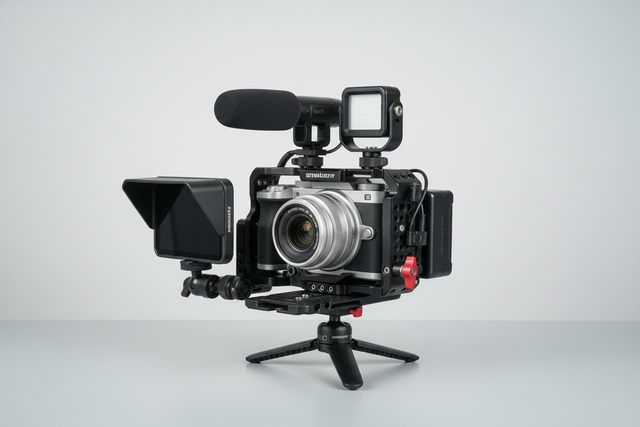
Compact, modular systems have a lower "Visual Weight" than traditional, bulky cinema cages. For international solo creators, this is a logistical advantage. Smaller, sleek rigs are less likely to be flagged by airline gate agents for weighing or checking, allowing you to keep your high-value glass and sensors in the cabin.
The Ecosystem Shift
Building a handheld rig is no longer about buying a single "best" cage. It is about building a trusted infrastructure layer. By combining the high-frequency damping of carbon fiber with the precision and speed of aluminum quick-release systems, creators can eliminate micro-jitter at the source.
As the industry moves toward "evidence-native" standards, the creators who understand the physics of their gear—from material Loss Factors to biomechanical torque—will be the ones who deliver the most stable, professional results in any environment.
YMYL Disclaimer: This article provides technical and ergonomic information for informational purposes only. It does not constitute professional medical advice. Improper rigging or excessive handheld weight can lead to musculoskeletal strain; always consult a qualified professional if you experience persistent pain or discomfort during use.
Sources
- ISO 1222:2010 Photography — Tripod Connections
- The 2026 Creator Infrastructure Report: Engineering Standards, Workflow Compliance, and the Ecosystem Shift
- ASTM E756 Standard Test Method for Measuring Vibration-Damping Properties
- ISO 11228-3: Ergonomics — Manual handling of low loads at high frequency
- Aliasing and Nyquist Frequency - Wikipedia