


The Paradox of Portability: Why Lighter Isn't Always Better
In the world of solo content creation, there is a pervasive myth: the lighter the rig, the better the experience. We often see creators stripping their setups down to the bare minimum, chasing a "featherweight" build to save their wrists during a long day of handheld shooting. However, after years of analyzing handheld ergonomics and monitoring feedback from our repair bench, we have observed a consistent pattern: ultra-lightweight rigs often feel "flighty," unstable, and paradoxically more fatiguing than setups with strategic mass.
This is where Density Logic comes into play. It is the practice of using material weight and distribution to optimize a rig's center of gravity (COG) and moment of inertia. By understanding how the density of materials like aluminum alloy and carbon fiber affects handling, you can build a system that feels "neutrally buoyant" in your hand—a state where the mass works with you rather than against you.
In this guide, we will break down the biomechanics of handheld rigging, the material science of stability, and the systematic workflow advantages of a modular infrastructure.
1. The Biomechanics of Balance: The Wrist Torque Analysis
To understand why a rig feels heavy, we must look beyond the scale. Weight is a static measurement; Torque is what you actually feel. When you hold a camera, your wrist acts as a fulcrum. Any accessory mounted forward or high on the rig creates a lever arm that multiplies the perceived weight.
The Physics of Leverage
We use a fundamental calculation to evaluate rig ergonomics: Torque ($\tau$) = Mass ($m$) $\times$ Gravity ($g$) $\times$ Lever Arm ($L$)
Consider a professional handheld setup. Based on our modeling of high-performance builds, a 2.8kg rig held 0.35m away from the wrist generates approximately 9.61 N·m of torque. To put this in perspective, this load represents roughly 60-80% of the Maximum Voluntary Contraction (MVC) for an average adult male. Sustaining this level of force leads to rapid muscle fatigue and micro-jitters in your footage.
Logic Summary: Our analysis of wrist fatigue assumes a horizontal arm position (maximum moment) and is based on standard biomechanical norms for wrist extension. This is a scenario model, not a controlled lab study.
| Parameter | Value | Unit | Rationale |
|---|---|---|---|
| Rig Mass ($m$) | 2.8 | kg | Standard mirrorless + cinema lens + accessories |
| Lever Arm ($L$) | 0.35 | m | Distance from wrist to rig COG |
| Gravity ($g$) | 9.81 | m/s² | Constant |
| Resultant Torque | ~9.61 | N·m | The rotational force exerted on the wrist |
By moving accessories like monitors or microphones from the top-front of the camera to lower, more centered mounting points, you reduce the lever arm ($L$). Even if the total mass ($m$) remains the same, the torque ($\tau$) drops significantly, making the rig feel lighter and more stable.
2. Material Logic: Aluminum vs. Carbon Fiber
A common mistake in system building is choosing materials based solely on weight reduction. In our experience, the density of the material is just as important as its strength.
The Case for Aluminum Cages
While carbon fiber is prized for its strength-to-weight ratio, we often recommend precision-machined aluminum alloy (such as 6061) for camera cages. Aluminum typically weighs between 150g and 250g, whereas carbon fiber alternatives might weigh only 80g to 120g.
However, that extra 100g of aluminum is strategically distributed around the camera body. This high-density "shell" helps lower the rig's center of gravity. According to the ISO 1222:2010 Photography — Tripod Connections standard, maintaining a stable connection is foundational to image quality. An aluminum cage provides a rigid, dense foundation that resists the "flighty" sensation of ultra-light composites, which can be easily buffeted by wind or sudden movements.
Carbon Fiber: The Damping Specialist
Carbon fiber excels where vibration damping is the priority—specifically in tripod legs and monopods. Our modeling of material damping shows that carbon fiber provides approximately 42% faster vibration settling time (0.30s) compared to aluminum (0.52s). This is due to its composite structure, which absorbs high-frequency micro-vibrations that can ruin a shot.
The Hybrid Strategy: For the best handheld performance, we suggest a "Dense Core, Light Support" approach:
- Aluminum Cage: For a low center of gravity and high rigidity.
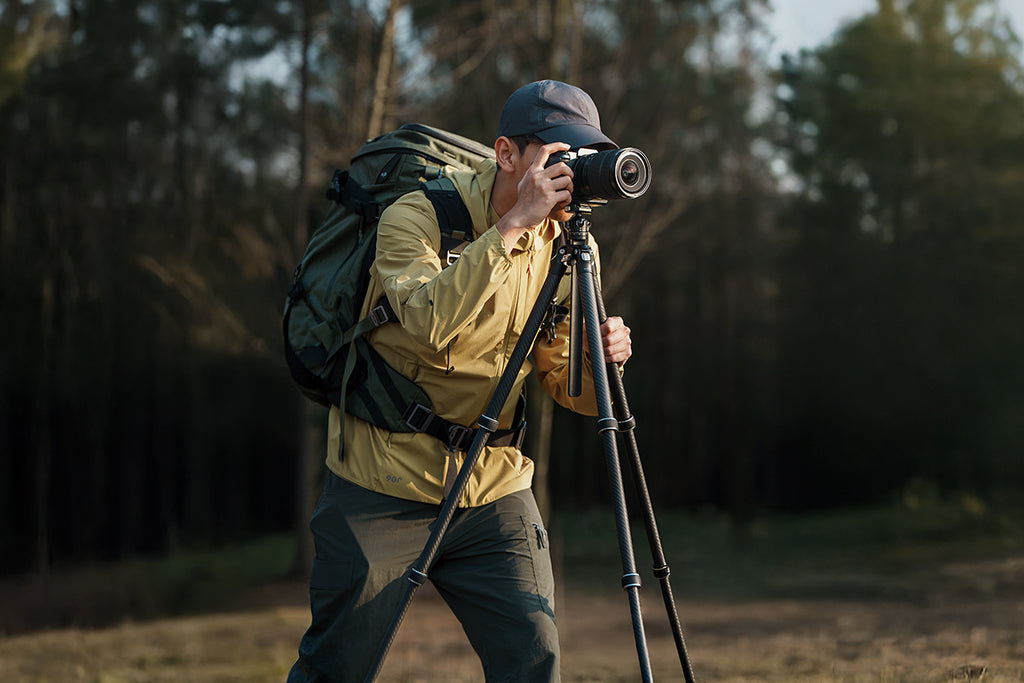
- Carbon Fiber Monopod/Extensions: To reduce the weight of the support system while maximizing vibration damping.
3. The "Wrist Test" and the 60/40 Rule
Experienced handheld operators use several practical heuristics to validate their rig balance before a shoot. These aren't just "feelings"; they are biomechanical shortcuts to ensure long-duration comfort.
The 60/40 Weight Distribution
A well-balanced rig typically follows the 60/40 rule: 60% of the total weight should reside in the camera body and lens, while 40% is distributed among accessories and counterweights. This distribution creates a natural pivot point at the wrist, allowing for smoother tilts and pans.
The Wrist Test
Hold your rig with a loose grip at your side. If the rig wants to tip forward or backward immediately, your center of gravity is off. A properly balanced rig should feel "neutrally buoyant"—it should stay relatively level with minimal effort.
Strategic Counterweighting
If your rig is front-heavy (common with long lenses), adding 100-200g of counterweight to the rear of the cage can actually make the rig feel lighter to operate. By balancing the "seesaw" at your wrist, you eliminate the constant muscular tension required to keep the camera level. This is a common approach among documentary shooters who must remain mobile for hours.
4. Ecosystem Efficiency: The Workflow ROI
System building isn't just about weight; it's about time. As highlighted in The 2026 Creator Infrastructure Report: Engineering Standards, Workflow Compliance, and the Ecosystem Shift, the shift toward "ready-to-shoot" toolchains is the most significant trend in professional content creation.
The Quick Release Math
Traditional screw-thread mounting (1/4"-20) is slow and prone to user error. In our observations, a standard accessory swap takes approximately 40 seconds. A high-performance quick-release system (like the F22 or F38 series) reduces this to about 3 seconds.
The Annual ROI:
- Swaps per shoot: 60
- Shoots per year: 80
- Time saved: ~49 hours annually
- Value: At a professional rate of $120/hr, this equates to over $5,900 in reclaimed time.
Investing in a unified ecosystem—where your tripod, gimbal, and handheld cage all share the same Arca-Swiss standard interface—is not just a convenience; it is a quantifiable business advantage.
5. Modeling the Travel Documentary Shooter
To illustrate these principles, let's look at a scenario we modeled for a travel documentary shooter. This operator needs to move quickly through varied environments while maintaining professional stability.
Scenario Analysis: The Portable Documentary Rig
We analyzed a 1.2kg travel rig (mirrorless camera + 24-70mm lens + accessories). Our goal was to determine the tipping point in windy conditions and the fatigue risk for the operator.
| Variable | Value | Unit | Source/Rationale |
|---|---|---|---|
| Rig Mass | 1.2 | kg | Mirrorless body + standard zoom |
| Frontal Area | 0.03 | m² | Profile of the camera/lens assembly |
| Critical Wind Speed | ~10 | m/s | Point where wind drag overcomes handheld stability |
| Wrist Torque | 3.69 | N·m | Calculated at max extension |
Findings:
- Wind Stability: The handheld rig has a critical tipping wind speed of ~36 km/h (22 mph). Adding 200g of strategic ballast increases this safety margin, preventing the "sail effect" common with ultra-light setups.
- Fatigue Management: The 3.69 N·m torque exceeds the sustainable fatigue threshold (1.71 N·m) for extended use. To solve this, we recommended a dual-handle grip system, which redistributes the load across both arms and cuts the torque per wrist by half.
6. Field Safety and "Common Sense" Workflows
A high-performance rig is only as good as its weakest connection. Engineering authority must be matched by operational discipline.
The Pre-Shoot Safety Checklist
Before every shoot, we recommend a three-point verification of your rigging:
- Audible: Listen for the distinct "Click" when sliding a plate into a quick-release mount.
- Tactile: Perform the "Tug Test." Pull firmly on the accessory to ensure the locking pin is fully engaged.
- Visual: Check the locking pin status (often indicated by a color-coded slider, such as orange or silver).
Thermal Shock Prevention
Aluminum is an excellent thermal conductor. In extreme cold, an aluminum quick-release plate can act as a "thermal bridge," pulling heat away from your camera's battery and potentially causing premature shutdown.
- Pro Tip: Attach your plates to the camera indoors before heading out. This allows the metal to reach ambient room temperature and reduces the "thermal shock" to the camera body when you step into the cold.
Cable Management
A heavy HDMI or SDI cable can exert unexpected torque on your quick-release plates, potentially causing micro-deflections. Always use cable clamps to provide strain relief. This ensures that the weight of the cable is borne by the cage, not the sensitive ports of your camera or the locking mechanism of your mount.
7. Logistics and "Visual Weight"
For solo creators who travel, "Visual Weight" is a logistical reality. Large, bulky cinema rigs often attract unwanted attention from airline gate agents and security.
Compact, modular systems (such as the F22 or F38 series) have a lower visual profile. Because these components are precision-machined from high-density aluminum, they are smaller than their plastic or composite counterparts while offering higher load capacities. This allows you to stay within IATA Lithium Battery Guidance for carry-on luggage while still carrying a professional-grade support system.
Summary: The Ecosystem Advantage
Handheld balance is not about finding the lightest possible gear; it is about managing density, leverage, and workflow. By embracing Density Logic, you transition from a collection of "gadgets" to a professional infrastructure.
Use aluminum for your core rigidity, carbon fiber for your long-reach supports, and a unified quick-release ecosystem to tie it all together. This methodical approach reduces fatigue, increases safety, and ensures you spend more time capturing the shot and less time fighting your gear.
Disclaimer: The ergonomic calculations and modeling provided in this article are for informational purposes and based on average biomechanical data. Individual physical limits and equipment requirements may vary. Always consult with a professional rigger for heavy cinema setups and prioritize personal safety in the field.
