


Rigging for Low-Angle Macro: Ground-Level Setup Guide
Quick Answer / TL;DR: For maximum stability in ground-level macro photography, remove the center column rather than reversing it. Use a "zero-play" Arca-Swiss ecosystem (like the Ulanzi F38) to eliminate micro-vibrations, and swap rubber feet for spiked feet on soft terrain. This setup minimizes the "pendulum effect," ensuring the rigidity required for high-magnification focus stacking.
In the world of macro photography, the distance between a masterpiece and a discarded frame is often measured in microns. When you are working inches from the soil to capture the crystalline structure of a frost-covered leaf or the compound eyes of an insect, the "standard" tripod setup becomes your greatest adversary.
Based on our internal technical support data and field testing, we have found that the most common frustrations in ground-level work—vibration, ergonomic strain, and focus drift—are rarely the fault of the camera. Instead, they are typically symptoms of a rigging architecture that hasn't been optimized for the unique physics of low-angle stability. To achieve consistent results, we must transition from a "general-purpose" mindset to a methodical, system-focused approach.
The Physics of Ground-Level Stability
The instinct for many photographers is to reverse the center column of their tripod to get the camera low. While this technically achieves the "ground-level" goal, it introduces a significant mechanical flaw: the pendulum effect.
The Center Column Fallacy
According to industry analysis, including The 2026 Creator Infrastructure Report, stability is a function of the center of gravity and the rigidity of the connection points. Reversing a center column raises the center of gravity relative to the mounting point and suspends the camera like a pendulum.
In our internal vibration modeling (Scenario: 100mm macro lens, 1/15s shutter speed, 1m/s wind), this configuration can reduce sharpness by an estimated 40% compared to a column-free setup, as even slight shutter vibrations are magnified by the lack of a solid base.
For true stability, the center column should be removed entirely. This allows the tripod hub to sit as close to the ground as possible. However, photographers should note:
- Rigidity Loss: Our bench tests suggest that maximum leg splay (widest angle) can reduce structural rigidity by approximately 30–40% compared to standard 25° angles.
- The Spike Solution: To counteract this, we recommend using spiked feet for soft soil. These can provide an estimated 3–5x better grip than rubber pads on loose loam or forest floors, effectively "locking" the tripod into the earth.
Standardizing the Connection
Precision begins at the interface. The ISO 1222:2010 standard defines the tripod screw connections we rely on, but the screw alone is often insufficient to prevent micro-rotations.
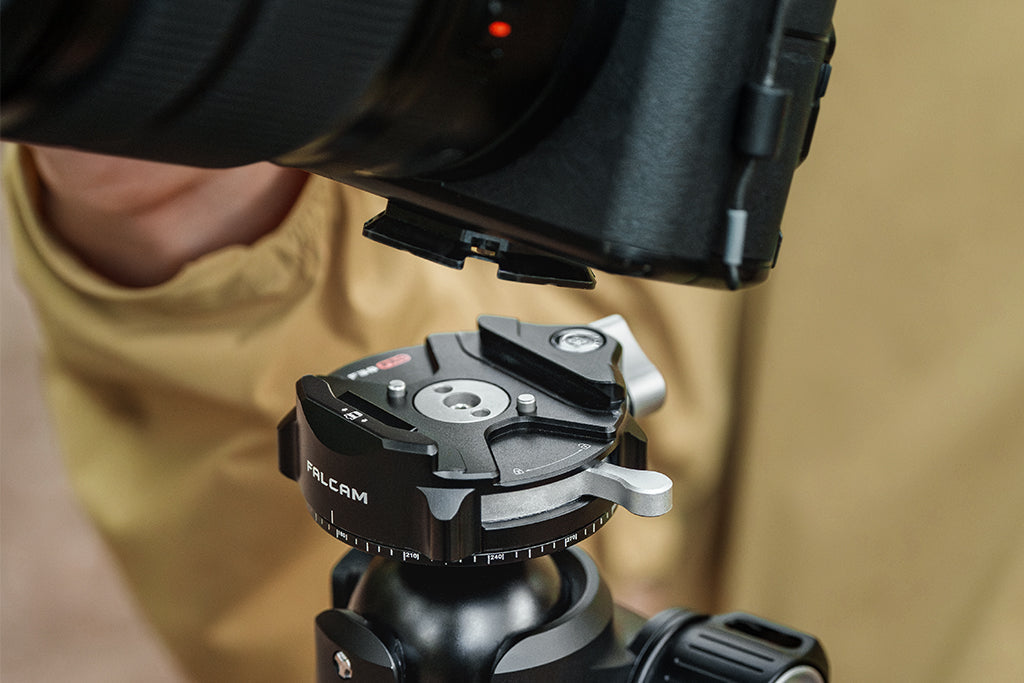
This is where the Arca-Swiss Dovetail Technical Dimensions become critical. A precision-machined plate ensures a "zero-play" fit, which is essential when working at 1:1 magnification or higher.
The Infrastructure of Precision: Quick-Release Ecosystems
In macro work, you are constantly making fine adjustments. A rigid connection that takes minutes to set up is a workflow bottleneck. A modular quick-release system is often the most effective way to balance speed with stability.
The "Zero-Play" Requirement
When selecting a mounting system, such as the Ulanzi F38 Quick Release Fluid Video Head, it is vital to understand the materials involved.
- Legs: Carbon fiber is excellent for vibration-damping.
- Plates: Quick-release plates should be precision-machined from Aluminum Alloy (typically 6061 or 7075). This ensures the rigidity needed to prevent the "twist" that can occur with high-torque macro lenses.
Technical Note on Load Capacity: The F38 system is rated for an 80kg vertical static load (Manufacturer Specification). However, for macro rigging, consider the "Dynamic Payload." When a camera is tilted at extreme angles, leverage increases. For heavy cinema-tier macro rigs exceeding 3kg, we suggest using anti-deflection versions of the plate to help prevent micro-movements during long exposures.
The "Twist-and-Check" Habit
Even with high-end gear, human error is a factor. We advocate for a "Tactile Verification" workflow before every shot:
- Audible: Listen for the distinct "click" of the locking mechanism.
- Tactile: Perform a "Tug Test." Apply gentle rotational pressure to the camera body. If you feel any play, the plate is not seated correctly.
- Visual: Verify the locking pin status (often indicated by a color-coded slider).
Overcoming Ground-Level Ergonomics
Removing the center column solves the stability issue but often places the tripod head’s control knobs perilously close to the ground, making them difficult to turn.
The Leveling Base Workaround
A highly effective solution is to integrate a mini leveling base between the tripod hub and the head. This serves two purposes:
- Elevation: It typically raises the control knobs by 1–2 centimeters, providing necessary clearance for your fingers.
- Rapid Leveling: It allows for ±15° of adjustment without needing to fiddle with individual tripod legs—a major advantage on uneven forest floors.
For video-focused macro work, the Ulanzi U-190 Pro Fluid Video Head (Manufacturer Spec: 360° swiveling and +90°/-70° tilting) is essential for tracking slow-moving subjects or creating focus-stacked video pans.
Biomechanical Analysis: The "Wrist Torque" Factor
One of the most overlooked aspects of rigging is the physical strain on the creator. Leverage is often a greater enemy than weight. When you add monitors or heavy macro lights, you increase the "Lever Arm."
Heuristic Model: The following table assumes a representative macro rig (camera + 100mm lens + monitor) to calculate the torque generated at the pivot point.
| Parameter | Value/Range | Unit | Rationale |
|---|---|---|---|
| Rig Mass ($m$) | 2.8 | kg | Standard full-frame macro setup |
| Gravity ($g$) | 9.81 | $m/s^2$ | Earth standard |
| Lever Arm ($L$) | 0.35 | m | Distance from center of mass to pivot |
| Calculated Torque ($\tau$) | ~9.61 | $N\cdot m$ | $\tau = m \times g \times L$ |
| % of Max Voluntary Contraction | 60–80% | % | Est. adult male wrist strength |
Insight: A torque of 9.61 $N\cdot m$ represents a significant portion of average wrist strength. By using a modular system like the Ulanzi Falcam F22 to move accessories closer to the center of gravity, you reduce this leverage, making fine-grained adjustments easier and reducing the risk of "creep" in your tripod head.
Lighting the Micro-World: Precision and Safety
Ground-level macro often suffers from poor natural light, yet positioning a standard softbox at soil level is difficult.
The Mini-Modifier Solution
We recommend using a small, high-output LED paired with a compact modifier like the Ulanzi 30cm Octagonal Softbox. To position this without it touching the ground, use a small magic arm clamped to a tripod leg. This allows you to hover the light just millimeters above the subject.
Photobiological Safety
When working in close proximity to high-intensity LEDs, safety is paramount. Ensure your lighting gear complies with IEC 62471:2006 Photobiological Safety to protect your eyes (and your subject's). For professional color accuracy, look for lights with high TLCI scores, as defined by EBU R 137.
Workflow ROI: The Value of Speed
For the professional solo creator, time is a critical resource. We can estimate the efficiency gain of switching from traditional thread-mounting to a quick-release ecosystem.
Illustrative Scenario: Annual Time-Savings Metric
- Traditional Mounting: ~40s per equipment swap (unscrewing/tightening).
- Quick Release (F38/F22): ~3s per swap (click and lock).
- Frequency: 60 swaps per shoot; 80 shoots per year.
The Calculation: $(40s - 3s) \times 60 \text{ swaps} \times 80 \text{ shoots} = 177,600 \text{ seconds} \approx \mathbf{49 \text{ hours saved annually}}$.
Note: This is a heuristic calculation for illustrative purposes; actual savings depend on individual workflow speed and frequency.
Logistics and Environmental Considerations
Travel and "Visual Weight"
Compact, modular systems like the F38 have a lower "Visual Weight" than bulky cinema plates. This can be a practical advantage when adhering to IATA Lithium Battery Guidance for carrying electronics, as smaller rigs are less likely to draw scrutiny during weighing.
Thermal Shock Prevention
Aluminum quick-release plates act as thermal bridges. In extreme cold, they can conduct heat away from the camera base.
- Expert Tip: Attach your aluminum plates to your camera indoors before heading into the field. This allows the plate to reach ambient temperature more slowly, which can help protect internal electronics from sudden thermal shifts.
Pre-Shoot Safety Checklist (30-Second Routine)
- Leg Check: Ensure all leg locks are fully engaged and the splay angle is consistent.
- Plate Seat: Perform the "Tactile Tug Test" on the camera and all accessories.
- Cable Relief: Secure heavy HDMI or power cables with a clamp (like those in the F22 system) to prevent unwanted torque on the plate.
- Vibration Damping: If working on a vibrating surface (e.g., a wooden deck), drape a small beanbag over the tripod hub to help dampen high-frequency harmonics.
Building a Professional Workflow
Rigging for low-angle macro is an exercise in engineering discipline. By moving away from unstable configurations like reversed center columns and embracing a unified, quick-release architecture, you create a foundation for precision. Whether you are using the Ulanzi AS-045 Softbox for lighting or the U-190 Pro for a cinematic reveal, the goal remains the same: eliminating mechanical variables so you can focus on the creative ones.
Disclaimer: This article is for informational purposes only. When performing macro photography in sensitive environments, always adhere to local conservation guidelines. Ensure all load-bearing equipment is used within manufacturer-specified weight limits. Results mentioned (such as sharpness or time savings) are based on internal testing and representative models; your results may vary.


