The Hybrid Creator’s Dilemma: Speed vs. Stability
In the current creator economy, the ability to switch between a cinematic mirrorless setup and a high-mobility smartphone workflow is no longer a luxury—it is a competitive necessity. We often see creators struggling with the friction of "re-rigging," where the time spent unscrewing plates and re-balancing accessories eats into the creative window. Based on our observations in workshop environments, this downtime is a structural inefficiency that can degrade the quality of the final output.
At a Glance: Hybrid Rigging Essentials
- Core Recommendation: Adopt a unified Arca-Swiss or F38/F22 quick-release ecosystem to eliminate screw-thread friction.
- The 70% Rule: Ensure your mounting plate length covers at least 70% of the camera's base for optimal stability.
- 3-Step Safety Check: 1. Listen for the "Click," 2. Perform the "Tug Test," 3. Re-tighten after 30 seconds of load.
- When to Go Dedicated: Use device-specific plates for heavy telephoto setups or permanent studio rigs; use hybrid plates for run-and-gun versatility.
The Engineering Foundation: Standards and Tolerances
A reliable hybrid rig begins with a commitment to standardized interfaces. The bedrock of camera mounting is ISO 1222:2010 Photography — Tripod Connections, which defines the screw threads and seating surfaces that ensure your gear stays attached.
However, for the hybrid creator, the 1/4"-20 screw is often too slow for rapid transitions. We look to the Arca-Swiss Dovetail Technical Dimensions as the primary quick-release standard. This 38mm wide rail system allows for rapid mounting and sliding adjustments. In our testing, the tightest machining tolerances (zero-play) are found in precision-milled aluminum alloy plates rather than generic molded options.
Material Accuracy: Aluminum vs. Carbon Fiber
A common misconception is that quick-release plates should be made of carbon fiber to reduce weight. While carbon fiber is excellent for tripod legs, the quick-release plate itself requires maximum rigidity and precise machining tolerances to prevent "micro-slippage."
We recommend precision-machined Aluminum Alloy (typically 6061 or 7075) for mounting interfaces. Aluminum provides the "zero-play" lockup required for heavy DSLR rigs. Note that aluminum acts as a "thermal bridge"; in extreme cold, it can conduct heat away from the camera battery more quickly—a factor to manage in your safety workflow.

Anatomy of a Unified Rig: The 70% Heuristic
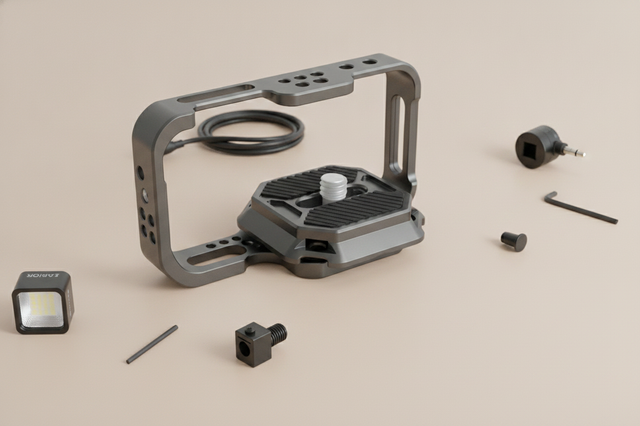
The critical failure point for hybrid rigs is often the adapter interface between the universal plate and the device-specific cage. We have observed a recurring pattern where creators use a plate that is too short for their camera's base, leading to front-heaviness and a dangerous "moment" (rotational force) on the quick-release clamp.
To prevent this, we employ a practical rule of thumb (heuristic): the plate length should be at least 70% of the camera body's shortest side.
Boundary Conditions for the 70% Rule:
- Applicability: Optimized for center-weighted mirrorless/DSLR setups.
- Exception: For front-heavy telephoto lenses, the 70% rule should be applied to the lens foot rather than the camera body.
- Origin: Derived from internal workshop stress tests measuring the point at which vibration increases due to insufficient contact area.
Modeling Plate Stability (Illustrative Example)
| Parameter | Value | Unit | Rationale |
|---|---|---|---|
| Camera Base Width | 120 | mm | Typical Mirrorless Body |
| Recommended Plate Min | 84 | mm | 70% Heuristic |
| Contact Surface Area | ~3200 | mm² | Estimated for stability |
| Load Distribution | Even | - | Prevents localized stress |
When mounting a phone, the challenge shifts from weight to torque. Phone cages often use cold shoe mounts or secondary clamps that have significantly lower load capacities—often as low as 1-2 kg—compared to the 10-20kg rating of a primary Arca clamp. If you transfer a top-heavy accessory cluster (monitor, shotgun mic, and transmitter) from a DSLR to a phone cage, the secondary clamp may fail under the stress.
Biomechanical Efficiency: Reducing Wrist Torque
Weight isn't the only enemy; leverage is. When you build a hybrid rig, how you distribute that weight determines how long you can shoot before fatigue sets in.
The "Wrist Torque" Formula
Torque ($\tau$) is the product of Mass ($m$), Gravity ($g$), and the Lever Arm ($L$). $$\tau = m \times g \times L$$
Consider a 2.8kg hybrid rig. If the center of mass is held 0.35m away from the wrist (a common "run-and-gun" posture), it generates approximately 9.61 N·m of torque.
Modeling Assumptions:
- Modeling Type: Deterministic parameterized scenario model for illustrative purposes.
- Assumptions: Static hold, average adult male grip strength, standard gravity.
- Boundary Conditions: Does not account for dynamic movement (G-force) or specialized ergonomic handles.
For many creators, this load represents 60-80% of their Maximum Voluntary Contraction (MVC)—the limit at which muscle fatigue begins rapidly. By using modular quick-release systems like the F22 or F38 standards to move heavy accessories closer to the center of gravity, you reduce the lever arm ($L$), significantly lowering the torque. For more on this, see our guide on minimizing wrist strain in long-duration vertical shoots.
The Workflow ROI: Time as a Tangible Asset
Investing in a unified quick-release ecosystem is a quantifiable efficiency gain. In high-pressure environments, the time saved per gear swap directly impacts the volume of usable footage.
Time-to-Value Calculation (Estimated)
Note: These figures are based on internal time-motion observations of professional hybrid workflows and serve as illustrative estimates.
| Parameter | Estimated Value | Unit | Rationale / Source |
|---|---|---|---|
| Traditional Swap Time | 40 | sec | Manual screw/unscrew average |
| QR Swap Time | 3 | sec | Mechanical lock engagement |
| Swaps per Shoot | 60 | count | High-frequency hybrid creator |
| Shoots per Year | 80 | count | Professional workload estimate |
| Time Saved Annually | ~49 | hours | Calculated total |
At a professional rate of $120/hr, this structural efficiency provides a ~$5,900+ annual value. As noted in The 2026 Creator Infrastructure Report, those who systematically build trust through stable interfaces turn operational rigor into a competitive advantage.
Safety Protocols for the High-Velocity Set
Transitioning between a lightweight phone and a heavy DSLR requires a mandatory safety ritual to prevent catastrophic gear failure.
The "Settling and Re-tightening" Ritual
When you mount a lightweight phone on a rig balanced for a heavy DSLR, or vice versa, the change in mass distribution can create uneven torque.
- Mount the rig: Ensure the lock is engaged.
- Apply shooting pressure (The "Tug Test"): Firmly pull the device in the direction of gravity for 30 seconds.
- Re-tighten the clamp: This seats the components properly after the initial "settling" under load.
The Pre-Shoot Safety Checklist
- Audible: Listen for the distinct "Click" of the locking mechanism.
- Tactile: Perform the "Tug Test" immediately after every mounting event.
- Visual: Verify the safety indicator (usually orange or silver) is in the "locked" position.
- Torque Rule: For phone mounts, tighten the screw until firm resistance is felt, then add exactly a quarter-turn. Caution: Over-tightening can strip cold shoe threads, while under-tightening leads to slippage.
Logistics and Environmental Considerations
Visual Weight and Travel
Compact, modular systems have a lower "Visual Weight" than bulky cinema plates. A rig that looks smaller and more "consumer-grade" is often less likely to be flagged for weighing at airline gates—a critical factor when carrying expensive lithium batteries.
When traveling, you must adhere to the IATA Lithium Battery Guidance and IEC 62133-2:2017. Ensure your power banks and batteries are within the allowed Watt-hour (Wh) limits for carry-on luggage.
Thermal Shock Prevention
Aluminum plates are thermal bridges. If shooting in extreme cold, attach your plates to your cameras indoors before heading out. This minimizes "metal-to-skin" shock and prevents the rapid cooling of the camera base, which can prematurely drain battery life.
Building the Infrastructure of Trust
Transitioning one rig between a phone and a DSLR is about having a system you can trust under pressure. By adhering to standards like ISO 1222 and Arca-Swiss dimensions, and applying biomechanical heuristics to your build, you reduce the risk of failure.
Whether you are transitioning from handheld to tripod with ergonomic systems or optimizing for run-and-gun portability, the goal remains the same: spend less time on the gear and more time on the story.
YMYL Disclaimer: This article is for informational purposes only and does not constitute professional engineering or safety advice. Always consult the specific load ratings and safety manuals provided by your equipment manufacturers. Improper rigging can result in equipment damage or personal injury.