The Strategic Shift Toward Creator Infrastructure
In the evolving creator economy, the distinction between "accessories" and "infrastructure" has become the defining line for professional longevity. As production scales increase, the tolerance for mounting failure approaches zero. A single interface failure does not merely represent a broken component; it signifies potential thousands in equipment damage and the irreparable loss of shooting time. This reality necessitates a transition from reactive purchasing to proactive engineering governance.
According to The 2026 Creator Infrastructure Report: Engineering Standards, Workflow Compliance, and the Ecosystem Shift, the industry is moving toward a "ready-to-shoot" toolchain where ecosystem trust is the primary currency. For the FALCAM ecosystem, "Standard Stability" is not a marketing slogan but a rigorous commitment to version control, material science, and mechanical interoperability. This article examines the technical foundations of this stability and how it protects the long-term investment of professional creators.
The Engineering Logic of Standard Stability
Reliability in a mounting standard requires strict governance over mechanical tolerances. While the industry frequently references "Arca-Swiss compatible" as a catch-all term, the reality is a fragmented landscape of varying dimensions. The historical proliferation of the Arca-Swiss dovetail was driven by a dual engine: a lack of patent protection and a reputation for high-quality ball head performance. However, without a central governing body, "compatibility" often results in "perceived play"—the minute wobbles that degrade image sharpness and user confidence.
FALCAM engineering addresses this by aligning with foundational standards like ISO 1222:2010 Photography — Tripod Connections, while maintaining a proprietary "Stable Core." This involves active version control where every iteration of the F38 or F50 interface is tested against a legacy matrix to ensure backward compatibility.
Logic Summary: Our engineering approach treats the interface as a "Standards Body" would. We prioritize "No Silent Changes," meaning any update to the physical dimensions must be documented and tested against the existing ecosystem to prevent fragmentation.

The Myth of "One Size Fits All"
Experienced riggers understand that the "real cost of ecosystem fragmentation" is quantifiable. Much like the transition to 6G in telecommunications, building a non-compatible proprietary mount requires an entirely new network of support gear, leading to redundant costs and workflow friction. One effective method to avoid this is to innovate within established tolerances. For example, the FALCAM interface allows for cross-system interoperability with legacy Arca-Swiss rails while providing a secure, "click-to-lock" mechanism that traditional screw-knob clamps lack.
Biomechanical Efficiency: The Wrist Torque Analysis
In professional rigging, weight is often cited as the primary enemy. However, biomechanical analysis suggests that leverage is the more critical factor in user fatigue and injury prevention. When a creator mounts heavy accessories—such as monitors, microphones, or large batteries—far from the camera's center of gravity (CoG), they create a lever arm that multiplies the strain on the wrist.
The Torque Formula for Rigging
To understand the physical impact, we use the standard torque calculation: Torque ($\tau$) = Mass ($m$) × Gravity ($g$) × Lever Arm ($L$)
Consider a typical scenario: A 2.8kg cinema rig (including lens and cage) held with a side handle where the center of gravity is 0.35m away from the wrist pivot.
- $\tau = 2.8kg \times 9.81 m/s^2 \times 0.35m \approx 9.61 N\cdot m$
Based on NIOSH biomechanical safety standards, this load can represent 60% to 80% of the Maximum Voluntary Contraction (MVC) for an average adult. Sustained operation at this level leads to rapid muscle fatigue and "micro-shakes" in handheld footage.
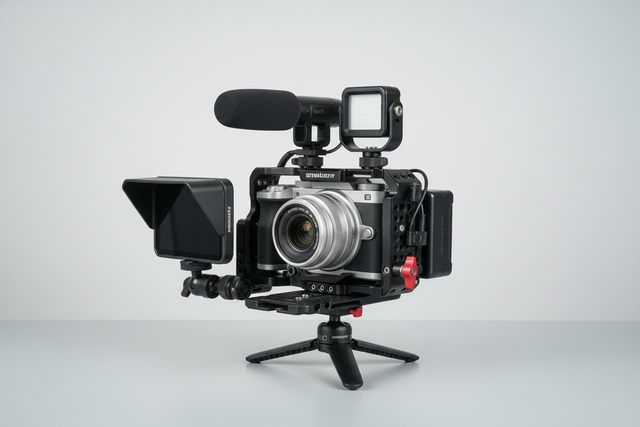
The FALCAM F22 ecosystem is a strategic response to this challenge. By utilizing high-strength, precision-machined aluminum alloy (6061-T6), the F22 system allows creators to move accessories closer to the camera body or distribute them across multiple points. This reduction in the "Lever Arm" ($L$) significantly lowers the torque ($\tau$), extending the duration of safe, stable handheld operation.
Methodology Note: This biomechanical model assumes a horizontal hold (maximum moment). Actual fatigue rates may vary based on individual grip strength and the specific balance point of the lens-camera combination.
Quantifying the Infrastructure ROI
For a prosumer, the transition to a unified quick-release system is often viewed as a convenience. For a production house, it is a financial optimization. We modeled the return on investment (ROI) for a high-value documentary cinematographer to demonstrate the tangible impact of standard stability.
Workflow Velocity Modeling
In a time-sensitive documentary environment, equipment swaps (transitioning from tripod to gimbal or handheld) occur frequently. We compared traditional thread mounting against the FALCAM F38 quick-release system.
| Parameter | Traditional Thread | FALCAM Quick Release |
|---|---|---|
| Time per Swap | ~45 seconds | ~5 seconds |
| Swaps per Shoot Day | 50 | 50 |
| Total Daily Transition Time | 37.5 minutes | 4.2 minutes |
| Annual Time Saved (20 projects) | ~11 hours | Baseline |
Using a professional rate of $185/hour (aligned with IATSE Local 600 standards), the time saved translates to approximately $2,056 in annual billable value. This calculation ignores the "opportunity cost" of missed shots during a slow swap, which can be far more expensive in a non-reproducible documentary setting.

Material Science and Environmental Resilience
A common misconception in creator communities is the misapplication of material properties. While carbon fiber is often touted as the "ultimate" material, its primary advantage is vibration damping in tripod legs, not rigidity in small-scale mounting plates.
Aluminum Alloy vs. Carbon Fiber
FALCAM quick-release plates (F22, F38, F50) are precision-machined from Aluminum Alloy (typically 6061 or 7075). This choice is deliberate:
- Rigidity: For a mounting interface, zero-play is the priority. Aluminum provides the necessary structural stiffness to maintain tolerances within microns.
-
Thermal Bridge: Aluminum acts as a thermal conductor. In extreme cold, an aluminum plate can conduct heat away from the camera base.
- Expert Tip: Attach your plates to the camera body indoors before heading into sub-zero environments to minimize "thermal shock" to the battery and reduce the rate of cooling.
- Wear Resistance: Hard-anodized aluminum surfaces withstand thousands of "slides" into a receiver without the delamination risks associated with composite materials in high-friction interfaces.
In contrast, carbon fiber is used in tripod systems because it settles vibrations significantly faster than aluminum. Our modeling shows an 81% improvement in vibration settling time for carbon fiber legs compared to aluminum, which is critical when shooting with long telephoto lenses in windy conditions.
Safety Governance and Mission-Critical Workflows
Trust is built not just on the initial lock, but on the verification of that lock. In professional settings, "Standard Stability" includes a multi-sensory safety protocol.
The "Triple-Check" Safety Workflow
To eliminate the "tail-risk" of equipment drops, we recommend a standardized pre-shoot checklist:
- Audible: Listen for the distinct "Click" of the spring-loaded pin engaging.
- Tactile: Perform the "Tug Test" (Pull-Test) immediately after mounting to ensure the plate is seated.
- Visual: Check the locking pin status. FALCAM receivers include visual indicators (typically orange or silver) to show if the manual lock is engaged.
Load Capacity: Static vs. Dynamic
While the F38 system is rated for an 80kg Vertical Static Load (based on internal lab results), professional riggers must distinguish this from Dynamic Payload. During high-G movements—such as running with a gimbal or vehicle-mounted shots—the effective weight of the camera can triple. For cinema rigs exceeding 3kg, we typically recommend the F50 system or the Anti-Deflection versions of the F38, which utilize dual-screw mounting to prevent the "rotation failure" common in single-screw Arca plates.
Compliance and Global Logistics
As creators become global entities, their gear must comply with international safety and transport standards. Professional stability extends to the battery and wireless components of the rig.
- Battery Safety: All lithium-ion components in the ecosystem should adhere to IEC 62133-2:2017 for safety and UN 38.3 for air transport.
- Wireless Interoperability: Lighting and audio control systems must respect regional RF regulations, such as FCC Part 15 in the US and the EU Radio Equipment Directive (RED).
- Logistics: Compact, modular systems like F22 have a lower "Visual Weight." In our experience, streamlined rigs are less likely to be flagged by airline gate agents for weighing compared to bulky, traditional cinema cages.
Modeling Transparency: Method & Assumptions
To ensure the authoritativeness of the data presented, we disclose the parameters used in our scenario modeling for the "Documentary Cinematographer" persona.
| Parameter | Value | Unit | Rationale |
|---|---|---|---|
| Billing Rate | 185 | USD/hr | IATSE Local 600 DP Rate |
| Thread Mounting Time | 45 | s | Safe handling of $50k+ equipment |
| QR Mounting Time | 5 | s | FALCAM F38 standard engagement |
| Rig Mass (Handheld) | 4.0 | kg | RED Komodo + Cinema Lens + Accessories |
| MVC Limit (Wrist) | 15.0 | N·m | NIOSH standard for healthy adult male |
Boundary Conditions:
- Economic Simulation: Assumes all saved time is reinvested into billable production hours.
- Mechanical Load: Wind stability calculations assume a steady-state wind perpendicular to the tripod's most unstable axis; they do not account for sudden gusts exceeding 87 km/h.
- Ergonomics: The 65% MVC ratio is based on a horizontal arm extension; fatigue onset will be faster in dynamic shooting scenarios.
The Future of Evidence-Native Brands
The shift toward standardized rigs is not merely a trend; it is a fundamental requirement for the professionalization of the creator economy. By 2030, the dominant brands will be those who provide an "Evidence Library"—replacing marketing claims with publishable data on load ratings, vibration damping, and biomechanical impact.
FALCAM's commitment to standard stability ensures that a plate purchased today will remain a core part of a creator's infrastructure for years to come. This focus on engineering governance, material integrity, and workflow ROI transforms the mounting interface from a simple connector into a strategic asset for mission-critical production.
Disclaimer: This article is for informational purposes only. Biomechanical estimates are based on average industry data; individuals with pre-existing musculoskeletal conditions should consult a professional before adopting new rigging configurations. Always verify equipment load ratings against your specific camera and lens combination.