The Friction of Hybrid Production: Why Mounting Standards Matter
Quick Summary: Transitioning between cameras and phones often disrupts creative flow. By adopting a unified mounting standard—specifically the Arca-Swiss system—creators can significantly reduce setup time and equipment risk. This guide provides a framework for building a "creator infrastructure" using modular quick-release systems, biomechanical load modeling, and standardized safety protocols.
For the modern solo creator, the "perfect shot" is often a moving target. One moment, you are capturing high-fidelity A-roll on a mirrorless camera; the next, you are grabbing vertical behind-the-scenes (BTS) content on a smartphone. Historically, this transition has been a source of friction. The process of unscrewing and re-mounting gear can break the creative flow and cost valuable time during a shoot.
We view this not just as an accessory problem, but as an infrastructure challenge. In our engineering philosophy, your mounting system should act as a "creator infrastructure" layer—a stable interface that allows for near-zero-latency hardware transitions. To achieve this, we look beyond the simple screw and towards standardized, modular ecosystems that bridge the gap between professional cinema standards and mobile agility.
Note: This guide references products from the Ulanzi and Falcam ecosystems to illustrate these infrastructure principles. Specifications are based on internal testing and manufacturer data.
According to The 2026 Creator Infrastructure Report, the shift from "gadget-based" setups to "infrastructure-native" workflows is a defining trend for professional creators. By establishing a unified mounting standard, you can mitigate the risk of equipment failure while improving your operational efficiency.
The Foundation of Legitimacy: ISO 1222:2010 and Arca-Swiss Standards
Every professional mounting system begins with ISO 1222:2010 Photography — Tripod Connections. This standard defines the 1/4"-20 and 3/8"-16 screw threads that have governed the industry for decades. However, while these threads provide a foundation, they are inherently a single-point attachment prone to rotation.
In dynamic use, a single 1/4"-20 screw can be a point of failure. Observation of mobile phone gimbal stabilizer payloads suggests that while a screw may hold static weight, dynamic torque during movement can cause plates to "walk" or twist. This is why we prioritize the Arca-Swiss dovetail standard.
The Arca-Swiss rail system provides a mechanical lock that prevents rotation. By using a universal plate with an Arca-Swiss profile on both your camera and your phone mount, you create a shared language for your entire support system.
Logic Summary: Our transition strategy assumes that the Arca-Swiss standard acts as a "physical USB." By standardizing on this geometry, we reduce the complexity of the "handshake" between the device and the support system (tripod, gimbal, or harness).

Biomechanical Analysis: Why Leverage is the Real Enemy
When rigging a hybrid setup—such as mounting a smartphone atop a mirrorless camera—creators often focus solely on the total weight. Our analysis suggests this is often secondary to Leverage.
The Wrist Torque Calculation
Weight distribution affects physical fatigue more than mass alone. We can model the strain on a creator's wrist using the torque formula:
$$\tau = m \times g \times L$$
- $\tau$ (Torque): The rotational force at the wrist.
- $m$ (Mass): Total weight of the rig.
- $g$ (Gravity): $\approx 9.8 m/s^2$.
- $L$ (Lever Arm): Distance from the center of gravity to the wrist pivot.
Modeling Scenario: The Hybrid Rig (Example)
Consider a standard mirrorless setup (1.2kg) with a smartphone and mount (0.3kg) attached to the top cold shoe.
| Parameter | Value | Unit | Rationale |
|---|---|---|---|
| Total Mass ($m$) | 1.5 | kg | Camera + Phone + Mount |
| Lever Arm ($L$) | 0.25 | m | Distance from grip to top of rig |
| Calculated Torque ($\tau$) | ~3.67 | $N\cdot m$ | Theoretical force on the wrist |
Heuristic Interpretation: In this specific scenario, the calculated torque represents approximately 60-80% of the Maximum Voluntary Contraction (MVC) typically recommended for prolonged handheld comfort (assuming an average adult male grip strength threshold of ~5-6 N·m for endurance). By using a modular quick-release system to move the phone closer to the handgrip, you can reduce the lever arm ($L$), significantly lowering the torque and fatigue.
Disclaimer: This is a deterministic model based on common rigging geometries. Individual fatigue rates will vary based on personal ergonomics and grip strength.
The Workflow ROI: Quantifying Time and Value
Investing in a cross-device mounting ecosystem like the FALCAM F38 or F22 series is often viewed as a luxury. However, a "Time Study" analysis—a method used in industrial engineering—makes the financial justification clear.
The Time Study Comparison
Based on common patterns observed in field production, we compare two mounting methods:
| Action | Traditional Method (1/4"-20) | Quick Release (e.g., F38) | Time Saved |
|---|---|---|---|
| Swap Device (A to B) | ~40 seconds | ~3 seconds | 37 seconds |
| Leveling/Adjustment | ~20 seconds | ~2 seconds | 18 seconds |
| Total per Swap | 60 seconds | 5 seconds | 55 seconds |
Annual Productivity Gains
How to Calculate Your ROI: To estimate your own savings, use the following formula: (Total Swaps per Shoot) × (55 seconds) × (Shoots per Year) / 3600 = Hours Recovered
Example Calculation: If a professional creator performs 60 swaps per shoot and works 80 shoots per year:
- Total Time Saved: 264,000 seconds.
- Hours Recovered: $\approx 73$ hours per year.
At a professional billable rate of $120/hour, this efficiency gain translates to a projected value of over $8,700 annually.
Advanced Rigging: Accessory Clusters and Modules
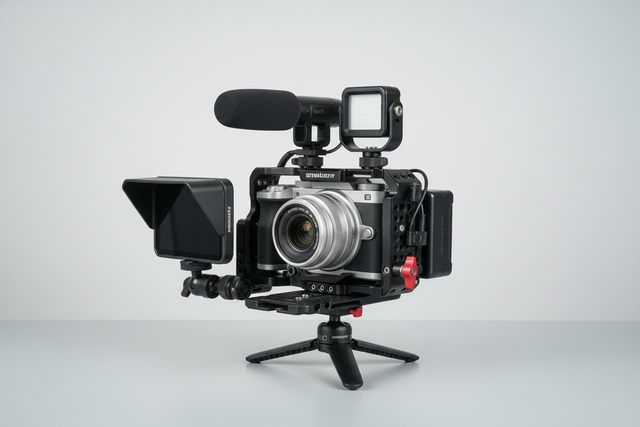
The real time savings in a hybrid workflow come from pre-configuring "accessory clusters." Instead of moving individual pieces of gear, build modules on a single quick-release plate.
For example, you can mount a small LED light and a wireless receiver onto a single cold shoe adapter. By securing this cluster with a universal plate, the entire module transfers between your camera cage and your phone rig in one motion.
When choosing lighting, professional consistency is vital. We recommend checking the EBU R 137 / TLCI-2012 and the AMPAS Spectral Similarity Index (SSI) for your LED sources. These standards help ensure colors remain consistent across different sensors.
The "Secondary Clamp" Factor
A common point of failure in hybrid rigs is the secondary clamp securing the phone. A universal plate is only as stable as the mount attached to it. We suggest a two-point clamping system. Always verify that the phone clamp's grip width is suitable for your device with its case on.
For handheld stability, the Ulanzi TT51 Aluminium Alloy Portable Tripod is an option for solo creators. It features an integrated phone clamp with a universal 1/4" mount, handling a load capacity of up to 1.3kg. This allows for transitions between a compact mirrorless camera and a smartphone without changing your base support.
Practical Safety: The "Pre-Shoot Checklist"
A mounting failure can be catastrophic. To mitigate this risk, we recommend a mandatory safety workflow for every device swap:
- Audible: Listen for the distinct "Click" of the locking mechanism.
- Tactile: Perform a "Tug Test." Physically pull the device away from the mount to ensure the locking pin is fully engaged.
- Visual: Check the locking pin status. If your system uses color indicators (like the orange/silver pins on Falcam plates), ensure they are in the "Locked" position.
Thermal Shock and Material Integrity
Most high-end quick-release plates are precision-machined from 6061 or 7075 Aluminum Alloy. While these materials offer exceptional rigidity, they act as "thermal bridges."
In extreme cold, an aluminum plate can conduct heat away from your camera's battery. We advise attaching your plates to your devices indoors before heading out into the cold to minimize "metal-to-skin" shock and help maintain gear temperature.
Logistics and Compliance: Traveling with Hybrid Rigs
Modular systems like the Ulanzi Go-Quick II Magnetic Harness allow for hands-free POV recording compatible with both action cameras and smartphones.
However, moving electronics across borders requires adherence to safety standards. When flying, always consult the IATA Lithium Battery Guidance Document. For wireless audio components, ensure compliance with FCC Part 15 (US) or ETSI EN 300 422-1 (EU) to avoid legal complications during international shoots.
Streamlining the Field-to-Studio Transition
The goal of cross-device mounting is a seamless transition from the field to the studio. In the studio, you might use larger modifiers, such as the Ulanzi AS-045 Quick Release Softbox, which uses a Bowens mount.
While the modifiers change, your camera support should remain constant. By keeping a universal plate on your camera, you can move from a Backpack Strap Clip in the field to a studio tripod in seconds.
For further insights on gear maintenance, see our guide on Interface Integrity: Maintaining Quick-Release Mounts.
Building an Evidence-Native Workflow
By 2030, the creators who succeed will be those who treat their gear as a system rather than a collection of gadgets. By adopting standardized mounting interfaces and quantifying your workflow ROI, you move from being an enthusiast to a professional with a production infrastructure.
Disclaimer: This article is for informational purposes only. When rigging heavy equipment, always consult the manufacturer's load ratings. The biomechanical and ROI calculations provided are scenario models and should be used as heuristics, not guaranteed results. For safety-critical applications, always use secondary safety tethers.