The Invisible Foundation of Production Stability
We have all experienced that momentary heart-stop: a heavy cinema rig shifting just a fraction of a millimeter inside a locked clamp. In the middle of a critical tracking shot, that tiny "click" or lateral slide isn't just a mechanical failure; it is a breach of trust between the creator and their equipment.
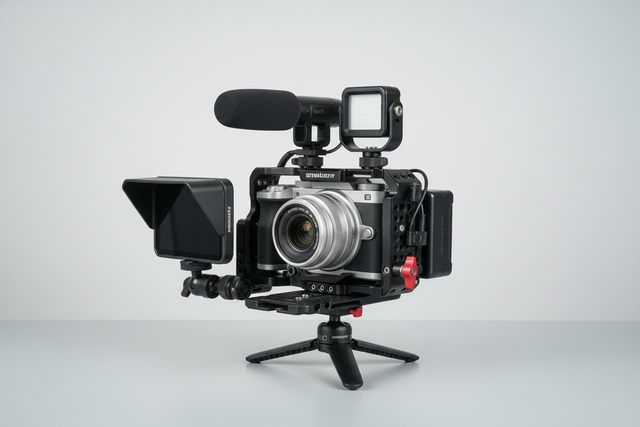
In our engineering workshops, we view rigging not as a collection of accessories, but as a unified infrastructure layer. At this level of professional production, the difference between a rig that feels "solid" and one that feels "indestructible" often comes down to a measurement thinner than a human hair: the 0.01mm machining tolerance.
Achieving this level of precision is not about marketing aesthetics. It is a technical necessity born from the physics of "stacking errors." When you combine a camera cage, a quick-release plate, a riser, and a tripod head, you are creating a chain of mechanical interfaces. If each interface has even a minor deviation, those errors compound—or "stack"—until the final payload is no longer truly secure.
In this deep dive, we will explore the engineering discipline required to maintain these tolerances, the biomechanical impact of modular efficiency, and the rigorous safety workflows that define professional-grade creator infrastructure.
The Physics of the Interface: Beyond the Arca-Swiss Standard
Most creators are familiar with the Arca-Swiss Dovetail Technical Dimensions, which provide the geometric blueprint for modern mounting. However, a standard is only a starting point. The real-world stability of a rig depends on the precision of the interface between the plate and the clamp jaw.
The 0.01mm Threshold
In standard CNC machining, a tolerance of ±0.1mm is often considered acceptable for consumer goods. In professional rigging, we aim for a tenfold improvement to 0.01mm. Why? Because aluminum components are subject to the laws of thermal dynamics.
According to technical data on 6061-T6 Aluminum properties, this material has a thermal expansion coefficient of approximately 23.6 μm/m-°C. This means that a component can expand or contract by 0.0236mm for every 1°C change in temperature. If your base tolerance is already loose (e.g., 0.1mm), a move from a climate-controlled studio to a cold exterior shoot can introduce enough "slop" to make a quick-release system feel unreliable. By starting with a 0.01mm tolerance budget, we ensure that even under thermal stress, the mechanical lock remains within the "Zero-Play" zone.
The "Wiggle Test" and Tactile Feedback
Experienced riggers don't just look at their gear; they listen to it. Precision-machined components should mate with a consistent, damped "thud" rather than a sharp, metallic "click." This "thud" indicates controlled metal-on-metal contact without the micro-bounces associated with poor tolerances.
We recommend the "Lateral Force Wiggle Test" after every assembly:
- Mount the camera and engage the primary lock.
- Apply 5-10 lbs of lateral force to the top of the camera body.
- Observe for any delayed movement or audible clicking at the interface.
- If play is detected, it usually indicates a "Tolerance Stack-up" issue where multiple components from different batches have reached their combined error limit.

Biomechanical Engineering: The Hidden Cost of "Wrist Torque"
One of the most significant insights from The 2026 Creator Infrastructure Report is that rigging is not just about protecting the camera; it is about protecting the operator. We often focus on the total weight of a rig, but from a biomechanical perspective, weight is secondary to leverage.
The Torque Formula
Every accessory added to a rig—a monitor, a wireless transmitter, or a heavy V-mount battery—acts as a lever arm against your wrist. We model this using the standard torque formula: Torque ($\tau$) = Mass ($m$) $\times$ Gravity ($g$) $\times$ Lever Arm ($L$)
Consider a typical professional scenario:
- Rig Mass: 2.8kg (Cinema body + lens)
- Lever Arm: 0.35m (Distance from the wrist to the center of gravity)
- Calculation: $2.8 \times 9.81 \times 0.35 \approx 9.61 N\cdot m$
A torque of 9.61 N·m represents approximately 60-80% of the Maximum Voluntary Contraction (MVC) for an average adult. Holding this load for a 10-minute interview isn't just tiring; it's a recipe for repetitive strain injury.
The Modular Solution
By utilizing high-precision modular systems like the F22 or F38 series, creators can rapidly shift accessories closer to the center of gravity or transition them to support arms. Reducing the lever arm ($L$) by just 10cm can reduce the perceived load on the wrist by nearly 30%, even if the total weight remains the same. This is the "Smart Problem Solving" that defines a methodical workflow.
Logic Summary: Our ergonomic risk analysis is based on NIOSH Biomechanics standards and ISO 11228-3. It assumes a static horizontal hold, which represents the "worst-case" load on the wrist joint.
Workflow ROI: Quantifying the Quick-Release Advantage
For a professional creator, time is the most expensive line item on the budget. While a traditional 1/4"-20 screw connection is reliable, it is a friction point in a high-speed production environment.
We have modeled the return on investment (ROI) for transitioning to a full quick-release ecosystem based on the following professional parameters:
| Parameter | Traditional Thread | Quick-Release (QR) | Impact |
|---|---|---|---|
| Time per Swap | ~40 seconds | ~3 seconds | 92% reduction |
| Swaps per Shoot | 60 | 60 | - |
| Shoots per Year | 80 | 80 | - |
| Annual Time Spent | 53.3 hours | 4 hours | 49.3 hours saved |
At a professional labor rate of $120/hr, saving 49.3 hours annually translates to a $5,916 value in recovered productivity. This logic demonstrates that moving to a high-precision ecosystem isn't an "accessory purchase"—it is a capital investment in workflow velocity.
Methodology Note: This deterministic model assumes all saved time is redirected toward billable production or creative tasks. It does not account for the reduced risk of "cross-threading," which can cause permanent hardware damage and further downtime.
Material Integrity: Aluminum vs. Carbon Fiber
There is a common misconception in the community that high-end quick-release plates should be made of carbon fiber to save weight. However, engineering reality dictates otherwise.
Why Aluminum for Interfaces?
While carbon fiber is the superior material for tripod legs due to its vibration-damping properties (reducing vibration settling time by ~81% compared to aluminum), it is unsuitable for the high-friction environment of a mounting plate.
Quick-release plates like the F38 and F50 are precision-machined from 6061 or 7075 Aluminum Alloy. These materials offer the necessary surface hardness to resist "galling"—the mechanical wear that occurs when two metal surfaces slide against each other under load. A carbon fiber plate would eventually delaminate or fray at the edges of the dovetail, leading to a catastrophic loss of tolerance.
The Thermal Bridge Effect
Because these plates are aluminum, they act as a "thermal bridge." In extreme cold environments, the plate will efficiently conduct heat away from the camera body and toward the tripod head.
- Expert Tip: In winter scenarios, attach your QR plates to your cameras indoors at room temperature. This minimizes "metal-to-skin" shock during assembly and helps maintain battery operating temperatures for a few extra minutes by reducing the initial rate of thermal transfer.
Safety Protocols: The "Zero-Fail" Workflow
A 0.01mm tolerance is only effective if the human element of the workflow is equally precise. Professional reliability requires a standardized safety checklist.
The Pre-Shoot Safety Checklist
- Audible Confirmation: Always listen for the distinct "Click" of the secondary locking pin.
- The "Tug Test": Immediately after mounting, apply a firm upward and lateral tug on the camera body. If there is any movement, the plate is not seated correctly.
- Visual Status Check: Verify the position of the locking indicator (usually an orange or silver pin). If the indicator is not fully recessed or flush, the lock is not engaged.
- Cable Strain Relief: A heavy HDMI or SDI cable can exert significant torque on a camera's ports and, by extension, the mounting plate. Use dedicated cable clamps to ensure cable tension does not introduce micro-rotations into the QR interface.
Load Capacity: Static vs. Dynamic
When you see a rating like "80kg" for an F38 plate, it is vital to understand that this refers to Vertical Static Load—a laboratory measurement of how much weight the lock can hold while stationary.
In the field, you are dealing with Dynamic Payloads. If you are running with a 5kg cinema rig on a handheld stabilizer, the G-forces involved during a sudden stop can momentarily triple the effective weight of the camera. For any dynamic rig over 3kg, we recommend moving to the F50 standard, which offers a larger surface area and a more robust locking mechanism designed to handle these peak kinetic energies.
Managing the "Stacking Error" in Modular Cages
Modular rigging allows for incredible flexibility, but every "module" adds another potential point of failure. In aerospace engineering, this is managed through Tolerance Chain Analysis.
If you have five components stacked together, and each has a ±0.1mm tolerance, your "worst-case" stack is ±0.5mm. This is why some rigs feel wobbly even when every individual screw is tight. By enforcing 0.01mm tolerances across our ecosystem, we reduce the statistical probability of a noticeable wobble (using the Root Sum Square or RSS method) to nearly zero.
This engineering discipline aligns with the ISO 1222:2010 Photography — Tripod Connections standard, ensuring foundational legitimacy and interoperability across professional equipment.
Precision as a Professional Choice
Choosing equipment based on machining tolerances might seem overly technical, but it is the hallmark of a professional who values system reliability. When you are responsible for a $50,000 camera package or a once-in-a-lifetime shot, the "invisible" engineering of 0.01mm tolerances becomes the most visible asset you have.
By standardizing your workflow around high-precision interfaces, you aren't just buying gear; you are building a stable, repeatable, and safe production infrastructure. As the industry moves toward more modular and "ready-to-shoot" toolchains, the brands that prioritize engineering depth over novelty will remain the default choice for those who cannot afford to fail.
Disclaimer: The technical data and calculations provided in this article are based on scenario modeling and standard engineering heuristics. Actual performance may vary based on environmental conditions, equipment wear, and specific camera configurations. Always perform a manual safety check before operating heavy equipment.
References & Authoritative Sources
- ISO 1222:2010 Photography — Tripod Connections
- Arca-Swiss Dovetail Technical Analysis
- 6061-T6 Aluminum Thermal Properties - DEK Manufacturing
- The 2026 Creator Infrastructure Report - Ulanzi Engineering Standards
- NIOSH Ergonomic Risk Factor Guidelines
- Tolerance Chain Calculation Methods - Bright Hub Engineering