Low-Angle Cinematography: Using Wide Leg Spreads Safely
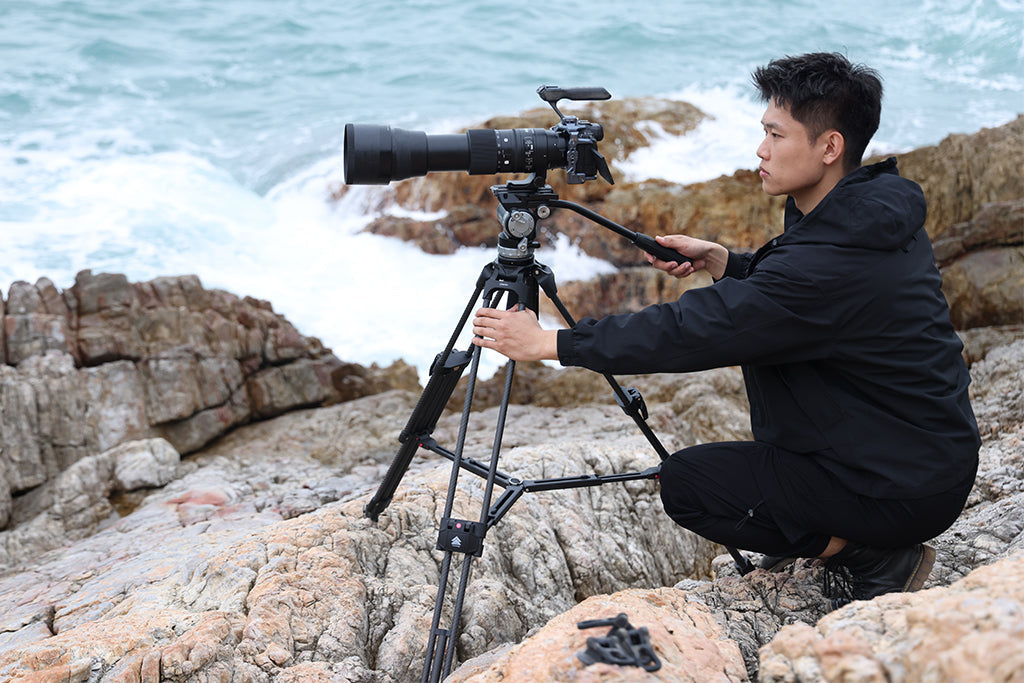
In travel cinematography, the difference between a generic landscape shot and a professional, immersive frame often comes down to perspective. Getting the camera inches from the ground—capturing the texture of volcanic rock or the rhythmic pull of a tide—requires a tripod system capable of ultra-wide leg spreads. However, as many outdoor creators discover the hard way, splaying tripod legs to their maximum limit introduces a set of mechanical risks that can jeopardize both your shot and your equipment.
We have observed through years of field troubleshooting that equipment failure at low angles is rarely the result of a single manufacturing defect. Instead, it is usually a "systemic collapse" caused by exceeding the safe geometry of the support, failing to account for terrain-specific friction, or misunderstanding the load limits of the mounting interfaces. In this guide, we will analyze the technical mechanics of low-angle stability and provide a methodical workflow for securing your rig in demanding environments.
The Geometry of Stability: The 60-Degree Heuristic
Most professional travel tripods offer three or four locking leg angles. While the widest setting often allows the tripod to sit nearly flat, the stability of the system degrades exponentially as the legs move away from the vertical axis.
According to the foundational standards for tripod connections, such as ISO 1222:2010, the interface between the camera and the support must remain rigid under specified loads. However, ISO standards govern the screw threads, not the structural behavior of the legs at extreme angles.
Based on our analysis of structural failure patterns in outdoor environments, we recommend the 60-Degree Spread Heuristic. While manufacturers often advertise 80-degree or 90-degree spreads for "ground-level" shooting, we have found that on soft or loose ground, you should never exceed a 60-degree spread from vertical for critical production shots.
Logic Summary: This heuristic is based on scenario modeling of lateral force resistance. At angles beyond 60 degrees, the downward force of the camera rig is increasingly converted into outward "splay" force. If the friction between the tripod feet and the ground is insufficient, the legs will slide outward, causing the center column or apex to strike the ground.
Modeling Stability at Wide Angles
| Parameter | Value/Range | Unit | Rationale |
|---|---|---|---|
| Maximum Safe Spread | 60 | Degrees | Balance of low height and lateral friction |
| Lateral Force Conversion | ~50% | Percentage | Estimated force directed outward at 60° |
| Safe Operating Time (Wind) | -50% | Percentage | Reduction in stability duration in moderate winds |
| Minimum Foot Trench Depth | 1-2 | cm | Required on rocky/loose terrain to prevent sliding |
| Sequential Load Test Force | 1.5x | Payload | Downward pressure applied before mounting camera |
Note: This is a scenario model based on common industry heuristics for travel-weight carbon fiber tripods, not a controlled lab study.
Material Science: Carbon Fiber vs. Aluminum Interfaces
A common misconception among creators is that a "carbon fiber system" means every component is made of that material. In a high-performance ecosystem like the FALCAM series, the roles of materials are specialized.
Carbon fiber is utilized for the tripod legs because of its exceptional stiffness-to-weight ratio. With a stiffness of approximately 181 GPa (gigapascals) compared to aluminum's 69 GPa, carbon fiber excels at damping the high-frequency vibrations caused by wind or nearby foot traffic. This is critical for low-angle shots where the camera is closer to the ground-level "vibration floor."
However, for load-bearing interfaces like the F38 or F50 quick-release plates, we utilize precision-machined Aluminum Alloy (6061 or 7075). Carbon fiber is unsuitable for quick-release plates because it cannot be machined to the sub-millimeter tolerances required by the Arca-Swiss Dovetail standard. Aluminum provides the "zero-play" rigidity necessary to ensure the camera does not micro-vibrate within the mount.
The Thermal Bridge Factor
One technical "gotcha" for outdoor creators is the Thermal Bridge. Because aluminum is an excellent conductor, an aluminum quick-release plate attached to your camera can act as a heat sink in extreme cold. This can accelerate battery drain by conducting cold directly into the camera body.
Pro Tip: In sub-zero environments, attach your quick-release plates to the camera while still indoors or inside a warm vehicle. This minimizes the "thermal shock" to the camera chassis and helps maintain battery performance during the shoot.
Biomechanical Efficiency: The Wrist Torque Analysis
When building a low-angle rig, creators often focus solely on the total weight. However, the Leverage of that weight is the true enemy of stability and physical longevity.
If you mount heavy accessories (like a 7-inch monitor or a large shotgun mic) far from the camera's center of gravity, you increase the torque on the mounting plate and the tripod head. We can model this using the standard torque formula:
Torque ($\tau$) = Mass ($m$) × Gravity ($g$) × Lever Arm ($L$)
Imagine a rig weighing 2.8kg. If you use a traditional long-arm mount that places a monitor 0.35m away from the central axis, you generate approximately 9.61 N·m of torque. Based on common biomechanical data, this load represents roughly 60-80% of the Maximum Voluntary Contraction (MVC) for an average adult’s wrist when handheld, and it creates significant "creep" on a tripod head splayed at wide angles.
By transitioning these accessories to a modular, low-profile system like the F22 quick-release ecosystem, you can move the accessories closer to the camera body (reducing $L$). This reduces the torque, allowing the tripod to remain stable even at wider leg spreads.
Field Safety: The Sequential Load Test
Before you trust a $5,000 camera body to a wide-spread tripod on rocky terrain, you must perform a Sequential Load Test. This is a pattern-recognition workflow we have developed to identify imminent slippage before it happens.
- Set the Angle: Splay the legs to your desired position (ideally under 60 degrees).
- The Trench Maneuver: On rocky or uneven ground, do not simply place the feet on the surface. Look for small indentations or use your foot to create a shallow trench. This vastly improves resistance to lateral sliding.
- Apply Manual Pressure: Before mounting the camera, apply firm downward and sideways pressure on the tripod apex with your hands.
- Listen and Feel: Listen for any "clicking" or "creaking" from the leg locks. This sound is a primary indicator of imminent slippage or a lock that hasn't fully engaged.
- The Tug Test: Once the camera is mounted via the quick-release plate, perform a physical "Tug Test." Pull upward on the camera to ensure the locking pin (the orange or silver indicator on FALCAM plates) is fully seated.
As noted in The 2026 Creator Infrastructure Report, trust in a system is built through these small, repeatable safety checks. A single failure in a load-bearing component is catastrophic; engineering for these "tail-risks" is what separates professional infrastructure from consumer gadgets.
The Workflow ROI: Why Quick-Release Systems Matter
For the solo travel videographer, time is the most constrained resource. We have calculated the "Workflow ROI" of moving from traditional 1/4"-20 threaded mounting to a unified quick-release ecosystem.
- Traditional Thread Mounting: ~40 seconds per equipment swap (unscrewing, aligning, tightening).
- Quick-Release Mounting (F38/F22): ~3 seconds per swap (click and lock).
The Annual Impact: If a professional creator performs 60 swaps per shoot and completes 80 shoots per year, the time saved is approximately 49 hours annually. At a conservative professional rate of $120/hr, this efficiency gain represents a $5,900+ value in recovered production time. This doesn't just make the shoot faster; it allows you to capture fleeting moments—like the exact second the sun hits the horizon—that would be lost during a manual screw-mount setup.
Environmental Constraints: Wind and Vibration
Low-angle shots are often synonymous with "exposed" locations—clifftops, beaches, or open plains. While a wide leg spread lowers the center of gravity, it also increases the surface area of the legs exposed to crosswinds.
A critical rule of thumb we use is to reduce your maximum safe operating time by 50% in moderate winds when using wide spreads. The constant micro-vibrations from wind can cause leg locks to "settle" or shift slightly over time. If you are shooting a long-exposure timelapse at a low angle, we recommend hanging a small weight (like a water bottle) from the tripod's center hook, but only if the legs are at a standard angle. At ultra-wide angles, adding weight can actually increase the risk of the legs splaying outward unless the feet are perfectly anchored in trenches.
Pre-Shoot Safety Checklist
- Audible: Did you hear the "Click" of the quick-release lock?
- Tactile: Did the "Tug Test" feel solid?
- Visual: Is the locking pin indicator visible and in the "locked" position?
- Mechanical: Are the leg locks tightened to resistance?
- Environmental: Are the feet seated in indentations or trenches?
Summary of the Ecosystem Approach
Mastering low-angle cinematography is not just about the "hero shot"; it is about managing the physics of the support system. By understanding the 60-degree heuristic, the biomechanics of torque, and the material differences between carbon fiber and aluminum, you build a "ready-to-shoot" toolchain that minimizes risk.
As the industry shifts toward more modular, "evidence-native" infrastructure, the goal is to spend less time fighting your gear and more time observing the frame. Whether you are navigating the logistical hurdles of airline travel—where the lower "Visual Weight" of a compact modular rig helps avoid gate-agent scrutiny—or bracing against the wind on a remote coastline, your stability depends on the integrity of the system.
Disclaimer: This article is for informational purposes only. Always consult your equipment's specific user manual for maximum load ratings and safety instructions. Using a tripod at extreme angles increases the risk of equipment damage or personal injury if not properly secured.
References & Sources
- ISO 1222:2010 Photography — Tripod Connections
- Arca-Swiss Dovetail Technical Dimensions and Analysis
- The 2026 Creator Infrastructure Report: Engineering Standards and the Ecosystem Shift
- IATA Lithium Battery Guidance for Travel (2025) (Context for travel logistics)
- Understanding Carbon Fiber Stiffness (GPa) in Photography
Related Insights: