



Balancing Weight and Payload: Finding Your Travel Sweet Spot
For the solo creator, the tripod is a paradox. It is the most essential piece of hardware for achieving professional-grade stability, yet it is often the first item we consider leaving behind to save weight. We have all been there: staring at a packing cube, weighing the benefits of a rock-solid support system against the physical toll of a ten-mile hike or the strict weight limits of a budget airline.
The industry often pushes two extremes: the "featherweight" travel tripod that vibrates in a light breeze, or the "indestructible" studio beast that requires a sherpa to transport. In our experience managing thousands of support system queries, we have found that the solution isn't finding the "best" tripod, but rather finding the optimized intersection of self-weight, payload capacity, and system modularity.
This guide provides a methodical framework for calculating your actual gear requirements, understanding the physics of stability, and building a modular ecosystem that protects your camera without sacrificing your mobility.
The Physics of Stability: Beyond the Spec Sheet
The most common mistake we see on the repair bench is a user trusting a tripod's "Maximum Load Capacity" as a literal performance guide. Most manufacturers rate their tripods based on Vertical Static Load—the amount of weight the legs can hold before collapsing under ideal, laboratory conditions. Real-world cinematography is rarely static and never ideal.
The 2x and 3x Safety Multipliers
To ensure mission-critical safety and prevent micro-vibrations that ruin high-resolution shots, we recommend a heuristic based on common patterns from professional field use:
- The Static Multiplier (2x): For standard shots on level ground in calm conditions, your total rig weight (camera, lens, plates, and accessories) should not exceed 50% of the tripod’s rated payload.
- The Dynamic Multiplier (3x): For panning, tilting, long-exposure photography, or shooting in windy environments, your rig weight should be no more than 33% of the rated payload.
Logic Summary: These multipliers account for the "creep" that occurs in ball heads over time and the damping deficiencies inherent in thinner leg sections. This is a heuristic for quick selection, not a laboratory-derived constant.
Understanding Connection Standards
Foundational legitimacy in support systems starts with the ISO 1222:2010 Photography — Tripod Connections. This standard defines the dimensions and tolerances for the 1/4"-20 and 3/8"-16 screws that unite your camera and tripod. While these connections are universal, the stability of the interface depends on the material of the plate and the precision of the machining.
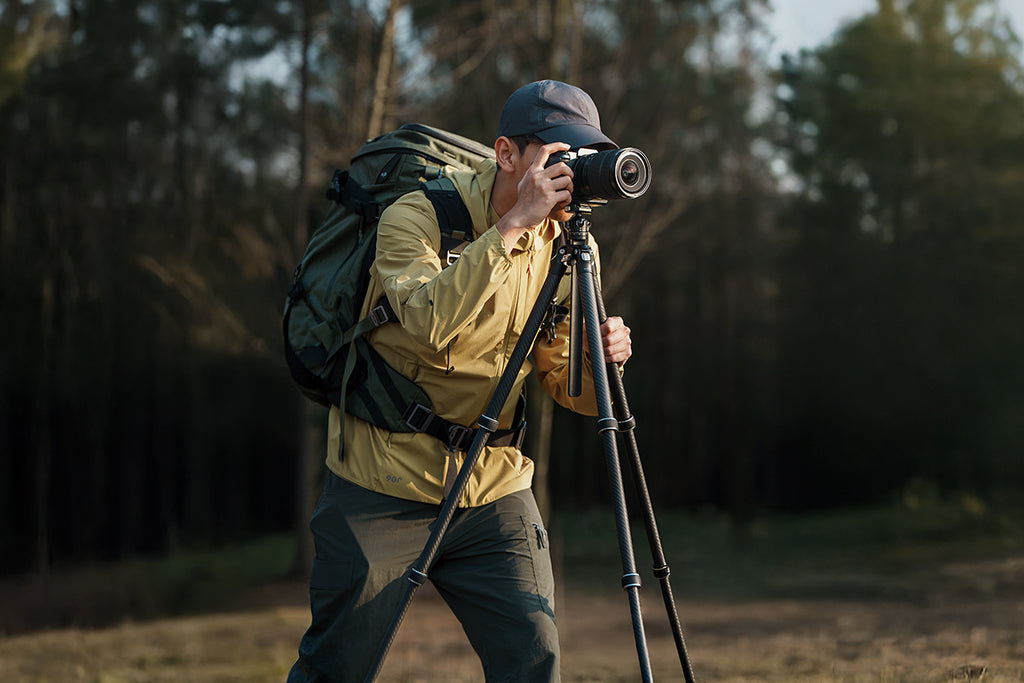
Material Science: Carbon Fiber vs. Aluminum Alloy
When building a travel-optimized system, the choice of material for the tripod legs is paramount. However, there is a common misconception regarding the components of the ecosystem.
Tripod Legs: The Carbon Fiber Advantage
Carbon fiber is the gold standard for travel for two reasons: its strength-to-weight ratio and its damping properties. According to industry benchmarks, a 5-lb carbon fiber tripod typically offers significantly greater stability than a 5-lb aluminum tripod. This is because carbon fiber's weave structure is inherently better at absorbing high-frequency vibrations (damping) than the resonant nature of hollow metal tubes.
Quick Release Plates: The Aluminum Necessity
Contrary to some marketing myths, high-performance quick-release plates (such as the F38 or F22 series) are precision-machined from Aluminum Alloy (typically 6061 or 7075), not carbon fiber.
Aluminum is selected for these interfaces because of its rigidity and machining tolerances. A quick-release plate must maintain a "zero-play" fit within the receiver. While carbon fiber is excellent for legs, it cannot be machined to the micron-level tolerances required for a secure Arca-Swiss style lock. Furthermore, aluminum acts as a "thermal bridge." In extreme cold, it will conduct heat away from your camera base, which can actually help keep the camera's internal electronics cool during long 4K/8K recording sessions, though it requires careful handling to avoid "metal-to-skin" shock.
| Component | Preferred Material | Key Benefit |
|---|---|---|
| Tripod Legs | Carbon Fiber | Vibration damping & weight reduction |
| Ball Head Body | Anodized Aluminum | Durability & smooth friction control |
| Quick Release Plate | Aluminum Alloy | Rigidity & precision fit |
| Leg Locks | Reinforced Polymer/Aluminum | Impact resistance & weight |
The "Silent Killer": Center of Gravity and Wrist Torque
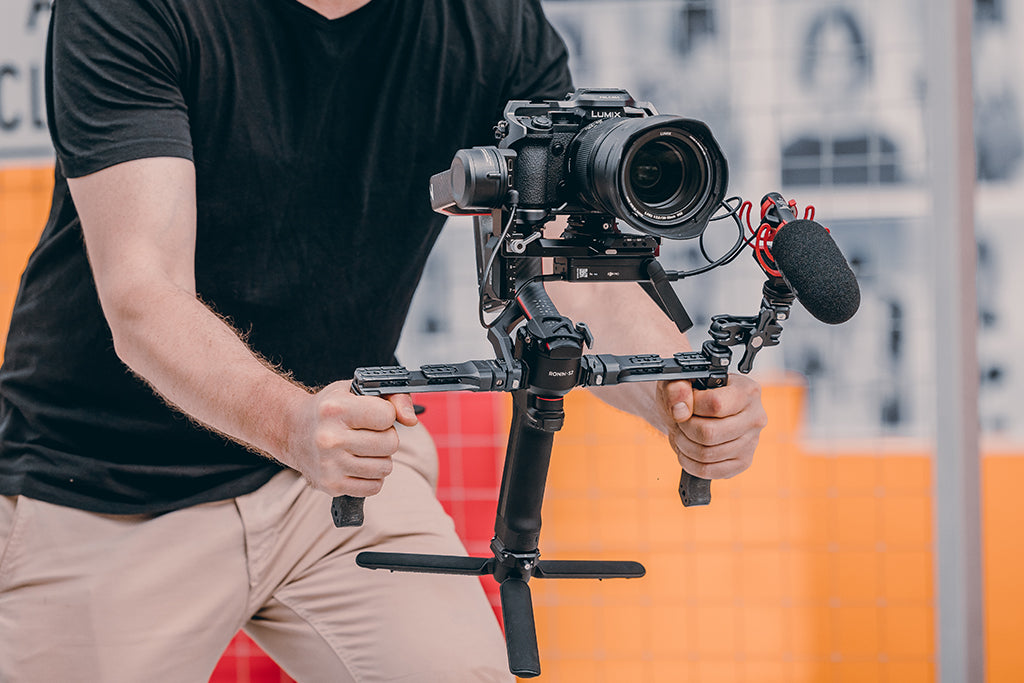
Weight is only one part of the stability equation. The geometry of your rig—specifically the Center of Gravity (CoG)—is what often leads to system failure. A top-heavy rig with a monitor, a large microphone, and a heavy telephoto lens creates a massive "lever arm."
The "Wrist Torque" Biomechanical Analysis
When you are operating a camera handheld or adjusting it on a tripod, you aren't just fighting weight; you are fighting torque. We can model this using a standard physics formula:
Torque ($\tau$) = Mass ($m$) × Gravity ($g$) × Lever Arm ($L$)
Consider a standard mirrorless rig weighing 2.8kg. If you mount a monitor on a 0.35m extension arm, it generates approximately $9.61 N\cdot m$ of torque.
Modeling Note: Our analysis of the "Solo Creator" persona assumes a standard adult forearm strength profile. In this scenario, $9.61 N\cdot m$ of torque represents roughly 60-80% of the Maximum Voluntary Contraction (MVC). This explains why users experience rapid fatigue and why tripod heads often "creep" or sag when accessories are mounted far from the central axis.
To mitigate this, we recommend a modular approach. By using lightweight, low-profile quick-release mounts (like the F22 system), you can keep accessories closer to the camera body, effectively shortening the lever arm ($L$) and reducing the torque on both your tripod head and your own wrists.
Workflow ROI: The Math of Efficiency
For the professional creator, every second spent fiddling with a tripod screw is a second lost on the production clock. We often hear from users who struggle with traditional 1/4"-20 threaded mounts, which are slow and prone to cross-threading.
The "Workflow ROI" Calculation
If we compare a traditional thread mounting process to a modern quick-release ecosystem, the financial implications are significant:
- Traditional Thread Mounting: ~40 seconds per swap.
- Quick Release (F38/F22): ~3 seconds per swap.
- Time Saved: 37 seconds per swap.
For a professional performing 60 swaps per shoot (switching between tripod, gimbal, and handheld) across 80 shoots per year, this system saves approximately 49 hours annually. At a professional rate of $120/hr, this translates to a ~$5,900+ annual value in recovered time. This structural efficiency is the primary justification for investing in a unified ecosystem rather than a collection of mismatched parts.
Travel Logistics and "Visual Weight"
Travel photography involves navigating more than just terrain; it involves navigating airline regulations. This is where the concept of "Visual Weight" becomes a logistical advantage.
Airline Compliance and IATA Guidelines
When traveling with a tripod that integrates power (such as a tripod with a built-in battery handle), you must adhere to the IATA Lithium Battery Guidance Document. Most airlines limit passengers to batteries under 100Wh in carry-on luggage.
Furthermore, compact, modular systems (like the F22/F38 series) have lower "Visual Weight" than bulky cinema plates. Large, industrial-looking rigs are more likely to be flagged by gate agents for weighing or mandatory checking. A sleek, integrated carbon fiber setup often passes through as standard personal equipment, saving you from potential baggage fees and the risk of gear damage in the cargo hold.
The Thermal Shock Prevention (Winter Scenario)
In cold climates, carbon fiber's non-conductive property is a genuine advantage for bare-handed operation. However, as noted earlier, the aluminum QR plates are highly conductive.
Pro Tip: Attach your aluminum QR plates to your cameras indoors before heading into the cold. This prevents "thermal shock"—the rapid cooling of the camera's baseplate which can lead to premature battery drain in sub-zero temperatures. It also ensures that the expansion/contraction of the metal doesn't affect the tightness of the screw during the shoot.
Practical Safety: The Pre-Shoot Workflow
No matter how high-end your tripod is, the weakest link is always the human interface. Based on patterns from customer support and warranty handling, we have developed a three-step safety check that should be performed every time you mount your rig.
The "Audible, Tactile, Visual" (ATV) Checklist
- Audible: Listen for the distinct "Click." If you don't hear it, the locking wedge hasn't fully engaged.
- Tactile: Perform the "Tug Test." Immediately after mounting, give the camera a firm upward pull. If there is any play, re-seat the plate.
- Visual: Check the locking pin or indicator. Many high-end systems (like the F38) feature a color-coded indicator (Orange/Silver) to show if the safety lock is engaged.
Cable Management and Torque
A heavy HDMI or USB-C cable can act as a secondary lever arm. If a cable is pulled taut, it creates unwanted torque on the quick-release plate, potentially causing micro-rotation over time. We recommend using dedicated cable clamps to provide strain relief, ensuring the weight of the cable is borne by the tripod's frame rather than the camera's sensitive ports.
Finding Your Sweet Spot
Selecting the right travel tripod system is an exercise in engineering trade-offs. You must balance the physical weight of the carbon fiber legs against the payload requirements of your heaviest lens, all while ensuring the quick-release interface is rigid enough for the task.
Remember the 2x/3x safety multipliers. Respect the center of gravity. And most importantly, view your tripod not as a standalone accessory, but as the foundation of a modular ecosystem. By prioritizing precision-machined aluminum interfaces and vibration-damping carbon fiber supports, you can build a rig that is both light enough for the trail and stable enough for the screen.
Disclaimer: This article is for informational purposes only. When using support systems for heavy cinema equipment or in extreme weather conditions, always consult the specific manufacturer's safety manual. Proper maintenance of locking mechanisms and regular inspection of mounting screws are the responsibility of the user to ensure gear safety.