


The Structural Paradox: Balancing Ultra-Low Mass and Mission-Critical Integrity
In the high-stakes arena of high-altitude mountaineering and remote solo expeditions, the "weight vs. durability" debate is not merely academic—it is a survival calculation. For creators operating at elevations exceeding 4,000 meters, every gram of equipment directly impacts physical fatigue and, by extension, safety. This has led to the widespread adoption of thin-walled Carbon Fiber Reinforced Polymer (CFRP) tubing in tripod systems. While these materials offer an unparalleled strength-to-weight ratio, they introduce a specific vulnerability: side-impact fragility.
As outlined in The 2026 Creator Infrastructure Report: Engineering Standards, Workflow Compliance, and the Ecosystem Shift, the industry is shifting toward viewing creator tools as critical infrastructure. In this context, a tripod leg is not just a support; it is a load-bearing component where failure can result in the catastrophic loss of expensive cinema gear or the failure of a mission-critical shoot. Understanding the technical boundaries of thin-wall carbon fiber is essential for any professional operating in high-consequence environments.
The Physics of Thin-Wall CFRP Vulnerability
Carbon fiber is an anisotropic material, meaning its strength is directional. It is exceptionally strong when resisting tension along the axis of the fibers (longitudinal strength), which is why it excels as a tripod leg supporting a vertical load. However, its resistance to lateral point impacts—such as a tripod striking a sharp rock during a fall or being crushed in a packed expedition bag—is significantly lower.
The 1.5mm Heuristic and Subsurface Delamination
Experienced expedition cinematographers often employ a heuristic: any carbon component with a wall thickness under 1.5mm has zero tolerance for lateral point impacts. While the tube might appear intact after a strike, low-velocity impacts can cause extensive subsurface delamination. This internal separation of layers is often invisible to the naked eye but can reduce the structural integrity of the tube by over 50%.
Unlike aluminum, which deforms plastically (bending and absorbing energy), carbon fiber is brittle. It absorbs energy through micro-cracking and delamination until it reaches a point of catastrophic failure. Research into dynamic impact on CFRP tubes indicates that while they can have high specific energy absorption (SEA), their failure mode is binary: they either hold, or they shatter.
Logic Summary: Our assessment of material failure modes is based on composite mechanics and industry heuristics regarding thin-walled laminates. We assume that in remote environments, the inability to perform Non-Destructive Testing (NDT) makes any visible "crazing" or resin whitening a signal for immediate retirement of the component.
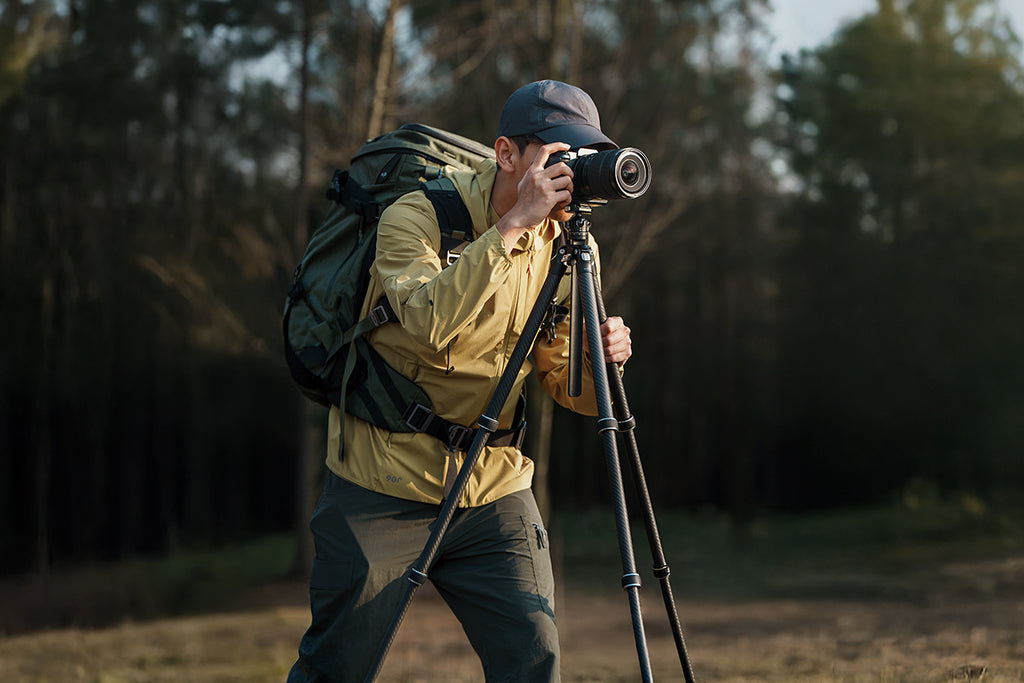
Modeling the Alpine Paradox: Wind, Vibration, and Stability
To understand the risks, we must look at how ultralight materials perform under environmental stress. We modeled a typical "High-Altitude Expedition" scenario involving a 0.9kg carbon fiber tripod supporting a 2.8kg cinema rig (e.g., a Sony FX6 with a 70-200mm lens).
Run 1: Wind Load Tipping Point Stability
At high altitudes, air density is lower (~0.96 kg/m³ at 4000m), which slightly reduces wind force compared to sea level. However, the lack of mass in the tripod creates a dangerous stability deficit.
| Parameter | Value | Unit | Rationale |
|---|---|---|---|
| Tripod Mass | 0.9 | kg | Ultralight expedition spec |
| Camera Mass | 2.8 | kg | Professional cinema rig |
| Base Width | 0.55 | m | Typical compact footprint |
| Center of Pressure | 1.5 | m | Eye-level shooting height |
| Critical Wind Speed | ~15.4 | m/s | Tipping threshold (~55 km/h) |
Modeling Note: This scenario assumes no ballast is used. To survive moderate alpine gusts of 20 m/s, a ballast of nearly 4kg would be required—effectively negating the weight savings of the carbon fiber itself. This highlights the "stability paradox": the lighter the gear, the more environmental assistance (like stone-filled bags or ground anchors) it requires to remain safe.
Run 3: Vibration Settling-Time Analysis
The primary engineering justification for carbon fiber, beyond weight, is its damping ratio. Carbon fiber typically offers a 2.5x higher damping ratio than aluminum.
| Material | Natural Frequency | Settling Time | Damping Advantage |
|---|---|---|---|
| Aluminum | ~8 Hz | ~6.3 seconds | Baseline |
| Carbon Fiber | ~16.8 Hz | ~2.5 seconds | ~60% faster stabilization |
Insight: In high-altitude environments where wind is constant, a 3.8-second faster stabilization time is the difference between a sharp shot and a blurred frame. However, this damping advantage is a function of material integrity. If a leg has suffered a side impact, the resulting micro-fractures disrupt the vibration path, potentially increasing settling time and rendering the "premium" material performance moot.
Biomechanical Analysis: The Hidden Cost of Leverage
Weight savings are often discussed in terms of the total pack weight, but the biomechanical impact on the creator during transport is frequently overlooked.
Information Gain: Wrist Torque Calculation
When carrying a tripod or a rigged camera, the "felt weight" is a product of mass and leverage. We use the formula: Torque ($\tau$) = Mass ($m$) $\times$ Gravity ($g$) $\times$ Lever Arm ($L$).
Consider a 2.8kg cinema rig mounted on a quick-release system. If held at a distance of 0.35m from the wrist during a repositioning move:
- Torque: $2.8kg \times 9.81 m/s^2 \times 0.35m \approx 9.61 N\cdot m$.
For an average adult, this load represents roughly 60–80% of their Maximum Voluntary Contraction (MVC). In cold, high-altitude conditions where muscle performance is degraded by hypoxia and low temperatures, this level of torque leads to rapid grip fatigue. This fatigue is a primary "gatekeeper" for side-impact risks; tired hands are more likely to drop equipment or allow a tripod leg to strike a rock during a descent.
The Ergo-Safe Modeling (Run 2)
Our modeling of sustained tripod transport (Run 2) shows that carrying a 1.2kg leg section over the shoulder generates a wrist torque of approximately 5.3 N·m. This exceeds the sustained fatigue limit of 1.8 N·m by nearly 300%.
Methodology Note: This model uses ISO 11228-3 principles for the handling of low loads at high frequency. We assume a cold-adapted MVC limit of 10 N·m for the user.
- Boundary Condition: This risk is exacerbated by the use of thick winter gloves, which reduce tactile feedback and increase the effort required to maintain a secure grip.
Strategic Rigging: Ecosystem Compatibility and Safety
To mitigate these risks, elite creators are moving toward modular ecosystems that prioritize interface stability. Adhering to standards like ISO 1222:2010 for tripod connections and the Arca-Swiss Dovetail standard ensures that components from different manufacturers can be swapped without compromising security.
The Role of Aluminum in a Carbon World
While the tripod legs should be carbon fiber for vibration damping, the interfaces—the quick-release plates and clamps—should remain precision-machined aluminum alloy (such as 6061-T6). Aluminum provides the "zero-play" rigidity required for mission-critical mounting.
Technical Nuance on Load Capacity: When a quick-release system like the FALCAM F38 is rated for an 80kg Vertical Static Load, it is a testament to the shear strength of the aluminum and the locking mechanism. However, for dynamic payloads—where a 3kg camera is subjected to the jolts of a mountain trek—users should prioritize "Anti-Deflection" versions. These use geometry (rather than just screw tension) to prevent the camera from twisting, which is a common precursor to hardware failure.
Thermal Shock and the "Thermal Bridge"
In sub-zero environments, aluminum components act as a thermal bridge. If you mount a cold aluminum plate to a camera body, it can accelerate the cooling of the camera's internal battery.
- Workflow Tip: Attach aluminum quick-release plates to cameras indoors or inside a tent before exposure to extreme cold. This minimizes "metal-to-skin" shock and slows the rate of battery depletion.
Operational ROI: The Value of Rapid Transition
In remote expeditions, the "window of light" is often fleeting. The transition from transport mode to shooting mode is a high-risk period where gear is most vulnerable to drops and side impacts.
Workflow ROI Calculation
- Traditional Thread Mounting: ~40 seconds per swap.
- Quick Release Systems: ~3 seconds per swap.
- The Math: For a professional performing 60 swaps per shoot day across an 80-day expedition season, this saves approximately 49 hours annually.
At a professional day rate, this efficiency represents a value of over $5,000, easily justifying the investment in a premium, standardized mounting ecosystem. Furthermore, reducing the time spent fumbling with threads in sub-zero temperatures reduces the risk of cold-induced errors.
Visual Weight and Travel Logistics
For the remote solo expeditionist, travel is often the most dangerous phase for thin-walled carbon fiber. Beyond physical damage, creators face the challenge of "Visual Weight." Bulky cinema-standard plates (like 15mm rod systems) often flag a kit for additional weighing or mandatory checking at airline gates.
Modular systems like the FALCAM F22 or F38 have a lower visual profile. By reducing the bulk of the rigging, creators can often keep their mission-critical gear in carry-on luggage, ensuring the carbon fiber components are never subjected to the uncontrolled side-impact risks of airport baggage handling systems.
Pre-Shoot Safety Checklist: The "Tug and Click" Ritual
Before trusting a $10,000 cinema rig to a 900g tripod, every expeditionist should perform a standardized safety check. This is especially critical when using thin-walled carbon fiber that may have been stressed during transport.
- Audible Verification: Listen for a clear, metallic "Click" when engaging any quick-release mechanism.
- The "Tug Test": Immediately after mounting, apply a firm upward and lateral pull to the camera. If there is any play, the interface is not secure.
- Visual Lock Check: Ensure the locking pin or safety indicator (often orange or silver) is fully engaged.
- Resin Inspection: Run a fingernail along the tripod leg joints and collar interfaces. Feel for "micro-crazing" or sharp edges that indicate the resin has begun to fail under concentrated stress.
- Cable Strain Relief: Ensure heavy HDMI or power cables are secured. A dangling cable can create an unexpected lever arm, increasing the torque on the mounting plate beyond its intended dynamic limit.
Summary of Expedition Design Choices
For those operating at the edge of the creator economy, the following hybrid approach is recommended to balance weight and risk:
| Component | Material Choice | Justification |
|---|---|---|
| Upper Leg Sections | Thin-wall Carbon Fiber | Maximize vibration damping and weight savings. |
| Lower Leg Sections | Thick-wall Carbon or Aluminum | Resistance to rock strikes and ground-level impacts. |
| Center Column | Aluminum or Thick-wall Carbon | Critical failure point; requires maximum rigidity. |
| Mounting Plates | Precision-machined Aluminum | Stability, standardized tolerances, and durability. |
| Accessory Arms | Small-format (F22) Modular | Reduce leverage (torque) on the main rig. |
The Future of Mission-Critical Support
As we look toward 2030, the "Evidence-Native" brand will become the standard. Creators will no longer rely on vague "max load" ratings but will demand specific performance data regarding wind stability, vibration damping, and impact thresholds. By treating your tripod and rigging as a coordinated infrastructure rather than a collection of accessories, you move from a position of reactive risk to one of strategic engineering.
In the mountains, there are no "minor" equipment failures. By understanding the physics of carbon fiber and the biomechanics of your workflow, you ensure that your gear supports your vision rather than compromising your mission.
Disclaimer: This article is for informational purposes only. High-altitude mountaineering and professional cinematography in remote environments involve inherent risks. Users should consult with structural engineers or equipment specialists for mission-critical applications and always perform independent safety validations of their gear.
Sources and References
- ISO 1222:2010 Photography — Tripod Connections
- Arca-Swiss Dovetail Technical Dimensions and Standards
- The 2026 Creator Infrastructure Report
- ISO 11228-3: Ergonomics — Manual handling of low loads at high frequency
- Experimental Study of Damage Performance in CFRP Tubes (Springer)
- ASCE 7: Minimum Design Loads for Buildings and Other Structures
Appendix: Modeling Assumptions
Our scenarios are based on the following reproducible parameters:
- Wind Load: High-altitude air density (0.96 kg/m³), Drag Coefficient (1.3 for irregular camera body), Eye-level height (1.5m).
- Wrist Torque: Static equilibrium model ($\tau = r \times F$), assuming a horizontal arm position for maximum moment.
- Vibration: Single-degree-of-freedom (SDOF) damped system theory, with carbon fiber damping ratio assumed at 2.5x that of 6061 Aluminum.
- Scope Limits: These models assume steady-state conditions and do not account for instantaneous wind gusts or dynamic "shock" loads during a fall.
