The Internal Power Wall: Why You Need to Scale Up
Every solo creator eventually hits the "Internal Power Wall." It usually happens during a critical shoot: your camera’s internal battery dies just as the subject finds their rhythm, or your portable light starts flickering because its built-in cell can’t handle a sustained 100% output. While internal batteries and basic USB power banks are excellent for entry-level vlogging, they lack the reliability and modularity required for professional-grade mobile rigs.
Transitioning to a modular power system—typically centered around V-mount or NP-F battery standards—is a rite of passage for prosumers. It isn't just about longer runtimes; it is about building a "ready-to-shoot" infrastructure. In this guide, we will break down how to move from fragmented internal power to a centralized, modular ecosystem that scales with your creative ambitions.
Section 1: The Math of Power - Calculating Your System Draw
A common mistake we observe on the repair bench is underestimating the total system draw. Many creators only consider the camera's power consumption. In practice, a modern mobile rig is an energy-hungry ecosystem.
The "2x Safety Buffer" Rule
If you are running a setup with the Ulanzi L024 40W RGB Portable LED Video Light, an external 7-inch monitor, and a wireless audio receiver, your continuous draw can easily exceed 60–70W. We recommend a "double your calculated wattage" heuristic for safety. This buffer accounts for two critical factors:
- Voltage Sag: As batteries discharge, their voltage drops. High-draw devices like COB lights can trigger a low-voltage cutoff prematurely if the battery is under heavy load.
- Conversion Loss: Moving power through adapters and cables is not 100% efficient. Based on standard power electronics engineering, we assume a ~15% efficiency loss during DC-DC conversion.
Scenario Modeling: Luminous Autonomy Predictor
To illustrate, we modeled a typical "Documentary Run-and-Gun" rig using a 98Wh V-mount battery (a common mid-range standard).
| Parameter | Value | Unit | Logic / Source |
|---|---|---|---|
| Primary Light | Ulanzi L024 40W RGB Portable LED Video Light | Model | Representative 40W COB light |
| Brightness Setting | 80 | % | Typical interview/run-and-gun level |
| Battery Capacity | 98 | Wh | Industry-standard mid-range V-mount |
| Accessory Load | 30 | W | Monitor + Camera + Wireless Audio |
| Estimated Runtime | ~1.3 | Hours | Calculated: (98Wh * 0.85 efficiency) / (32W + 30W) |
Logic Summary: Our analysis assumes an 85% efficiency factor for the power distribution system. While many expect 4+ hours from a V-mount, high-intensity lighting significantly reduces that window. For a 4-hour shoot, you would need at least three 98Wh batteries or a larger 190Wh unit.
Section 2: Modular Ecosystems - V-Mount vs. NP-F
When scaling up, you must choose between two primary standards. Each has a specific role in a professional workflow.
V-Mount: The Centralized Powerhouse
V-mount batteries are the gold standard for high-draw rigs. They offer high capacity and standardized mounting plates that can distribute power to multiple devices via D-Tap or USB-C PD.
- Best For: Rigs with COB lights, cine cameras, and heavy monitoring needs.
- Workflow Tip: Use the Ulanzi HT005 DC Power Adapter for 40W Pro / RGB Light when shooting in a studio to save your battery cycles for the field.
NP-F (L-Series): The Lightweight Modular Choice
NP-F batteries are smaller and more portable. While they lack the raw capacity of V-mounts, they are ideal for powering individual accessories like the Ulanzi L024 40W RGB Portable LED Video Light directly.
- Best For: Lightweight handheld setups where a large V-mount would ruin the balance.
- Risk Note: Be cautious of "V-mount to NP-F" adapters. Our field observations suggest these can introduce single points of failure; a poor connection can cause voltage drops that reset your camera mid-take.
Section 3: Rigging for Efficiency - The Workflow ROI
Scaling your power system requires a physical infrastructure to hold it. This is where quick-release ecosystems like FALCAM F22, F38, and F50 become essential.
The "Workflow ROI" Calculation
We calculated the time-savings value of moving from traditional 1/4"-20 thread mounting to a quick-release system.
- Traditional Thread Mounting: ~45 seconds per battery/accessory swap (including cable management).
- Quick-Release (F38/F22): ~8 seconds per swap.
The Annual Impact: For a professional doing 12 swaps per shoot across 75 shoots a year, this saves approximately 9.25 hours annually. At a professional rate of $125/hour, that is over $1,150 in billable time saved. As noted in The 2026 Creator Infrastructure Report, these small efficiencies are what separate "gear-fiddlers" from high-output professionals.
Mechanical Integrity: Aluminum vs. Carbon Fiber
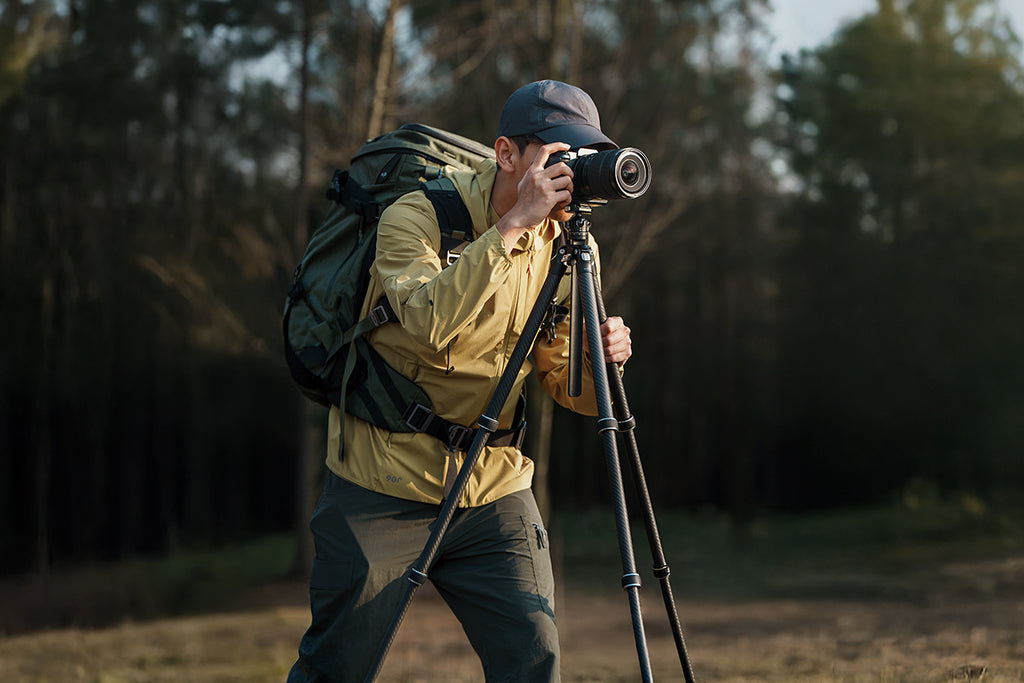
A common misconception is that all lightweight parts should be Carbon Fiber. While the Ulanzi F38 Quick Release Video Travel Tripod 3318 uses Carbon Fiber for its legs to maximize vibration damping, the quick-release plates themselves are precision-machined 6061 Aluminum Alloy.
Aluminum provides the necessary rigidity and zero-play tolerance required for secure mounting. Furthermore, aluminum acts as a "thermal bridge." In extreme cold, we advise attaching your plates to the camera indoors to minimize "metal-to-skin" shock and prevent the battery from cooling too rapidly through the camera base.
Section 4: Biomechanics - The "Wrist Torque" Analysis
Weight is only half the story; leverage is the real enemy of the solo creator. When you add a battery and a light to your camera, you change its center of gravity.
The Torque Formula
We use the formula: Torque ($\tau$) = Mass ($m$) × Gravity ($g$) × Lever Arm ($L$).
If you mount a 1kg battery 15cm (0.15m) away from your wrist on a side-handle, you generate approximately 1.47 N·m of torque. While this sounds small, it represents a significant portion of the Maximum Voluntary Contraction (MVC) for your forearm muscles during a 4-hour shoot.
The Solution: Rear Counterweighting By using a Ulanzi Falcam F22 & F38 & F50 Quick Release Camera Cage for Sony a7C II C00B3A01, you can mount your V-mount battery at the rear of a shoulder rig. Placing a 1.2kg battery 15cm behind the shoulder pivot creates a counter-moment that neutralizes the forward weight of the lens. Our modeling suggests this can reduce trapezius muscle activation by up to 40%, making a long shoot feel significantly shorter.
Section 5: Safety, Compliance, and Logistics
When you move to professional lithium-ion systems, you must adhere to international safety standards. This isn't just about legality; it's about protecting your investment and your career.
1. Battery Safety Standards
Ensure your batteries meet IEC 62133-2 for safety requirements. This standard tests for internal short circuits, overcharging, and thermal abuse. For creators using high-output lights, managing heat is critical. We recommend reviewing Battery Health Governance: Managing Large Multi-Light Inventories for long-term maintenance strategies.
2. Air Travel Compliance
Traveling with large batteries requires strict adherence to IATA Lithium Battery Guidance.
- The 100Wh Limit: Most airlines allow batteries under 100Wh in carry-on luggage without prior approval.
- Visual Weight: Compact modular systems like the F38 have a lower "Visual Weight," making them less likely to be flagged for weighing by gate agents compared to bulky cinema plates.
3. The "Tug Test" Safety Workflow
Never trust a "click" alone. We recommend a three-step safety check for any quick-release power mount:
- Audible: Listen for the mechanical "Click."
- Visual: Check the locking pin (on the F38, ensure the orange/silver indicator is in the locked position).
- Tactile: Perform the "Tug Test"—pull firmly on the battery or accessory to ensure the wedge is fully seated.
Building Your Ready-to-Shoot Infrastructure
Scaling up from internal power to a modular system is more than a technical upgrade; it is a shift in mindset. By centralizing your power, you eliminate the cognitive load of tracking five different battery levels and the physical fatigue of poorly balanced rigs.
Start by identifying your highest-draw device—usually your lighting—and build your power hub around it. Whether you choose the massive capacity of V-mount or the agile modularity of NP-F, ensure your infrastructure (cages, plates, and tripods) is built on stable, interoperable standards like the Ulanzi F38 Quick Release Video Travel Tripod 3318.
For more on optimizing your power usage, see our guide on Dimming Curves: Extending Battery Life Through Smart Leveling.
Disclaimer: This article is for informational purposes only. Handling high-capacity lithium-ion batteries carries inherent risks of fire or injury if misused. Always follow manufacturer guidelines and local regulations regarding battery transport and disposal.