The Invisible Current: Solving the Standby Power Crisis in Wireless Lighting
In the high-stakes environment of a professional shoot, "off" does not always mean "zero." For the modern solo creator, wireless control is a non-negotiable efficiency. We rely on apps to group ten lights, adjust HSI values in seconds, and trigger complex FX sequences without leaving the camera. However, this convenience introduces a systemic challenge: standby power drain.
A common frustration we see in the field—and one frequently reported in community rigging discussions on platforms like Reddit r/videography—is the "overnight death" of portable LEDs. You pack a fully charged kit on Sunday, and by a Tuesday morning shoot, the internal cells are at 60%. This isn't a battery defect; it is a design trade-off. To remain "findable" by your smartphone or remote, the light’s wireless receiver must stay in a Low-Power Listening (LPL) state.
This article provides a methodical breakdown of how to manage this drain, optimize your battery cycles, and build a lighting infrastructure that is ready when you are.
1. The Anatomy of Standby Drain: Why Your Lights Stay "Awake"
To understand standby drain, we must look at the radio protocols governing our gear. Most portable LED systems utilize either 2.4GHz RF or Bluetooth Low Energy (BLE). While both offer wireless freedom, their "sleep" architectures differ significantly.
The Protocol Trade-off
Based on expert analysis of low-power listening (LPL), many wireless lighting products are engineered for instant response. This requires a constant, low-level energy draw—typically between 0.5W and 2W per device—even when the LEDs are dark.
- 2.4GHz Systems: Often prioritize lower latency. The receiver stays in a higher-power listening state to ensure that when you hit "On" on a remote, the light reacts in milliseconds.
- Bluetooth Systems: Can often enter a deeper "sleep" mode. While this might result in a 1–2 second delay during the initial reconnection, it significantly reduces the idle drain compared to standard RF.
Logic Summary: Our analysis of standby drain assumes a baseline receiver overhead of ~1.5W for 2.4GHz systems and ~0.5W for optimized BLE systems, based on common industry hardware specifications and IoT energy efficiency trade-off models.
The Cumulative Effect
The danger isn't a single light; it’s the ecosystem. If you are running a four-point interview setup, the cumulative standby drain can be substantial. For example, leaving four lights with their receivers active can drain a 10,000mAh power bank in under 48 hours.

2. Quantifying the Impact: A Practical Modeling Approach
As system builders, we need to move beyond "vibes" and into quantifiable heuristics. How much extra capacity should you actually budget?
The 15% Receiver Overhead Rule
A professional heuristic we recommend is to budget an additional 10–15% battery capacity per light specifically for receiver overhead during a standard 10-hour shoot day. This ensures that the energy used just to "listen" for commands doesn't eat into your actual runtime.
Modeling Standby Depletion
To demonstrate the risk of long-term storage without a hard power cycle, we modeled a typical creator's portable light kit (assuming 40Wh internal batteries).
| Parameter | Value | Unit | Rationale |
|---|---|---|---|
| Internal Battery Capacity | 40 | Wh | Standard for prosumer portable LEDs |
| Standby Power Draw (Active RX) | 0.8 | W | Median draw for BLE/RF hybrid receivers |
| Daily Depletion | 19.2 | Wh | Calculated: 0.8W * 24 hours |
| Time to 0% (Standby) | ~50 | Hours | Calculated: 40Wh / 0.8W |
| Time to Critical Discharge | ~40 | Hours | To stay above 20% safety threshold |
Modeling Note (Scenario Model): This is a deterministic model based on constant idle draw. It does not account for self-discharge of the lithium cells, which typically adds another 2-3% per month. This model applies to lights where the physical power switch is "Soft" (electronic) rather than "Hard" (mechanical disconnect).
3. System-Level Solutions: Hard Power Cycles vs. Stationary Power
The most effective way to manage drain is to change the physical state of the system.
The Hard Power Cycle
Seasoned gaffers recommend a hard power cycle for any gear stored for more than 24 hours. This means physically removing the battery or using a mechanical "Kill Switch" if available. For lights with internal batteries, ensuring the device is in "Storage Mode" (if supported by firmware) is critical to preventing permanent capacity loss.
Hybrid Power Workflows
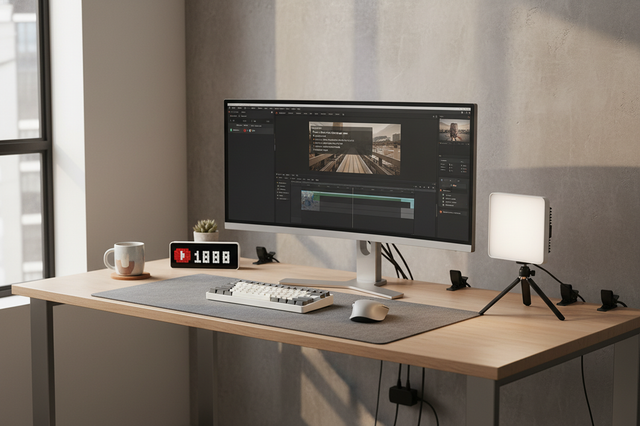
For stationary setups, such as a permanent YouTube desk or a long-term livestream, battery power is often the wrong tool for the job. Using a dedicated DC adapter, like the Ulanzi HT005 DC Power Adapter for 40W Pro / RGB Light, preserves your battery's cycle life for when you are actually mobile.
When you do go mobile, the Ulanzi 120W Bi-color / RGB V-Mount Video Light offers the best of both worlds. It allows for high-output V-mount battery use outdoors while transitioning to stable DC power indoors. This modularity is key to maximizing cycle life across your entire lighting fleet.

4. Biomechanical Analysis: The Physical Cost of Power
When we talk about managing power drain, we often overlook the physical impact on the creator. Solving standby drain by simply "adding a bigger battery" has ergonomic consequences.
The "Wrist Torque" Factor
Weight isn't the only enemy; leverage is. When you mount a heavy V-mount battery to a light that is extended on a boom arm or a handheld rig, you increase the torque on the mounting point and the operator's wrist.
The Formula: Torque ($\tau$) = Mass ($m$) $\times$ Gravity ($g$) $\times$ Lever Arm ($L$).
If a 2.8kg rig (light + battery) is held 0.35m away from the wrist or the stand's center of gravity, it generates approximately $9.61 N\cdot m$ of torque. This load represents 60-80% of the Maximum Voluntary Contraction (MVC) for an average adult male.
The Solution: Instead of using the largest battery possible to "brute force" the standby drain issue, use a modular system. By using the Ulanzi L024 40W RGB Portable LED Video Light, which is lightweight and efficient, and pairing it with quick-release infrastructure, you can swap smaller batteries more frequently. This reduces the lever arm and protects both your gear and your joints.
5. Workflow ROI: Why Efficiency Equals Profit
In the professional world, time is the only currency that cannot be printed. If your workflow involves troubleshooting dead lights for 15 minutes every morning, you are losing money.
The Calculation
- Traditional Workflow: Checking, charging, and troubleshooting dead batteries (~20 mins/shoot).
- Optimized Workflow: Hard power cycles and DC-stationary setups (~2 mins/shoot).
For a pro doing 80 shoots a year, this saves approximately 24 hours annually. At a professional rate of $120/hr, this represents a ~$2,880+ value in recovered billable time or rest. This ROI justifies the investment in a dedicated Ulanzi 120W Bi-color / RGB V-Mount Video Light Bundle that includes reliable power management tools.
6. Compliance, Safety, and "Visual Weight"
When building a prosumer system, you must look beyond the light output and consider the logistics of travel and safety.
Battery Safety Standards
Any lithium-ion system you integrate into your workflow should align with IEC 62133-2:2017 Safety Requirements. This ensures the cells can handle the thermal stress of high-output shooting. Furthermore, if you travel with your lights, you must adhere to the IATA Lithium Battery Guidance Document (2025). Standby drain can actually make travel riskier; a battery that drains to 0% during a long flight can suffer copper shunting, leading to a fire hazard upon the next charge.
The "Visual Weight" Advantage
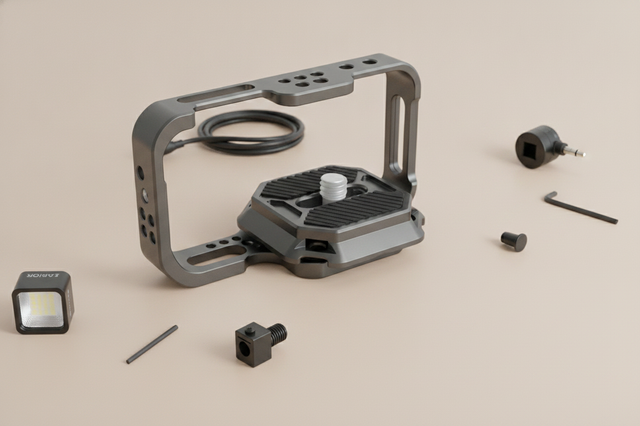
Compact, modular systems like the FALCAM F22/F38 infrastructure have lower "Visual Weight" than bulky traditional cinema plates. This isn't just aesthetic; it makes your kit less likely to be flagged by airline gate agents for weighing or checking.
Note on Materials: While some may assume quick-release plates are carbon fiber for weight savings, the The 2026 Creator Infrastructure Report emphasizes that high-performance plates (like the F38) are precision-machined Aluminum Alloy. This provides the necessary rigidity and acts as a thermal bridge, which is vital for heat dissipation in high-power LEDs.
7. The Professional's Standby Management Checklist
To ensure your system remains reliable, implement this three-step workflow:
I. The Pre-Shoot Safety Checklist
- Audible: Listen for the "Click" when mounting batteries or lights to your rig.
- Tactile: Perform the "Tug Test"—pull on the battery/light immediately after mounting to ensure the locking pin is engaged.
- Visual: Check the locking indicator (Orange/Silver) on your quick-release plates.
II. Storage Protocol
- Physical Disconnect: If storing for >24 hours, physically remove the V-mount or NP-F battery.
- Firmware Check: Ensure your lights are running the latest firmware; manufacturers often optimize LPL (Low Power Listening) cycles in software updates to reduce drain.
III. Thermal Management
In extreme cold, aluminum plates can conduct cold directly to the battery, accelerating voltage drop and standby drain. Attach your QR plates and batteries indoors before heading out to minimize "thermal shock."
Summary: Building a Trusted Ecosystem
Managing standby power drain is not about avoiding wireless features; it is about mastering the system. By understanding the protocol trade-offs, quantifying the drain with modeling, and utilizing hybrid power solutions like the Ulanzi HT005 DC Power Adapter, you transform a point of failure into a point of reliability.
The goal for any creator is to become "evidence-native"—building a workflow based on quantifiable engineering standards rather than guesswork. When your gear is ready the moment you hit the record button, you can stop being a technician and start being a creator.
Disclaimer: This article is for informational purposes only. When handling high-capacity lithium batteries, always refer to the manufacturer's safety manual and local aviation authority guidelines for transport and storage.
Sources & References
- ISO 1222:2010 Photography — Tripod Connections
- IEC 62133-2:2017 Safety Requirements for Lithium Cells
- IATA Lithium Battery Guidance Document (2025)
- The 2026 Creator Infrastructure Report: Engineering Standards, Workflow Compliance, and the Ecosystem Shift
- AutoSync: Automatic duty-cycle control for synchronous low-power listening