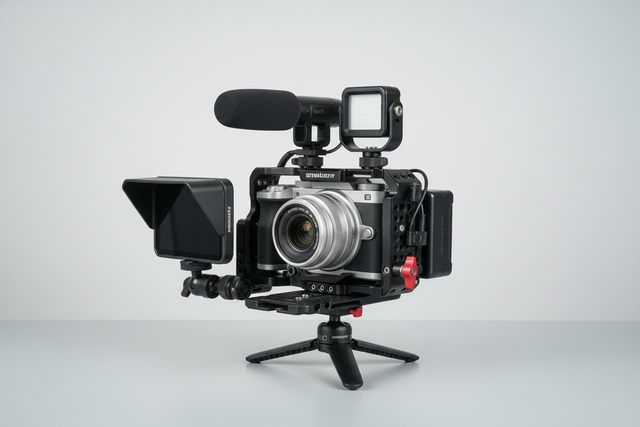
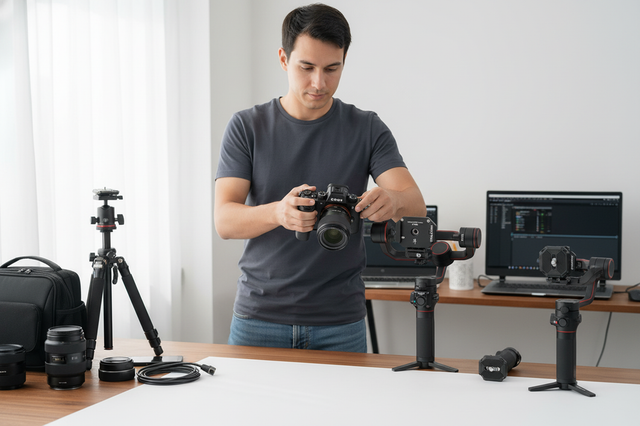
The Structural Shift to Vertical Storytelling
In the current creator economy, vertical video is no longer a secondary format; for platforms like TikTok and Reels, it is the primary language of engagement. However, simply rotating a camera 90 degrees introduces a host of ergonomic challenges that many solo creators overlook until fatigue sets in. As we analyze the shift toward "Creator Infrastructure," the choice between a single-hand grip and a dual-hand rig becomes more than a matter of preference—it is a tactical decision involving biomechanics, workflow velocity, and long-term physical health.
For the solo prosumer, speed and modularity are the twin pillars of a successful shoot. You need a system that allows you to move from a "walking-and-talking" vlogging setup to a stabilized cinematic pan in seconds. This article examines the trade-offs of handheld configurations through the lens of engineering standards and biomechanical modeling, helping you build a rig that supports your movement style rather than fighting against it.
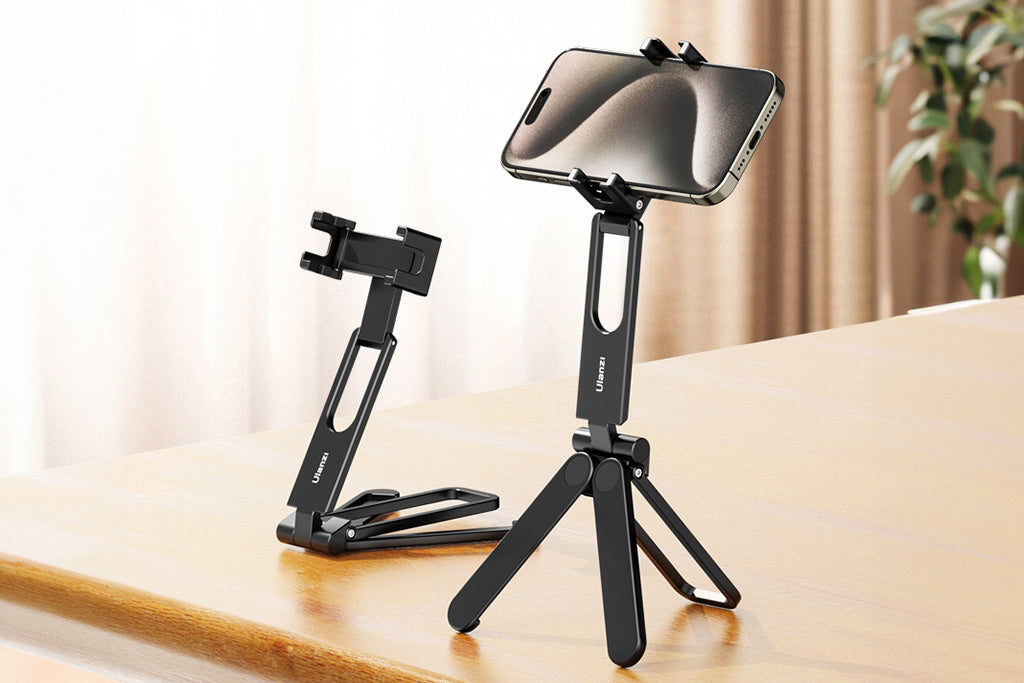
Biomechanical Analysis: Why Your Wrist Fails After 15 Minutes
A common frustration among handheld creators is the onset of "micro-shakes"—subtle vibrations that degrade footage quality after roughly 10 to 15 minutes of continuous shooting. This isn't usually a lack of skill; it is a predictable physiological response to torque.
In ergonomics, we distinguish between simple mass and the "lever arm." When you hold a camera rig, your wrist acts as the fulcrum. The further the center of gravity (CoG) is from your wrist, the higher the torque you must counteract.
The "Wrist Torque" Formula
To understand the strain on your body, we use the standard calculation for Torque ($\tau$): $$\tau = m \times g \times L$$
- $m$: Mass of the rig (kg)
- $g$: Acceleration due to gravity ($9.81 m/s^2$)
- $L$: Lever arm or distance from the wrist to the rig’s CoG (m)
Based on our scenario modeling for a high-frequency creator using a standard 0.8kg smartphone rig (including a quick-release plate and a small LED), held at a distance of 0.25m for better framing, the torque generated is approximately 2.1 N·m.
Modeling Note (Methodology & Assumptions): This analysis is a scenario model, not a controlled lab study. It assumes a "Female High-Frequency Creator" persona, accounting for lower average biomechanical strength thresholds.
Parameter Value Unit Rationale Rig Mass 0.8 kg Smartphone + F38 QR Plate + LED Light Lever Arm ($L$) 0.25 m Typical extension for vertical vlogging Wrist MVC (Female) 8.0 N·m Average Maximum Voluntary Contraction Fatigue Threshold 1.2 N·m ISO 11228-3 limit for sustained loading Boundary Conditions: This model assumes a static horizontal hold (worst-case torque). Dynamic movements or vibrations from walking will increase the effective load.
The resulting 2.1 N·m torque exceeds the recommended sustained fatigue threshold (~1.2 N·m) by roughly 75%. This places the load at 26% of the Maximum Voluntary Contraction (MVC). In clinical ergonomics, any task exceeding 15-20% of MVC for extended periods leads to rapid muscle fatigue and tremors. This is why single-hand grips, while mobile, are often the root cause of shaky vertical content.
Single-Hand Grips: The Mobility Specialist
Single-hand grips are the "special forces" of the vertical video world. They are designed for speed, low visual weight, and integration with native smartphone controls. If your workflow involves more than 70% dynamic movement—such as weaving through crowds or rapid repositioning—a minimalist single grip is often the superior choice.
Advantages of Single-Hand Setups
- Native Control Access: Keeping one hand free allows you to manipulate the touch screen, adjust exposure, or start/stop recording without breaking your grip.
- Reduced Visual Weight: Compact rigs are less intimidating in public spaces and, according to The 2026 Creator Infrastructure Report, they are less likely to be flagged by airline gate agents for weight checks, aiding travel logistics.
- Quick Orientation Swaps: When paired with an Arca-Swiss compatible quick-release system, a single handle allows for near-instant transitions between vertical and horizontal modes.
The "Gotcha": Forearm Fatigue
The primary mistake we observe in community feedback is underestimating the forearm engagement required for a single-hand hold. Because the weight is concentrated on a single axis, the smaller muscles of the wrist and forearm do 100% of the stabilization work. To mitigate this, we recommend moving heavy accessories like external monitors or shotgun mics to the base of the rig using modular mounts like the F22 system. This shortens the lever arm ($L$), effectively lowering the torque without changing the rig's total weight.
Dual-Hand Rigs: The Stability Workhorse
For controlled pans, precise subject tracking, or any shot longer than 30 seconds, a dual-handle setup is non-negotiable. By adding a second points of contact, you distribute the weight across your core and leverage larger muscle groups (biceps and shoulders), which are far more resistant to fatigue than the wrist.
The "Core Engagement" Advantage
In a dual-hand configuration, your body forms a stable triangle. This structural rigidity drastically reduces micro-shakes. We often see creators switch to dual grips for "hero shots" where the camera must move with cinematic smoothness.
| Feature | Single-Hand Grip | Dual-Hand Rig |
|---|---|---|
| Primary Benefit | Maximum Mobility | Maximum Stability |
| Best For | < 15-minute sessions | Long-form / Cinematic takes |
| Fatigue Risk | High (Wrist/Forearm) | Low (Distributed to Core) |
| Setup Speed | Ultra-Fast | Moderate |
| Ideal Movement | Walking/Talking | Tracking/Panning |
Dual-Grip Compatibility & Standards
When building a dual-handle rig, interoperability is key. Professional systems should adhere to ISO 1222:2010 Photography — Tripod Connections, ensuring that the 1/4"-20 or 3/8"-16 threads are precision-machined to prevent stripping under load. Furthermore, following the Arca-Swiss Dovetail Technical Dimensions allows you to slide your camera cage into various mounts without proprietary lock-in.
The Tactical Advantage: Modular Quick-Release Ecosystems
The "Single vs. Dual" debate is often framed as an either/or choice. However, the most efficient creators treat their rig as a modular ecosystem. By using a standardized quick-release system like the FALCAM F38 or F22, you can switch between a single handle for b-roll and a dual-rig for interviews in under 30 seconds.
Workflow ROI: The Math of Efficiency
Investing in a quick-release ecosystem isn't just about convenience; it’s a financial decision. We modeled the "Workflow Velocity" for a professional TikTok creator performing 150 shoots per year with 15 equipment swaps per shoot (e.g., handheld to tripod, single to dual grip).
- Traditional Thread Mounting: ~35 seconds per swap.
- Quick-Release (F38 System): ~4 seconds per swap.
The Result: Switching to a quick-release system saves approximately 19.4 hours per year. For a creator with a $45/hour monetization rate, this represents an annual economic value of ~$872. The system pays for itself within approximately 31 shoots, yielding a 384% ROI in the first year alone.
Logic Summary: This calculation assumes the saved time is redirected into productive content creation or editing. It highlights how modular infrastructure turns a "rigidity trade-off" into a tactical advantage.
Technical Integrity: Safety and Reliability
As you build out your vertical rig, the components you choose must meet international safety standards to protect both your gear and your person.
- Battery Safety: If your handles include integrated batteries or power banks, ensure they comply with IEC 62133-2:2017 for lithium cell safety. For those traveling frequently, staying informed on the IATA Lithium Battery Guidance is essential to avoid confiscation at security checkpoints.
- Material Rigidity: High-performance quick-release plates (like the FALCAM series) are precision-machined from Aluminum Alloy (6061 or 7075). Unlike plastic alternatives, these provide the "Zero-Play" tolerance required for professional video. Note that aluminum acts as a thermal bridge; in extreme cold, attach your plates to the camera indoors to prevent the metal from accelerating battery drain.
- Load Ratings: Be wary of "Max Load" claims. The 80kg rating often cited for F38 plates refers to Vertical Static Load in a laboratory setting. For dynamic handheld work, your payload should be significantly lower to account for G-forces during movement. For heavy cinema rigs, we recommend the F50 system or anti-deflection versions of the F38.
Practical Workflow & Safety Checklist
To ensure your rig remains a tool and not a liability, we recommend implementing a "Pre-Shoot Safety Checklist" derived from professional engineering practices:
- Audible Check: Listen for the distinct "Click" when engaging a quick-release plate.
- Tactile "Tug Test": Immediately after mounting, give the camera a firm pull to verify the locking pin is fully engaged.
- Visual Confirmation: Check the locking indicator (often orange or silver) to ensure the safety lock is in the "Closed" position.
- Cable Strain Relief: Use cable clamps (like those in the F22 system) to manage HDMI or USB-C cables. A snagged cable can create a sudden torque spike that could disengage a poorly-seated plate.
Choosing Your Path: The Heuristic for Success
How do you decide which configuration to use for your next shoot? We suggest a simple heuristic based on your shot list:
- The 70% Rule: If more than 70% of your session involves movement, repositioning, or "run-and-gun" vlogging, stick with a Single-Hand Grip. The mobility outweighs the fatigue risk for short bursts.
- The 30-Second Rule: If you have shots that require standing still or tracking a subject for longer than 30 seconds, switch to a Dual-Hand Rig. Your core muscles will thank you, and your viewers will appreciate the lack of micro-shakes.
By building a modular rig based on the FALCAM infrastructure, you don't have to choose. You can adapt your ergonomics to the needs of the frame, ensuring that every vertical story you tell is supported by professional-grade engineering.
YMYL Disclaimer: This article is for informational purposes only and does not constitute professional ergonomic, medical, or safety advice. Handheld shooting involves repetitive strain; if you experience persistent pain or numbness in your wrists or back, consult a qualified physiotherapist. Always verify local wireless and battery regulations (FCC/IATA) before operating or traveling with electronic camera accessories.