The Invisible Threat to Your Carbon Fiber Investment
In our service center and through analyzing common warranty feedback patterns, we have observed a recurring frustration among professional creators: the "fused" joint. You invest in a high-performance carbon fiber support system, such as the Ulanzi F38 Quick Release Video Travel Tripod 3318, expecting years of reliability. Yet, after a single season of coastal shooting or humid expeditions, you may find that the aluminum tripod head and the carbon fiber mounting plate have become nearly inseparable.
Quick Summary: How to Prevent Seized Joints
- Use a Barrier: Apply a thin layer of nickel or ceramic-based anti-seize compound to all metal-to-carbon thread interfaces.
- Control Torque: Hand-tighten until snug, then add only a 1/4 turn with a tool to avoid resin micro-fractures.
- Scheduled Maintenance: Clean and re-lubricate joints every 90 days (or after every coastal shoot).
- The Goal: These steps are designed to significantly reduce the risk of galvanic corrosion and ensure your gear remains modular.
This "fusion" often isn't a mechanical failure of the threads; it is a chemical reaction known as galvanic corrosion. Because carbon fiber is an electrically conductive material, it behaves like a "noble" metal when in contact with aluminum or steel. When an electrolyte—like salt spray or even high humidity—enters the interface, your camera rig essentially becomes a low-voltage battery. The result is the oxidation of the metal components, which can lead to seized threads, "white powder" residue (aluminum oxide), and potential structural damage.
As we move toward the "ecosystem" model of creator infrastructure, understanding these material interactions is vital. According to The 2026 Creator Infrastructure Report: Engineering Standards, Workflow Compliance, and the Ecosystem Shift, the shift from isolated gadgets to integrated toolchains requires consistent maintenance discipline to help maintain long-term compatibility.

The Science of the "Carbon Battery"
Galvanic corrosion typically occurs when three conditions are met:
- Two electrochemically dissimilar materials are in physical contact.
- There is an electrical pathway between them.
- They are exposed to an electrolyte (moisture).
In the context of camera support, Carbon Fiber Reinforced Polymer (CFRP) sits high on the galvanic series. It is cathodic (noble), while aluminum—the primary material for quick-release plates and tripod heads—is anodic (active).
When you mount an aluminum head to a carbon fiber center column, the potential difference is notable. Based on standard electrode potential data, aluminum sits at approximately -1.66V, while carbon is roughly +0.3V (though this varies based on the specific fiber type and resin coating). This gap creates the "voltage" that drives the oxidation of the aluminum.
Practical Note: Our observations suggest that corrosion is most common when the carbon fiber weave is exposed at the thread interface or through micro-abrasions, creating the necessary electrical contact for the reaction to proceed in the presence of moisture.
Modeling the Marine Environment Risk (Illustrative Example)
For documentary filmmakers working in coastal zones, the risk is often accelerated. Saltwater is a highly efficient electrolyte, with conductivity significantly higher than freshwater.
To illustrate the importance of maintenance, we modeled a hypothetical scenario involving a marine filmmaker using a professional cinema rig on a carbon fiber tripod. This model estimates how localized corrosion at the leg hinges or mounting plate might impact structural stability.
Scenario Parameters: Marine Stability Model
This table represents a heuristic model for risk assessment, not a guaranteed lab result.
| Parameter | Value | Unit | Rationale |
|---|---|---|---|
| Tripod Mass | 1.3 | kg | Ulanzi F38 Quick Release Video Travel Tripod 3318 |
| Camera Rig Mass | 2.8 | kg | Professional cinema body + telephoto lens |
| Target Wind Speed | 15 | m/s | Typical safe operating limit for coastal filming |
| Electrolyte Conductivity | ~5.0 | S/m | Standard Seawater conductivity (average) |
| Maintenance Interval | 90 | Days | Recommended professional field rotation |
Estimated Modeling Insights:
- Corrosion Acceleration: In high-salinity environments, the rate of aluminum pitting at the carbon interface is estimated to be 50–100× faster than in a climate-controlled studio, based on general marine engineering rules of thumb.
- Structural Impact: Our model suggests that unchecked galvanic corrosion can potentially reduce the critical wind speed tolerance of a rig by an estimated 20–30% over time. A tripod that is stable in 15 m/s (34 mph) winds may experience joint instability at lower speeds if oxidation compromises the connection.
- Maintenance Value: Regular preventive maintenance every 3 months can significantly reduce the risk of "seized-thread" downtime. For a high-volume professional, we estimate this could represent up to $2,700 in potential annual savings by avoiding specialized repairs and lost shooting opportunities (calculated based on average professional day rates and equipment replacement costs).
Biomechanical Analysis: Why Precision Rigging Matters
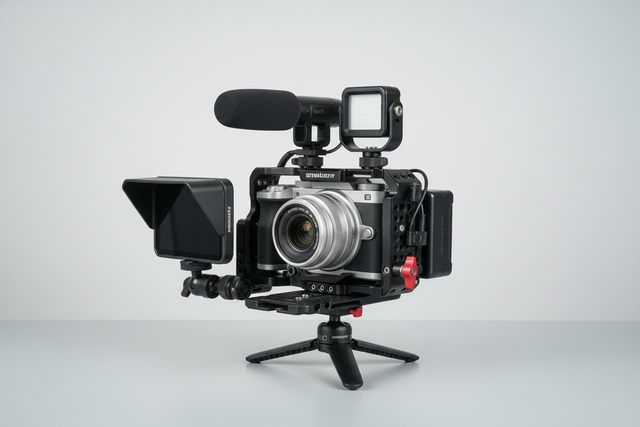
It is a common misconception that "heavier is better" for stability. In reality, the challenge for the creator is often leverage. When we build rigs using the Ulanzi Falcam F22 & F38 & F50 Quick Release Camera Cage for Sony a7C II C00B3A01, we are optimizing the center of gravity to reduce strain on both the gear and the operator.
Consider this Example Wrist Torque Calculation: Torque ($\tau$) = Mass ($m$) $\times$ Gravity ($g$) $\times$ Lever Arm ($L$).
In a setup with a 2.8kg rig where a monitor is mounted on a long arm 0.35m away from the pivot point, it generates approximately 9.61 N·m of torque. For many users, this load can represent 60–80% of their Maximum Voluntary Contraction (MVC). By using the modular F22 system to bring accessories closer to the camera body, you reduce the lever arm ($L$), which helps lower physical fatigue and reduces stress on the mounting threads.

The Workflow ROI: Quick Release vs. Traditional Threads
Beyond material safety, the transition to a unified ecosystem like the Falcam F38 or F50 is a strategic business decision. We have calculated the potential impact of switching from traditional 1/4"-20 screw mounting to a quick-release system based on typical professional workflows.
The "Time is Money" Heuristic
- Traditional Thread Mounting: ~45 seconds per swap (including alignment and tightening).
- F38 Quick Release: ~5 seconds per swap.
Hypothetical Annual Efficiency Gain: For a professional filmmaker performing 25 swaps per shoot day across 80 shoots a year:
- Time Saved: ~22 hours annually.
- Reclaimed Value: At a professional rate of $125/hr, this efficiency gain represents over $2,700 in potential labor value per year.
Actual results will vary based on individual shooting frequency, but this model supports the investment in a stable platform like the Ulanzi Falcam TreeRoot Quick Lock Travel Tripod R141K-320P, where the speed of the "Quick Lock" mechanism directly benefits production volume.
Practical Prevention: The Maintenance Protocol
To help prevent aluminum accessories from fusing to carbon fiber supports, we recommend a methodical maintenance routine based on common industrial practices.
1. The Barrier Method: Non-Reactive Lubricants
Standard grease may wash away or trap abrasive grit. Instead, consider a marine-grade anti-seize compound.
- Note: Avoid copper-based anti-seize, as copper is another noble metal that can potentially worsen the galvanic reaction. Use nickel or ceramic-based compounds.
- Application: Apply a thin, translucent layer to the threads of the mounting screw and the mating surface of the Ulanzi U-190 Pro Fluid Video Head E009GBB1. Wipe off any excess to avoid attracting dust.
2. Fastening Discipline: Snug, Not Crushed
A common mistake is over-tightening metal screws into carbon fiber. While carbon fiber is exceptionally strong in tension, it can be sensitive to localized crushing forces.
- Heuristic: Hand-tighten until the surfaces meet (snug), then add approximately a quarter-turn with a tool. Over-tightening can create micro-fractures in the resin, which may trap moisture and accelerate internal corrosion.
3. Thermal Management (The Winter Scenario)
In extreme cold, aluminum plates can act as a "thermal bridge," potentially conducting heat away from the camera battery faster than the surrounding air.
- Pro Tip: If possible, attach your aluminum plates to your camera indoors at room temperature. This helps ensure a solid seat and reduces the "thermal shock" to the camera's baseplate when transitioning to the field.
Pre-Shoot Safety Checklist
Before every mission-critical shoot, we advise a three-point verification of your support infrastructure:
- Audible: Listen for the definitive "Click" when sliding the plate into the Ulanzi Falcam TreeRoot Quick Lock Travel Tripod R141K-320P.
- Tactile: Perform the "Tug Test." Physically pull on the camera body to confirm the locking pin is fully engaged before releasing your grip.
- Visual: Check the locking indicator. On the F38 system, ensure the safety lock is visibly engaged to prevent accidental trigger release.
Structural Integrity for the Long Haul
Building a reliable creator rig involves managing the interfaces where different materials meet. By understanding the electrochemical reality of carbon fiber and aluminum and implementing a consistent maintenance routine, you can better protect both your equipment and your workflow.
Whether you are using the Ulanzi U-190 Pro Fluid Video Head E009GBB1 for smooth pans or relying on the 10kg vertical static load capacity of the F38 system for a cinema setup, the longevity of your gear depends on the care taken at the connection points.
For further reading on maintaining gear in challenging environments, we recommend our guides on Protecting Carbon Gear in Coastal Zones and Inspecting Carbon Fiber for Cracks.
Disclaimer: This guide is for informational purposes only. Always refer to your specific product manuals for exact torque specifications and load limits. Ulanzi is not responsible for damage resulting from improper maintenance or exceeding rated payloads.