Choosing Replacement Fasteners: OEM vs. Third-Party Hardware
It happens to every creator eventually. You are on a remote shoot, or perhaps just reconfiguring your rig at the studio, and a small, silver screw vanishes into the grass or under a floorboard. In that moment of frustration, the temptation is to grab any 1/4"-20 bolt from a local hardware store or a generic bin of spare parts.
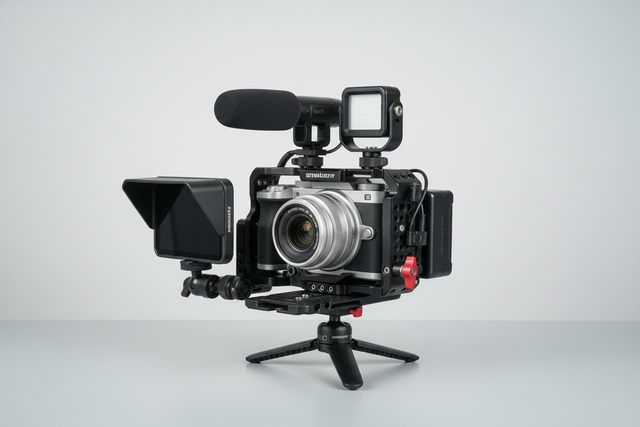
However, as we often observe on our repair benches and through patterns in warranty handling, what seems like a simple mechanical substitute can become the primary catalyst for equipment failure. A camera rig is not just a collection of parts; it is a precision-engineered infrastructure. Choosing between Original Equipment Manufacturer (OEM) fasteners and third-party hardware requires an understanding of material science, thread geometry, and the biomechanical consequences of a joint failure.
This guide provides a methodical framework for evaluating replacement hardware, ensuring your handheld rigging maintains its structural integrity and mission-critical reliability.
The Anatomy of the Joint: Why "Just a Screw" Doesn't Exist
In the world of camera rigging, the most common connection is governed by the ISO 1222:2010 Photography — Tripod Connections standard. This standard defines the 1/4"-20 UNC and 3/8"-16 UNC threads that act as the universal language of our industry.
However, the standard only defines the dimensions, not the metallurgy or the manufacturing tolerances. Based on common patterns from customer support and engineering audits, the most frequent point of failure is not the screw shearing in half. Instead, it is the female threads within the aluminum alloy casting of your rig stripping out.
The Problem with Generic Hardware
Generic hardware store screws are often manufactured for static construction or furniture, not for the high-vibration, high-torque environment of a mobile camera rig. Even if the diameter is correct, a generic screw may have a slightly different thread angle or root radius. This creates concentrated stress points rather than distributing the load across the entire thread surface.
Logic Summary: Our analysis of fastener longevity assumes typical rigging stress cycles based on industry heuristics. We categorize failure modes into "Thread Stripping" (ductile failure of the rig) vs. "Fastener Shearing" (brittle failure of the screw).
Material Compatibility: The Galvanic Risk
Most professional rig components, such as those in the FALCAM ecosystem, are precision-machined from high-grade Aluminum Alloy (typically 6061 or 7075). While these materials are chosen for their strength-to-weight ratio, they are susceptible to galvanic corrosion when paired with certain third-party fasteners.
A common approach is to use stainless steel screws for their perceived strength. However, when stainless steel contact aluminum in a humid or salty environment, an electrochemical reaction occurs. Without a specialized coating or an anti-seize compound, these parts can fuse together or, worse, the aluminum surrounding the hole can weaken and crumble.

Critical vs. Non-Critical Joints: A Decision Framework
Not every screw in your kit carries the same level of risk. To make an informed choice, you must perform a "Joint Criticality Analysis." This approach is aligned with engineering standards that differentiate hardware based on the consequences of failure.
According to technical insights on critical vs. non-critical fastening, a joint is considered "critical" if its failure results in equipment damage, personal injury, or the total loss of a shoot.
1. Critical Joints (OEM Mandatory)
- Camera-to-Plate Connections: The single 1/4"-20 screw holding your $5,000 body to a quick-release plate.
- Vertical Tension Mounts: Any fastener that fights gravity directly.
- Safety-Related Suspension Bolts: Screws used in overhead rigging or vehicle mounts.
For these joints, OEM fasteners are preferred because they offer traceability to a certified standard, such as SAE J429 or ISO 898-1.
2. Non-Critical Joints (Third-Party Acceptable)
- Trim and Cosmetic Screws: Fasteners holding non-load-bearing plastic shrouds.
- Cable Clamp Screws: While important for workflow, a failure here rarely results in a dropped camera.
- Cold Shoe Accessory Screws: For lightweight items like a plastic shotgun mic.
The Cost of "Budget" Hardware
Data from industrial gearbox and heavy equipment studies shows that OEM parts typically last ~2,500 hours versus ~1,200 hours for budget aftermarket parts. This represents a 52% shorter lifespan. In a camera rig context, this translates to more frequent loosening, thread wear, and eventual failure.
| Feature | OEM Fastener | Budget Third-Party | Specialized Industrial |
|---|---|---|---|
| Material | Certified Alloy (e.g., 12.9 Grade) | Low-carbon Steel / Unknown | Stainless / Titanium |
| Coating | Zinc / Anodized | Thin Zinc / None | Dacromet / Xylan |
| Tolerance | High (ISO 1222 compliant) | Variable | Ultra-High |
| Traceability | High (Batch Tested) | None | High (Mill Certs) |
| Cost | Premium | Low | Very High |
Information Gain: Biomechanical Analysis of Wrist Torque
The danger of choosing the wrong fastener or an insecure rigging setup isn't just to the camera; it’s to the creator. Weight is often blamed for fatigue, but the true enemy is leverage.
When you use third-party hardware that requires bulky adapters or causes your rig to expand outward, you increase the "Lever Arm" ($L$). We can model the physical strain using the formula: Torque ($\tau$) = Mass ($m$) $\times$ Gravity ($g$) $\times$ Lever Arm ($L$)
The MVC Impact
Consider a 2.8kg rig. If the center of gravity is held 0.35m away from the wrist, it generates approximately $9.61 N\cdot m$ of torque. For an average adult, this load represents 60-80% of the Maximum Voluntary Contraction (MVC)—the limit of what your muscles can sustain before rapid fatigue and potential injury.
By using low-profile, modular OEM systems like the FALCAM F22 or F38, you keep the mass closer to the wrist. This reduces the lever arm and brings the MVC down to a sustainable 20-30% range. Choosing a replacement screw that is too long or requires extra washers to fit can subtly shift this balance, increasing long-term wrist strain.
Modeling Note (Reproducible Parameters):
Parameter Value Unit Rationale Rig Mass ($m$) 2.8 kg Standard prosumer mirrorless rig Gravity ($g$) 9.81 $m/s^2$ Earth standard Lever Arm ($L$) 0.35 m Distance from wrist to rig center MVC Threshold 60-80 % Estimated range for average adult male Modeled Result ~9.6 $N\cdot m$ Theoretical torque load
Information Gain: The Workflow ROI of "Ready-to-Shoot"
Reliable fasteners do more than just hold gear; they save time. When you use a standardized system, you eliminate the "friction" of hunting for specific tools or dealing with screws that back out under vibration.
As detailed in The 2026 Creator Infrastructure Report, the shift toward "Ecosystem Trust" is driven by quantifiable ROI. We can calculate the value of switching from traditional threaded mounting to a standardized Quick Release (QR) system.
- Traditional Thread Mounting: ~40 seconds per swap (finding tool, aligning, tightening).
- Standardized Quick Release (F38/F50): ~3 seconds per swap.
For a professional creator performing 60 swaps per shoot (switching between gimbal, tripod, and handheld) over 80 shoots a year, the time saved is approximately 49 hours annually. At a professional rate of $120/hr, this represents a ~$5,900+ value in recovered productivity. This ROI is only possible if your fasteners are reliable enough to stay tight shoot after shoot.
Practical Maintenance: The "Pro Rigger" Protocol
To prevent the need for replacement fasteners in the first place, experienced riggers follow a specific maintenance protocol. This ensures that even when you are Maintaining Structural Integrity in Vertical Tension Mounts, your hardware remains secure.
1. The Star-Pattern Sequence
When tightening a plate with multiple screws, never tighten one fully before starting the others. Follow a "star pattern" (tightening opposite corners in increments). This ensures even clamp pressure and prevents the aluminum component from warping, which is the leading cause of "slow loosening" under vibration.
2. Calibrated Torque
While most creators tighten by "feel," using a small calibrated torque driver (set to 2-3 $N\cdot m$ for most 1/4"-20 rigging) prevents over-tightening. Over-tightening stretches the bolt and deforms the aluminum threads, making the joint more likely to fail in the future.
3. The Pre-Shoot Safety Checklist
Before every shoot, perform this three-step check on all load-bearing fasteners:
- Audible: Listen for the "Click" when engaging quick-release systems like the FALCAM F38.
- Tactile: Perform the "Tug Test." Pull firmly on the mounted camera to ensure the locking pin is fully seated.
- Visual: Check the locking indicator. Many professional mounts feature an orange or silver indicator to show when the safety lock is disengaged.
4. Thermal Shock Prevention
Aluminum plates act as a "thermal bridge." In extreme cold, they conduct heat away from the camera battery rapidly. To prevent this, attach your aluminum QR plates to your cameras indoors at room temperature. This allows the metal to seat properly before the material contracts in the cold, ensuring a tighter fit and reducing "metal-to-skin" shock during handling.

Addressing Corrosion and Environmental Hazards
If you must use third-party hardware, pay attention to the coating. Standard zinc plating is often insufficient for outdoor use. Specialized manufacturers often offer Dacromet or Xylan coatings, which can provide over 600 hours of salt spray resistance.
Furthermore, if your rig includes electronic components or wireless audio, ensure your fasteners do not interfere with RF transparency. Bulky steel cages can sometimes act as a Faraday cage, affecting Wireless Mic Regulations compliance by reducing signal range.
Conclusion: Engineering Your Ecosystem
Choosing a replacement fastener is a decision between short-term convenience and long-term system integrity. While third-party hardware can serve in non-critical roles, the "infrastructure layer" of your rig—the plates, mounts, and load-bearing joints—demands the precision and traceability of OEM hardware.
By standardizing your rig around a trusted ecosystem and following professional maintenance protocols, you move from being a "gadget collector" to a "system builder." This methodical approach not only protects your gear but also optimizes your biomechanical health and workflow ROI, ensuring you are always ready to shoot.
References & Authoritative Sources:
- ISO 1222:2010 Photography — Tripod Connections
- The 2026 Creator Infrastructure Report
- SAE J429 / ISO 898-1 Fastener Standards
- IATA Lithium Battery Guidance (For Rigged Power)
Disclaimer: This article is for informational purposes only. Mechanical failure can result in equipment damage or injury. Always consult your equipment's manual and use calibrated tools for mission-critical rigging. If you suffer from chronic wrist or back pain, consult a medical professional or ergonomic specialist before modifying your handheld workflow.