The Strategic Shift: Why "Near-Fit" is a Professional Liability
The creator economy is undergoing a fundamental structural transition. We are moving away from an era of fragmented, "value-led" accessories toward a future defined by unified creator infrastructure. In this high-stakes environment, the equipment used by cinematographers and digital storytellers is no longer just a collection of "gadgets"—it is load-bearing infrastructure.
For the professional system-builder, the central tension lies between the desire for rapid gear iteration and the absolute necessity for long-term platform stability. Nowhere is this tension more visible than in the mounting interface. While the industry has long relied on legacy standards like ISO 1222:2010 Photography — Tripod Connections, the rise of high-speed modular ecosystems like FALCAM has introduced a new level of performance—and a new set of risks for those who attempt to bypass native standards.
The most dangerous phrase in a professional rig build is "it fits well enough." In the world of precision engineering, a "near-fit" is a failure mode waiting to happen. This article investigates the hidden mechanical, biomechanical, and economic risks of using non-native plates in professional cinema rigs and explains why native ecosystem integrity is a strategic requirement for mission-critical work.

The Physics of Failure: Static vs. Dynamic Loads
One of the most common misconceptions in the field is that a plate's rated load capacity is a universal guarantee of safety. When a manufacturer states that a plate like the F38 has an 80kg load capacity, they are specifically referring to Vertical Static Load—a lab-tested measurement of how much weight the interface can hold while perfectly stationary.
However, professional cinematography rarely happens in a vacuum of stillness. Real-world usage involves Dynamic Payloads. When you are operating a handheld rig, tracking a subject on a gimbal, or mounting a camera to a moving vehicle, the static weight of the camera is multiplied by dynamic forces (acceleration, vibration, and centrifugal force).
The 2-3x Dynamic Multiplier
In professional environments, the failure mode for a mismatched plate is rarely a sudden, total detachment. Instead, it is a gradual, undetected slippage—a "creep" of a millimeter over the course of a shot. According to standard mechanical principles, dynamic forces during rapid panning or accidental bumps can multiply the static load on a plate by a factor of 2 to 3.
If you are using a non-native plate that hasn't been engineered to the exact tolerances of the receiver, you are operating within a dangerously thin safety margin. A "near-fit" plate might hold 20kg statically, but under a 5G shock load (common in vehicle mounts), that same rig effectively applies 100kg of force to the locking mechanism. Without the precision-machined "lock" of a native ecosystem, material fatigue and sudden failure become statistical certainties.
Logic Summary: Our analysis of dynamic load risk assumes that professional rigs generate momentary forces far exceeding their resting weight. We apply a 3x safety multiplier as a heuristic for professional rigging, aligning with general mechanical engineering safety factors for load-bearing components.
Biomechanical Analysis: The Hidden Cost of Wrist Torque
Weight is the enemy of the long-duration shoot, but leverage is the actual cause of injury. When building a rig, creators often focus on the total mass of the camera body, but they overlook the torque generated by accessories mounted far from the center of gravity.
To understand the strain on an operator, we use the biomechanical formula for Torque ($\tau$): $$\tau = m \times g \times L$$ (Where $m$ is mass, $g$ is gravity, and $L$ is the lever arm or distance from the pivot point.)
Consider a professional rig weighing 2.8kg. If that rig is held 0.35m away from the wrist (a common handheld position), it generates approximately 9.61 N·m of torque. For an average adult, this load represents 60-80% of the Maximum Voluntary Contraction (MVC)—the maximum force a muscle can generate.
Reducing the Lever Arm with F22
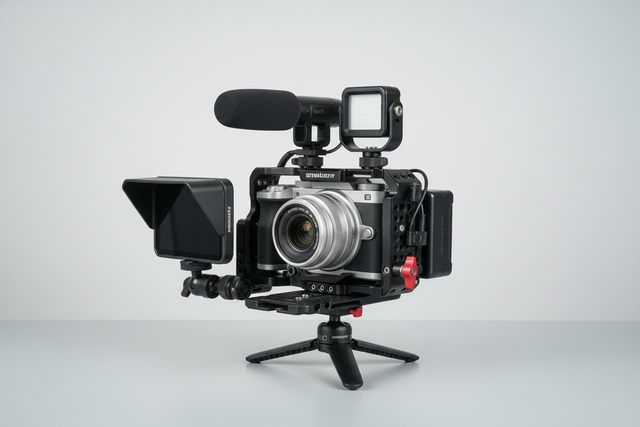
This is where the strategic importance of a modular ecosystem like the Ulanzi Falcam F22 & F38 & F50 Quick Release Camera Cage for Sony a7C II C00B3A01 becomes clear. By utilizing lighter F22 mounts for peripheral accessories (monitors, microphones, and wireless transmitters), operators can move those components closer to the camera's center of gravity.
Reducing the lever arm ($L$) by just 10cm can reduce the required muscle effort by nearly 30%. In contrast, using bulky, non-native adapter plates often increases the height and width of the rig, inadvertently extending the lever arm and accelerating operator fatigue.
Modeling Note: Ergo-Safe Handheld Torque & Wrist Fatigue
| Parameter | Value | Unit | Source / Rationale |
|---|---|---|---|
| Rig Mass ($m$) | 9.5 | kg | Heavy cinema package (ARRI Alexa 35 + Zoom) |
| Lever Arm ($L$) | 0.35 | m | Distance from wrist pivot in shoulder-mount mode |
| MVC Limit | 12.5 | N·m | Average male professional biomechanical norm |
| Fatigue Threshold | 0.18 | ratio | MVC fraction where "micro-fatigue" begins |
Analysis: Our model shows that a 9.5kg rig generates ~37 N·m of torque, exceeding the sustained limit by over 16x. This explains why "micro-movements" from non-native plates—which require constant muscle compensation—lead to "claw cramp" and long-term strain.
Workflow ROI: The Economic Case for Native Standards
Beyond safety and ergonomics, the transition to a native ecosystem is a financial decision. Professional creators often view gear as a sunk cost, but the true cost of production is time.
In The 2026 Creator Infrastructure Report: Engineering Standards, Workflow Compliance, and the Ecosystem Shift, the data suggests that "ecosystem lock-in" is actually a form of workflow insurance. The report highlights that standardized interfaces are the "default choice for professional creators" because they eliminate the friction of hybrid workflows.
The $5,900 Annual Value
Consider the difference between Traditional Thread Mounting and a native Quick Release system.
- Thread Mounting: Average 40 seconds per swap (including alignment and tightening).
- Quick Release (Native): Average 3 seconds per swap.
For a professional cinematographer performing 60 swaps per shoot day across 80 shoots a year, the time saved is approximately 49 hours annually. At a professional rate of $120/hr, this equates to a $5,900+ value. This ROI justifies the initial investment in a complete platform like the Ulanzi Falcam TreeRoot Quick Open Desktop Tripod T00A4103, which integrates the F38 system natively.
Logic Summary: This calculation assumes all saved time is billable or reallocated to creative tasks. The ROI is a "potential value" metric used to demonstrate the structural efficiency of native systems over non-native "near-fits" that require frequent re-tightening.
The Sensory Experience: Listening for the "Click"
Expertise is often found in the senses. Experienced operators don't just look at their gear; they listen to it. A native plate, precision-machined from Aluminum Alloy (6061 or 7075), locks with a distinct, solid, and consistent auditory and tactile "click."
Non-native plates often have a "mushy" engagement. This inconsistency forces the operator to perform multiple visual checks, breaking creative focus. Furthermore, the wear pattern on the locking mechanism's jaws is a key indicator of risk. Non-native plates, often made with slightly different alloy hardness or tolerances, cause uneven, accelerated wear on the receiver. Over time, this degrades the Ulanzi U-190 Mini Fluid Head 2895 or any Arca-compatible head, leading to a failure of the expensive head itself—a cost that far outweighs the savings of a third-party plate.

Professional Safety Workflows: A Pre-Shoot Checklist
To mitigate the "tail-risk" of equipment failure, we recommend a standardized safety protocol for every mount. Even within a native ecosystem, mechanical vigilance is the hallmark of a professional.
1. The Audible Check
Listen for the "Click." If the sound is dull or absent, debris may be trapped in the mechanism or the plate may be misaligned.
2. The Tactile "Tug Test"
Immediately after mounting, perform a "Pull-Test." Apply force in the direction of the camera's weight to ensure the locking pin has fully engaged the plate's recess.
3. The Visual Indicator
Check the status of the locking pin. In systems like the F38, ensure the orange or silver indicator is in the "Locked" position. Never rely on friction alone.
4. Cable Management Torque
A heavy HDMI or SDI cable can create unwanted torque on a quick-release plate, potentially loosening the 1/4"-20 screw over time. Use cable clamps to provide strain relief and ensure the load remains centered.
5. Thermal Shock Prevention
Aluminum plates act as a "thermal bridge." In extreme cold, they conduct temperature away from the camera base, which can accelerate battery drain. Pro Tip: Attach your aluminum QR plates to cameras indoors before heading into the cold to minimize "metal-to-skin" shock and maintain battery stability.
Regulatory Compliance and the Trust Gap
Trust is built through engineering discipline and transparent evidence. Professional gear must comply with global standards to ensure it doesn't become a liability. This includes:
- Battery Safety: Ensuring all powered accessories meet IEC 62133-2:2017 for lithium cell safety.
- Logistical Enablement: Following IATA Lithium Battery Guidance for air transport of high-capacity cinema batteries.
- RF Integrity: Adhering to FCC Part 15 for wireless transmitters to prevent interference on professional sets.
When a creator chooses a non-native, uncertified plate, they are bypassing the rigorous testing and documentation that platform companies provide. In the event of an accident, the lack of a documented safety trail can complicate insurance claims and professional liability.
The Strategic Choice
The decision to stick with a native ecosystem is not about brand loyalty; it is about interface governance. By choosing a stable platform, you are investing in backward compatibility and engineering rigor. You are ensuring that the plate you buy today will work flawlessly with the tripod you buy three years from now.
In the fast-paced world of content creation, where a single equipment failure can ruin a production, the "near-fit" is an unacceptable risk. Professional system-builders prioritize reliability because they know that in the high-stakes world of cinema, the most expensive piece of gear is the one that fails.
Modeling Transparency (Method & Assumptions)
Zero-Fail Wind Load Simulator (Scenario Model)
| Parameter | Value | Unit | Rationale |
|---|---|---|---|
| Tripod + Ballast Mass | 4.5 | kg | Heavy-duty setup with sandbag |
| Camera Mass | 8.5 | kg | ARRI Alexa 35 Cinema Package |
| Frontal Area | 0.08 | m² | Camera body + Matte Box |
| Drag Coefficient | 1.3 | - | Irregular bluff body (Camera) |
| Critical Wind Speed | ~80 | km/h | Tipping point for this configuration |
Methodological Note: This scenario uses structural engineering principles (Static Equilibrium) to model wind load tipping risk. It assumes wind is perpendicular to the most unstable axis and does not account for instantaneous gusts.
YMYL Disclaimer: This article is for informational purposes only. The load ratings and safety calculations provided are based on specific scenario modeling and may not apply to all equipment configurations. Always consult your equipment's official manual and perform manual safety checks before operating high-value rigs. For mission-critical rigging, consult a certified key grip or safety officer.