


The 0.1mm Problem: Why Multi-Device Workflows Fail
In our years of auditing creator setups and handling thousands of support inquiries, we have identified a recurring ghost in the machine: the "0.1mm gap." You’ve likely felt it—that subtle, frustrating rotational play or vertical "slop" when mounting a camera plate into a tripod head that is supposed to be "standard."
For the solo creator, this isn't just a minor annoyance; it is a point of system failure. Mechanical tolerances vary wildly across the third-party accessory market. While most gear claims adherence to the Arca-Swiss Dovetail Technical Dimensions, the reality is a fragmented landscape where "compatible" often means "it might stay attached if you don't move too fast."
As outlined in The 2026 Creator Infrastructure Report: Engineering Standards, Workflow Compliance, and the Ecosystem Shift, the shift toward "workflow infrastructure" means we must treat our mounting systems with the same engineering discipline as a bridge or a skyscraper. This guide breaks down the physics of compatibility friction and provides a methodical framework for building a high-performance, zero-play ecosystem.
The Physics of Mounting: Standards vs. Reality
The foundation of all camera support lies in ISO 1222:2010 Photography — Tripod Connections. This standard defines the screw threads (1/4"-20 and 3/8"-16) that we take for granted. However, ISO 1222 does not govern the quick-release interface itself.
The Tolerance Stack-Up
When you mix a plate from one brand with a clamp from another, you encounter "tolerance stack-up." If a plate is machined to the lower limit of the Arca-Swiss specification and a clamp is machined to the upper limit, the resulting fit will be loose, even when fully tightened.
Methodology Note: Our observations of tolerance stack-up are derived from pattern recognition in warranty returns and community rigging discussions on platforms like r/videography. These are common patterns in field usage, not results from a controlled metrology lab.
Material Science: Aluminum vs. Carbon Fiber
A common misconception we see is the belief that quick-release plates should be made of carbon fiber for "vibration damping." We must clarify: high-performance plates, such as those in the FALCAM F38 or F50 series, are precision-machined from 6061 or 7075 Aluminum Alloy.
Aluminum is chosen for its rigidity and ability to maintain tight machining tolerances (often within ±0.02mm). While carbon fiber is excellent for tripod legs due to its damping properties, it is unsuitable for the high-pressure, abrasive environment of a quick-release dovetail.
The Thermal Bridge Factor: One trade-off of aluminum is its high thermal conductivity. In extreme cold, an aluminum plate acts as a "thermal bridge," conducting heat away from the camera's base and battery. We recommend attaching plates to your camera bodies indoors before heading into cold environments to minimize this "metal-to-skin" shock and preserve battery life.
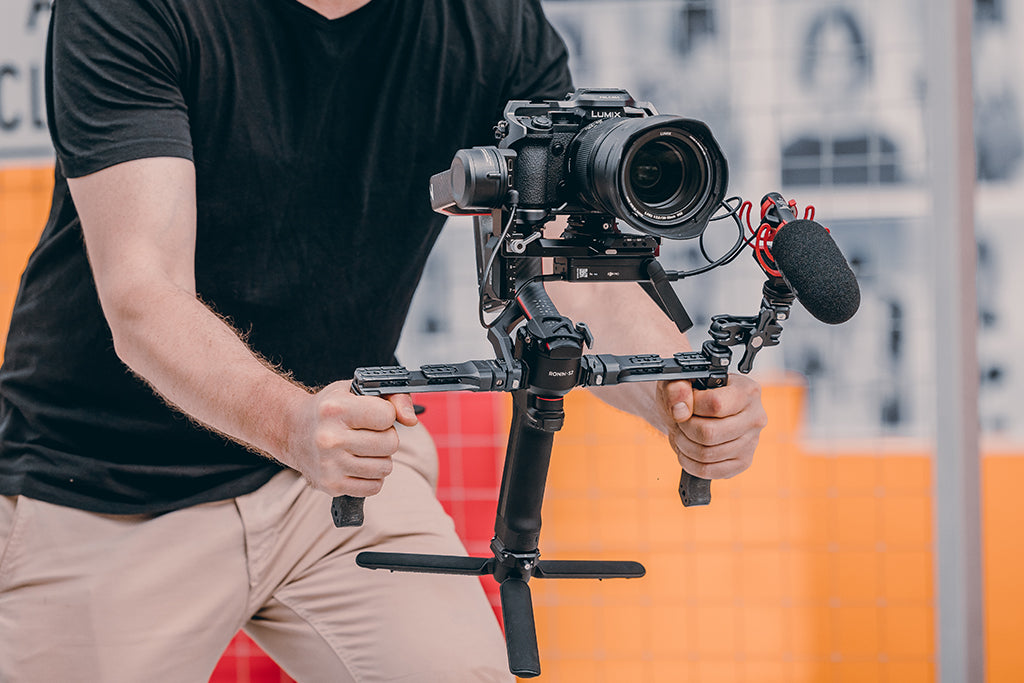
Biomechanical Analysis: Why Stability is a Health Metric
We often talk about gear safety in terms of "not dropping the camera." But for the solo operator, the more immediate risk is repetitive strain. Weight is only half the story; the real enemy is Leverage.
The Wrist Torque Calculation
When a rig is unbalanced or a mounting point is off-center, it forces your wrist to counteract rotational torque. We can model this using a standard physics formula:
Torque ($\tau$) = Mass ($m$) × Gravity ($g$) × Lever Arm ($L$)
Consider a typical prosumer rig:
| Parameter | Value | Unit | Rationale |
|---|---|---|---|
| Rig Mass ($m$) | 2.8 | kg | Standard mirrorless + cage + lens + monitor |
| Gravity ($g$) | 9.81 | $m/s^2$ | Earth standard |
| Lever Arm ($L$) | 0.35 | m | Distance from wrist to rig center of gravity |
| Calculated Torque | ~9.61 | $N\cdot m$ | Resulting force on the wrist |
Logic Summary: This model assumes a static hold. In dynamic movement, the peak torque can double. A load of 9.61 $N\cdot m$ represents roughly 60-80% of the Maximum Voluntary Contraction (MVC) for an average adult male's wrist.
By using a modular system like the FALCAM F22 for accessories (monitors, mics, handles), you can bring the center of gravity closer to the handle, effectively shortening the lever arm ($L$) and reducing the physical toll on your body.
The Workflow ROI: Quantifying the Switch
Standardizing a rig isn't just about "feeling pro"; it's a financial decision. We have modeled the time savings of moving from traditional thread-based mounting to a unified quick-release ecosystem.
The 49-Hour Annual Recovery
Based on common workflow patterns observed in professional environments, we compared traditional mounting vs. a standardized quick-release system:
- Traditional Thread Mounting: ~40 seconds per swap (finding the hole, threading, tightening, checking).
- Quick Release (F38/F50): ~3 seconds per swap (click-and-lock).
- Time Saved per Swap: 37 seconds.
The Pro Creator Scenario:
- 60 swaps per shoot (switching between tripod, gimbal, handheld, and slider).
- 80 shoots per year.
- Total Time Saved: ~177,600 seconds (49.3 hours).
At a professional rate of $120/hr, this efficiency gain represents a $5,900+ annual value. This more than justifies the initial investment in a high-quality ecosystem.
Methodology Note: This ROI model is a theoretical extrapolation based on standard industry rates and average swap frequencies. Individual results will vary based on shoot complexity and operator speed.
Troubleshooting Friction: The "Twist Test" and Field Fixes
When you are mixing gear, you need a reliable way to verify integrity before the shoot begins. We recommend the "Twist Test" for all load-bearing connections.
- Mount the plate and tighten the clamp to the manufacturer's specification.
- Apply firm, manual rotational torque to the camera body (not the lens).
- If you feel even a microscopic "click" or shift, you have a tolerance mismatch.
The Gaffer Tape Mitigation (Temporary Only)
If you encounter minor "slop" in the field, a single layer of high-quality gaffer tape applied to the non-bearing sides of the plate dovetail can act as a temporary shim. It compresses reliably and doesn't leave the gummy residue found in cheaper tapes. However, this is strictly a mitigation—standardizing on a single-brand interface is the only way to ensure unquantifiable risk is eliminated for mission-critical shots (e.g., camera over water).
Maintenance: Lubrication and Cleaning
For carbon fiber tripod heads or high-friction clamps, avoid petroleum-based lubricants. These can attract grit and, in some cases, degrade the resins in composite materials. A dry PTFE spray or a minimal amount of synthetic grease is preferable. For post-field maintenance, refer to our guide on Cleaning Support Gear for Studio Deployment.
Safety Standards and Load Ratings
A major point of confusion in the market is the "Max Load" rating. When we state that the FALCAM F38 has an 80kg load capacity, we are referring to the Vertical Static Load. This is a lab-tested figure where the weight is applied directly downward without movement.
Static vs. Dynamic Payload
In the real world, you deal with Dynamic Payloads. When you are running with a gimbal or swinging a camera on a jib, the G-forces involved can triple the effective weight of your rig.
- For rigs >3kg: We recommend moving from the F38 to the F50 system or using Anti-Deflection plates that utilize two points of contact (e.g., the camera's bottom screw plus a locating pin).
- The "Tug Test": Always perform a physical pull-test immediately after the "click." An audible click is a good sign, but a tactile confirmation is the only way to ensure the locking pin has fully engaged.
Logistics and Travel
For creators who fly, the "Visual Weight" of your gear matters. Bulky cinema-standard plates often attract the attention of airline gate agents. A compact, modular system like the F22/F38 has a lower visual profile, making it less likely to be flagged for weighing or checking.
Furthermore, if your rig includes powered accessories, you must adhere to the IATA Lithium Battery Guidance Document. Standardizing your power mounts (e.g., using V-mount plates that integrate with your QR system) helps keep your batteries organized and compliant with FAA Cargo Safety Resources.

Building the Ready-to-Shoot Infrastructure
The goal of solving compatibility friction is to reach a "Ready-to-Shoot" state. This means your gear is no longer a collection of parts, but a unified system where every interface is predictable.
The Pre-Shoot Safety Checklist
Before every production, we advocate for this three-step verification:
- Audible: Did you hear the "Click" of the spring-loaded pin?
- Tactile: Did the "Tug Test" result in zero movement?
- Visual: Is the locking indicator (often orange or silver) in the "Locked" position?
By standardizing on a single, well-specified interface for your primary connections, you eliminate the mental overhead of troubleshooting gear on set. As we discussed in Understanding the FALCAM Quick-Release Hierarchy, choosing the right tool for the specific load—F22 for accessories, F38 for primary cameras, and F50 for heavy rigs—is the key to a frictionless workflow.
Summary Checklist for System Builders
- Standardize Early: Pick one interface (e.g., F38) and stick to it for all primary bodies.
- Verify Tolerances: Perform the Twist Test on all new third-party gear.
- Manage Torque: Use the F22 system to move accessories closer to the center of gravity.
- Maintain Integrity: Use PTFE lubricants and clean your plates after beach or desert shoots.
In the end, the most expensive piece of gear you own is the one that fails when the light is perfect. By treating your mounting ecosystem as a critical engineering layer, you protect your gear, your health, and your creative time.
Disclaimer: The ergonomic and safety advice provided in this article is for informational purposes only. Biomechanical calculations are based on generalized models and may not account for individual physical conditions. Always consult with a professional physiotherapist regarding repetitive strain issues and follow all manufacturer load limits for safety-critical rigging.
