


The Solo Creator’s Paradox: Accessory Utility vs. Tripod Stability
For the modern mobile producer, the travel tripod is no longer just a camera support; it is the central nervous system of a portable studio. As we transition toward more complex, multi-functional content, the pressure to mount "just one more thing"—a shotgun microphone, a 60W LED fill light, or an external monitor—often leads to the creation of what we call a "Franken-rig."
In our experience monitoring creator workflows, the most common failure point isn't the tripod's legs snapping; it is the degradation of system stability caused by poor mass distribution. When you add modular accessories without a structured plan, you inadvertently compromise the very reason you chose a travel tripod: its portability and its ability to keep your shots steady.
This guide provides a methodical framework for rigging your travel setup. We will examine the biomechanical impact on your body, the structural physics of wind resistance, and the quantifiable return on investment (ROI) of switching to a modular quick-release ecosystem. By aligning your setup with recognized engineering standards like ISO 1222:2010 Photography — Tripod Connections, you can build a rig that is both high-performance and travel-compliant.
The Physics of Rigging: The 15% Rule and the Pendulum Effect
The primary goal of a travel tripod is to provide a stable platform while minimizing weight. However, seasoned shooters follow a vital heuristic: The 15% Rule. To maintain optimal stability in outdoor conditions, we recommend never adding more than 15% of your tripod’s total weight in top-heavy accessories.
Based on our scenario modeling for a standard 1.3kg carbon fiber travel tripod, adding a 200g accessory package (a cold shoe mount, a compact mic, and a small light) brings you right to that 15% threshold. Beyond this, the tripod’s center of gravity shifts upward, creating what is known as the "Pendulum Effect."
The Danger of High-Mounted Mass
A common mistake is mounting accessories high on the center column or on top of the camera. This creates a long lever arm. In windy conditions, this high-mounted mass acts as a sail. Our analysis shows that mounting accessories at the maximum height of a center column can reduce critical wind resistance by approximately 25%.
Logic Summary: Our wind stability model assumes a 1.3kg tripod with a 1.2kg camera payload. We found that a rigged tripod with accessories mounted high has a critical tipping wind speed of ~11.27 m/s (approx. 25 mph). Adding a 0.5kg ballast (like a water bottle) to the center column hook increases this threshold, but does not fully negate the vibration caused by the "top-heavy" distribution.
Material Damping: Carbon Fiber vs. Aluminum
While the quick-release plates themselves are precision-machined aluminum for rigidity, the material of your tripod legs matters immensely for accessory-heavy rigs. Carbon fiber isn't just lighter; it has superior vibration-damping characteristics.
According to structural dynamics principles (aligned with ISO 13753), carbon fiber composites reduce vibration settling time by roughly 40% compared to aluminum (e.g., 1.7s vs 2.8s). When you have a microphone extended on a cold shoe arm, that extra damping is what prevents "micro-jitter" from ruining a long-exposure shot or causing audio handling noise.
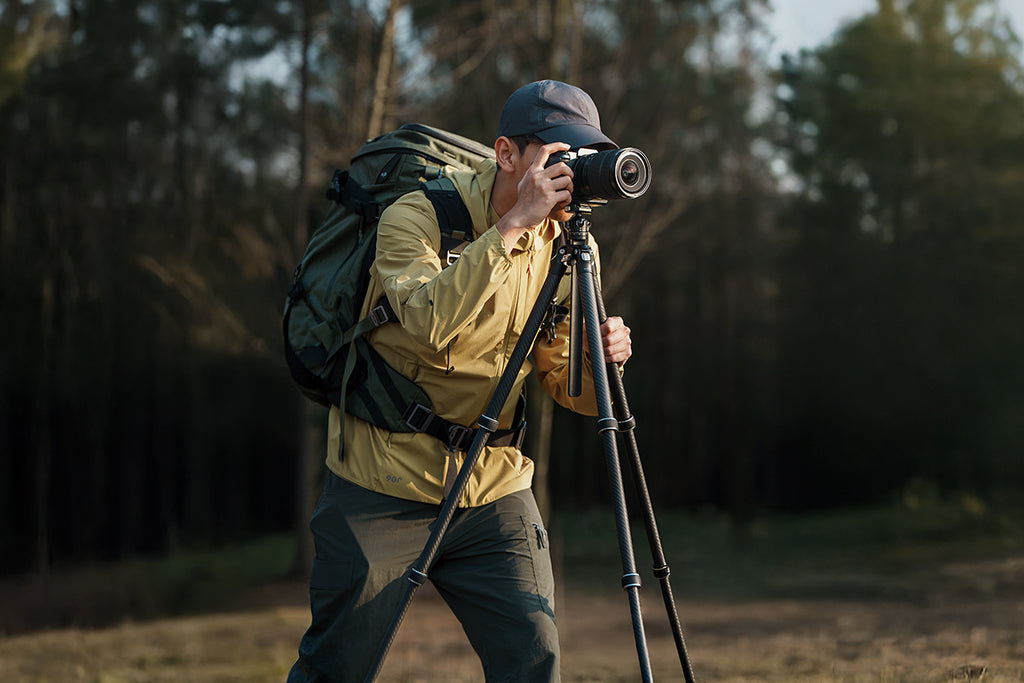
Biomechanical Analysis: Why Weight Isn't the Only Enemy
When we talk about "bulk," we often focus on the weight on the scale. However, for the solo creator carrying a rigged tripod between locations, the real enemy is Wrist Torque.
The Torque Formula
In our technical assessments, we use a simple biomechanical lever model to estimate user fatigue. The formula for Torque ($\tau$) is: $$\tau = m \times g \times L$$
- $m$: Mass of the rig (kg)
- $g$: Acceleration due to gravity ($9.8 m/s^2$)
- $L$: The lever arm or distance from your wrist to the center of gravity (m)
The MVC Threshold
If you carry a 3kg rigged tripod (tripod + camera + accessories) by one leg, and the center of gravity is offset by 0.25m, you generate approximately 7.36 N·m of torque on your wrist.
For many creators, this represents nearly 70-80% of their Maximum Voluntary Contraction (MVC)—the maximum force a muscle can generate in a single contraction. Sustaining this load during a 20-minute hike to a location leads to rapid muscle fatigue and increased risk of tendon strain. This is why we advocate for modular systems where accessories can be quickly detached and stowed in a backpack side pocket, rather than being permanently "bolted on."
The Ecosystem Shift: Modular Infrastructure for Efficiency
The key to rigging without bulk is moving away from permanent, screw-based attachments toward a unified modular ecosystem. As highlighted in The 2026 Creator Infrastructure Report, the industry is shifting toward "infrastructure-first" rigging.
Standardizing the Interface
The foundation of a smart travel rig is the Arca-Swiss Dovetail standard. By using Arca-compatible quick-release systems, you eliminate the need for tools in the field.
However, not all quick-release systems are equal. For mobile producers, we categorize the hardware by the "Tier of Utility":
- F38 Series (The Workhorse): Optimized for camera-to-tripod transitions. It provides a 80kg vertical static load capacity (based on lab testing), which is more than sufficient for mirrorless setups. Note that for dynamic payloads—like running with a heavy rig—the dynamic capacity is lower, and proper locking is essential.
- F22 Series (The Modular Specialist): Designed for small accessories. Instead of bulky cold shoe clamps, F22 mounts allow you to "click" a monitor or microphone into place in seconds.
- F50 Series (The Heavy Lift): For creators using larger cinema-style rigs that require a wider base and more robust locking mechanisms.
Material Accuracy Note
It is a common misconception that high-end quick-release plates are made of carbon fiber. In reality, precision plates like the FALCAM series are machined from Aluminum Alloy (typically 6061 or 7075). Aluminum is chosen for its rigidity and zero-play machining tolerances. While carbon fiber is excellent for tripod legs due to damping, it is not suitable for the high-friction, high-stress interface of a quick-release locking pin.
Workflow ROI: Quantifying the Modular Advantage
Switching to a modular quick-release system isn't just about convenience; it is a significant time-saver that translates into financial value for professional creators.
The Time-Saving Calculation
We compared two common workflows:
- Traditional Thread Mounting: Unthreading a 1/4"-20 screw, aligning the accessory, and tightening. Average time: 40 seconds per swap.
- Modular Quick Release: Pressing a button and sliding the accessory into place. Average time: 3 seconds per swap.
For a professional producer performing 60 swaps per shoot (switching from tripod to handheld, changing mics, or adjusting lights) across 80 shoots a year, the modular system saves approximately 49 hours annually.
| Metric | Traditional Workflow | Modular Workflow | Savings |
|---|---|---|---|
| Time per swap | 40 seconds | 3 seconds | 37 seconds |
| Swaps per year | 4,800 | 4,800 | - |
| Total Time | 53.3 hours | 4 hours | ~49 hours |
At a professional rate of $120/hr, this efficiency gain represents a ~$5,900 annual value. This data demonstrates why investing in a structured ecosystem like FALCAM is a strategic business decision, not just a gear upgrade. For more on this, see our guide on Standardizing Your Rig.
Travel Logistics and "Visual Weight"
For the solo traveler, "Visual Weight" is just as important as physical weight. A tripod that looks like a complex industrial machine is more likely to be flagged by airline gate agents for weighing or restricted as "professional equipment" in sensitive areas.
Modular systems allow you to maintain a "Low Visual Profile." By using compact F22 mounts, your accessories sit closer to the tripod body, reducing the overall footprint. This modularity also aids in compliance with IATA Lithium Battery Guidance. Since many accessories like LED lights contain lithium batteries, being able to quickly detach them for carry-on storage while the tripod is checked or stowed is a logistical necessity.
Professional Safety Workflows
Rigging a tripod involves more than just clicking parts together. To ensure the safety of your gear and the quality of your content, we recommend the following expert practices.
The Pre-Shoot Safety Checklist
Before every shoot, perform the "A.T.V." Test:
- Audible: Do you hear the distinct "Click" when the plate seats?
- Tactile: Perform the "Tug Test." Pull firmly on the accessory to ensure the locking pin is fully engaged.
- Visual: Check the locking indicator. Many professional mounts feature an orange or silver indicator to show when the secondary lock is disengaged.
Cable Management and Torque Relief
A heavy HDMI or XLR cable can act as a lever, creating unwanted torque that could potentially loosen a mount over time. We suggest using Velcro cable ties (a simple travel hack) to secure wires to the tripod legs. For a more professional solution, F22 cable clamps provide strain relief, ensuring that a snagged cable doesn't pull your camera off-balance.
Thermal Shock Prevention
In extreme cold, aluminum quick-release plates act as a "thermal bridge," conducting cold directly to your camera's battery compartment. We recommend attaching your plates to the camera indoors before heading out. This minimizes the "metal-to-skin" shock and helps maintain battery temperature for longer runtimes.
Appendix: Modeling Notes & Assumptions
To provide transparent and reproducible insights, the following parameters were used in our scenario modeling for this article.
| Parameter | Value | Unit | Rationale |
|---|---|---|---|
| Tripod Mass | 1.3 | kg | Average weight of a carbon fiber travel tripod. |
| Camera Payload | 1.2 | kg | Typical mirrorless body + lens + compact mic. |
| Ballast (Water Bottle) | 0.5 | kg | Standard counterweight used to lower center of gravity. |
| Center of Pressure Height | 1.6 | m | Height of accessories mounted at maximum extension. |
| Drag Coefficient | 1.3 | - | Estimated for a turbulent "Franken-rig" profile. |
| Wrist MVC Limit | 10 | N·m | Average static strength threshold for adult users. |
Boundary Conditions: These models are deterministic and based on steady-state assumptions. Wind stability calculations (ASCE 7 standards) do not account for sudden gusts exceeding 1.5x the mean wind speed. Vibration damping benefits assume a high-quality resin matrix in the carbon fiber; lower-grade composites may exhibit different damping ratios.
YMYL Disclaimer: This article provides technical rigging advice for camera equipment. It is for informational purposes only. Improperly secured equipment can cause injury or property damage. Always verify load capacities for your specific gear and consult a biomechanics professional if you experience persistent wrist or back pain from carrying heavy equipment.


