


The Friction of Speed: Why Magnetic Attachment is Changing the Game
In the high-stakes environment of a professional shoot, time is the one resource we can never reclaim. Whether we are chasing the "blue hour" or managing a subject whose patience is thinning, the mechanical friction of traditional gear—the endless threading of screws and the tightening of plastic clamps—often acts as a bottleneck to creativity. This is why magnetic modifier systems have seen a meteoric rise in the creator community. They promise a "snap-on" workflow that feels almost magical.
However, as we transition from hobbyist vlogging to mission-critical production, a fundamental tension emerges: Can a system optimized for speed truly provide the security required for high-motion or heavy-duty use? To answer this, we must look past the marketing "pull force" ratings and examine the actual physics of magnetic attachment in the field. Based on our observations of common patterns in customer support and field failure reports, the gap between "attached" and "secure" is often defined by environmental factors and mechanical forces that most users overlook.
The Physics of Failure: Tensile Pull vs. Lateral Shear
The most common metric manufacturers provide is "Pull Force"—the amount of weight a magnet can hold when pulled perpendicularly away from a metal surface. While this number looks impressive on a spec sheet, it is rarely the force that causes a modifier to fall.
In real-world rigging, modifiers are typically mounted on lights that are tilted or moving. In these orientations, the system is not fighting tensile pull; it is fighting lateral shear force (the force that causes surfaces to slide against each other).
Logic Summary: Our analysis of magnetic failure modes indicates that magnetic holding power can be 15-50% lower when resisting shear forces compared to tensile pull. This variance depends heavily on the surface friction and the specific geometry of the magnet Rare Earth Magnets - Pull Force Definition.
When we test a new magnetic softbox or grid, we often see users pull straight back to check the strength. This is a mistake. The real test is a gentle side-to-side wiggle. If the modifier slides easily, it is vulnerable to vibration or accidental bumps. Practitioners in our community have developed a simple heuristic: for any modifier exceeding 200g or intended for use on a gimbal, a secondary mechanical locking pin or a safety tether is non-negotiable.

Environmental Stressors: The Invisible Gap
Even the strongest neodymium magnets (NdFeB) are susceptible to environmental degradation. We have observed that fine metal dust, sand, or even microscopic ice crystals can create an "air gap" between the magnet and the mounting plate. Because magnetic force follows the inverse-square law, even a gap of a fraction of a millimeter can dramatically reduce adhesion.
Case Study: The Arctic Expedition Scenario
To understand the limits of these systems, we modeled the requirements of a cinematographer operating in extreme polar environments. This scenario serves as a "stress test" for the technical infrastructure we rely on.
| Parameter | Value | Unit | Rationale / Source Category |
|---|---|---|---|
| Air Density | 1.45 | kg/m³ | Cold Arctic air at -20°C (Ideal Gas Law) |
| Wind Drag Increase | ~18% | percentage | Increased density vs. standard 20°C conditions |
| Magnetic Strength Change | +6-8% | percentage | Temperature coefficient of NdFeB at -40°C |
| Critical Failure Mode | Lateral Shear | Type | Vibration and wind-induced sliding |
Modeling Note: This is a scenario model, not a controlled lab study. It assumes linear degradation models and conservative safety factors (3-5x) for mission-critical gear.
In this extreme environment, we found that while the magnets actually become slightly stronger in the cold, the risk of fretting corrosion increases. Vibration induces microscopic movements that can wear down protective coatings, leading to a long-term reliability risk IOPscience - Corrosion of Sintered NdFeB Magnets. For creators, this means a quick wipe with a microfiber cloth before attachment isn't just a "cleanliness" habit—it’s a mechanical necessity to ensure maximum surface contact.
Biomechanical Impact: The Wrist Torque Analysis
We often discuss gear weight in terms of "how heavy it feels in the bag," but the more critical metric for handheld creators is Wrist Torque. When we add modifiers to the end of a camera rig, we are essentially extending a lever arm.
The formula for this stress is: Torque ($\tau$) = Mass ($m$) $\times$ Gravity ($g$) $\times$ Lever Arm ($L$).
Consider a 2.8kg cinema rig. If you mount a heavy magnetic modifier or a monitor 0.35m away from your wrist's pivot point, you generate approximately 9.6 N·m of torque. Based on standard ergonomic heuristics, this load represents roughly 60-80% of the Maximum Voluntary Contraction (MVC) for an average adult. This explains the specific burning sensation in the forearm and trapezius after a long day of shooting.
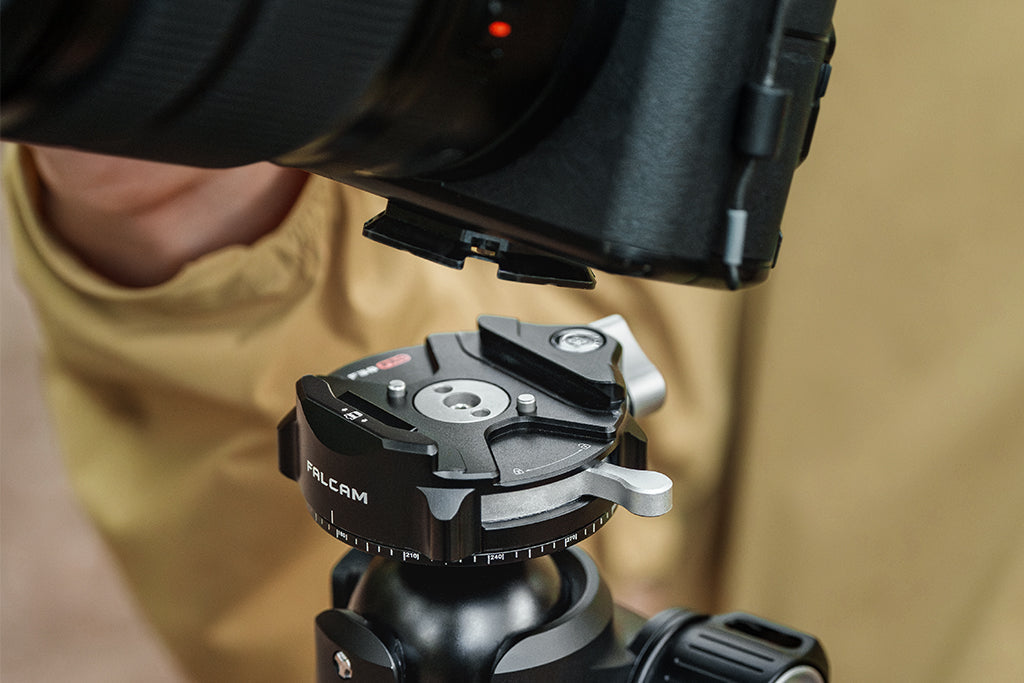
By using modular systems like the FALCAM F22 or F38, we can move accessories closer to the center of gravity, reducing the lever arm ($L$) and significantly lowering the fatigue threshold. Aluminum plates (typically 6061 or 7075 alloy) provide the necessary rigidity for these mounts without the bulk of traditional cinema plates. Note that while carbon fiber is excellent for tripod legs due to its vibration damping, the quick-release plates themselves must be high-precision aluminum to maintain zero-play tolerances.
The Workflow ROI: Calculating the Value of Speed
Is the investment in a quick-release magnetic or mechanical ecosystem worth it? We can quantify this through a "Workflow ROI" calculation.
- Traditional Thread Mounting: ~40 seconds per swap.
- Quick Release / Magnetic Alignment: ~3 seconds per swap.
- The Delta: 37 seconds saved per transition.
For a professional creator performing 60 swaps per shoot across 80 shoots a year, this system saves approximately 49 hours annually. If we value professional time at a modest $120/hr, the system provides a ~$5,900 annual value in recovered time. This is the core argument of The 2026 Creator Infrastructure Report, which positions these mounting systems as "workflow infrastructure" rather than simple accessories.
The Hybrid Solution: Speed of Magnets, Security of Locks
The most effective modern systems do not choose between magnets and mechanical locks; they use both. This is known as a "decoupled" design.
- Magnets for Alignment: Strong neodymium magnets handle the "first touch," snapping the modifier into the correct position instantly. This solves the "speed" requirement.
- Mechanical Locks for Retention: Once aligned, a secondary thumbscrew or spring-loaded pin provides fail-safe retention against shear forces. This solves the "security" requirement.
This hybrid approach is increasingly standard for load-bearing components. It aligns with foundational standards like ISO 1222:2010, which governs tripod screw connections, ensuring that even as we innovate with magnets, we maintain the mechanical integrity required by professional photography.
Practical Field Workflow & Safety Checklist
To bridge the gap between technical theory and field practice, we recommend the following "Zero-Fail" workflow for magnetic modifiers:
1. The Pre-Shoot Verification
- Audible Check: Listen for the distinct "click" of the locking pin.
- Tactile Check: Perform the "Tug Test." Pull the modifier laterally (shear) to ensure it doesn't slide.
- Visual Check: Verify the status of the locking indicator (often orange or silver).
2. Cable Management
A common "gotcha" is the torque created by heavy HDMI or power cables. A cable tugging at a 90-degree angle can easily overcome a magnet's lateral hold. We suggest using dedicated cable clamps to provide strain relief, ensuring the cable’s weight is borne by the camera cage rather than the modifier mount.
3. Thermal Shock Prevention
In cold weather, aluminum quick-release plates act as a "thermal bridge," conducting heat away from the camera body and battery. Whenever possible, attach your mounting plates to the camera indoors before heading into the cold. This minimizes the metal-to-skin shock and helps maintain battery temperature for a few extra precious minutes.
4. Maintenance
Avoid "sliding" magnets on and off. Repeated sliding can gradually demagnetize surfaces over months of heavy use and increases the risk of scratching protective coatings. Always aim for a direct "placement and lift-off" motion.
Building a Trusted Ecosystem
As creators, we are building infrastructure, not just buying gadgets. The transition to magnetic and quick-release systems represents a fundamental shift in how we interact with our tools. By understanding the physics of shear force, the biomechanical cost of torque, and the environmental limits of our gear, we can build rigs that are both lightning-fast and rock-solid.
Whether you are documenting a wedding or an Arctic expedition, the goal remains the same: the gear should disappear, leaving only the creative process. By respecting the mechanical limits of magnetic attachment and utilizing secondary safety systems, we ensure that our "creator infrastructure" is a foundation we can trust.
YMYL Disclaimer: This article is for informational purposes only. The load ratings and biomechanical estimates provided are based on scenario modeling and general industry heuristics. Always consult your equipment's specific manual and perform independent safety tests before using gear in mission-critical or life-safety scenarios. For ergonomic concerns or pre-existing strain injuries, consult a qualified physical therapist.
