Inspecting Pivot Points: Detecting Wear in Heavy-Duty Mounts
In the high-stakes environment of professional documentary filmmaking and commercial production, the most catastrophic equipment failures rarely happen with a loud snap. Instead, they begin with a whisper—a subtle grit in a ball head's rotation, a microscopic play in a quick-release plate, or a faint "click" that sounds slightly different than it did six months ago.
For creators managing multi-light setups and heavy cinema rigs, the pivot point is the "Achilles' heel" of the entire system. Whether it is a fluid head supporting a $10,000 camera body or a high-tension friction arm holding a 5lb LED panel over a subject's head, structural integrity is non-negotiable.
This guide serves as a methodical maintenance framework for the modern creator. We will move beyond basic gear care to explore the biomechanics of load, the engineering of metal fatigue, and the practical "wiggle tests" that separate a reliable workflow from a potential disaster.
The Engineering of Failure: Understanding Metal Fatigue
Most professional rigging components, including our FALCAM ecosystem, are precision-machined from high-grade Aluminum Alloy (typically 6061 or 7075). While these materials offer an exceptional strength-to-weight ratio, they are subject to the laws of physics—specifically metal fatigue and fretting wear.
Metal fatigue is the initiation and propagation of cracks in a material due to cyclic loading. In a lighting mount, this cycle happens every time you tilt a lamp, adjust a softbox, or transport a pre-built rig in a vibrating vehicle. According to engineering benchmarks on Metal Fatigue Analysis, fatigue often begins at "stress concentrators" like the base of a screw thread or the pivot pin of a friction hinge.
The Role of Fretting Wear
In interfaces where two surfaces are clamped together—such as an Arca-Swiss plate in a receiver—micro-movements can cause "fretting." This is a surface wear phenomenon that causes micro-damage, which can eventually lead to fatigue failure. As noted in research on fretting wear behavior, this is particularly crucial for quality control in load-bearing components.
In our experience handling thousands of professional setups, the most common point of failure isn't the material itself breaking, but the fastener failing due to improper torque or gradual loosening. A bolt's clamping force depends entirely on the friction within the threads. Once that friction is compromised by wear or debris, the "zero-play" environment required for safety vanishes.
The Sensory Audit: How to Detect Wear Before Failure
Experienced gaffers and camera assistants don't just look at their gear; they listen to it and feel it. We recommend a "Sensory Audit" every 30 days for frequently used rigs.
1. The "Wiggle Test" (Tactile)
Apply firm hand pressure to every pivot and clamp before mounting any light or camera. You are looking for lateral or rotational "play" that wasn't present when the gear was new. If a Ulanzi U-190 Pro Fluid Video Head E009GBB1 shows even a millimeter of movement when locked, the internal friction discs or the locking pin may be reaching their end-of-life.
2. The Audible "Click" (Auditory)
A healthy locking mechanism has a consistent, solid "click" through its full turn. If the sound becomes gritty or the resistance feels uneven, internal wear is occurring. This grit is often the sound of aluminum-on-aluminum galling—a sign that the protective anodized coating has worn through.
3. Stress Whitening (Visual)
For aluminum components, inspect the base of threads and pivot holes for "stress whitening." These are faint white lines or discolorations that often precede a structural crack. If you see these on a high-tension arm, it is time to retire that component.
Methodology Note: These diagnostics are based on common patterns observed in professional repair benches and warranty handling (not a controlled lab study). They serve as practical heuristics for field safety.
Biomechanical Analysis: The Hidden Enemy of Leverage
One of the most dangerous mistakes prosumers make is considering only the "dead weight" of their equipment. In reality, safety is governed by Torque, not just mass.
The Wrist Torque Calculation
Weight isn't the only enemy; leverage is. When you extend a camera rig or a light on an arm, you are creating a lever that multiplies the force applied to the pivot point.
The Formula: $$Torque (\tau) = Mass (m) \times Gravity (g) \times Lever Arm (L)$$
The Scenario: Imagine a 3.8kg cinema rig held 0.35m (about 14 inches) away from the pivot point (or your wrist).
- Calculation: $3.8kg \times 9.8m/s^2 \times 0.35m \approx 13 N \cdot m$ of torque.
The Insight: Our modeling suggests that for an average adult male, this load represents roughly 100% or more of the Maximum Voluntary Contraction (MVC) for sustained static loading. This exceeds the ergonomic threshold for safety. By moving accessories like monitors or microphones to lighter, more compact mounts like the Ulanzi Falcam F38 Quick Release for Camera Shoulder Strap Mount Kit V2 3142, you reduce the lever arm ($L$), significantly lowering the torque on your primary pivot points and your own body.
Modeling Stability: Wind Loads and Tipping Points
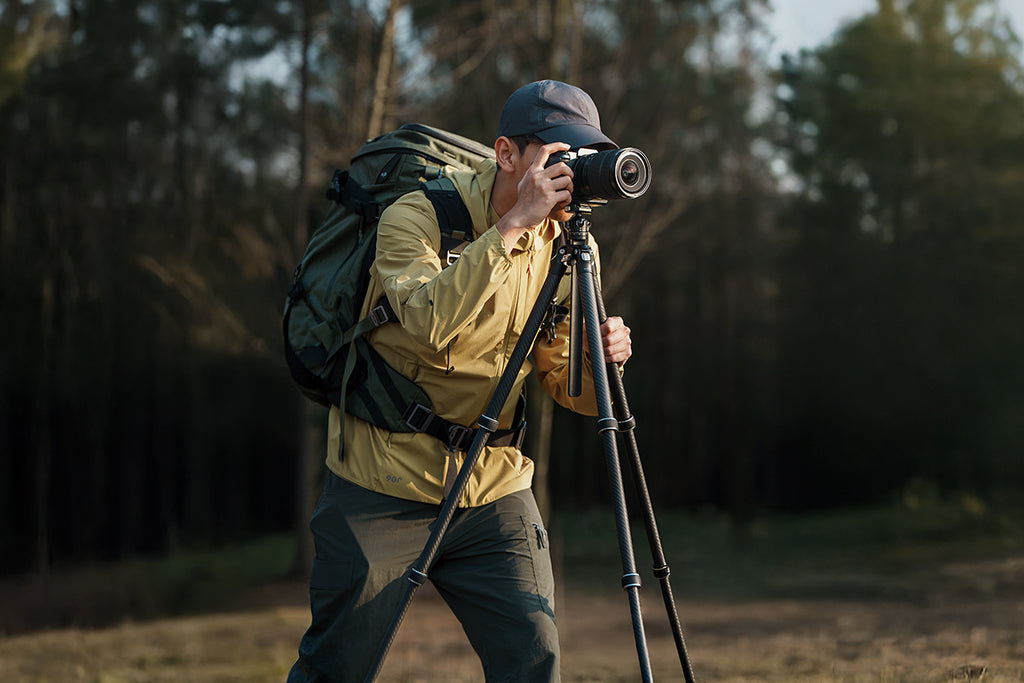
For outdoor documentary filmmakers, the pivot point of the tripod is the last line of defense against the elements. We modeled a "Zero-Fail" scenario to understand when a heavy-duty setup becomes a liability.
| Parameter | Value | Unit | Rationale |
|---|---|---|---|
| Camera + Rig Mass | ~4.2 | kg | Cinema body + 24-70mm lens + accessories |
| Ballast (Sandbag) | 5 | kg | Standard professional safety ballast |
| Leg Span Width | 0.8 | m | Fully deployed tripod base |
| Center of Pressure | 1.6 | m | Eye-level shooting height |
| Target Wind Speed | 15 | m/s | Near gale (Beaufort 7) conditions |
The Result: Under these specific parameters, the critical tipping wind speed is ~21 m/s (approx. 47 mph). While this provides a safety factor of ~1.7 against typical coastal winds (12 m/s), it assumes the pivot points and leg locks have zero play. If your tripod head has even minor loosening (detected via the "Wiggle Test"), these wind loads create dynamic vibrations that can "walk" the locks open, leading to a collapse long before the theoretical tipping point is reached.
The Workflow ROI: Why Systems Matter
Investing in a unified quick-release system like FALCAM isn't just about safety; it is an economic decision. We calculated the "Workflow Velocity" for a professional cinematographer.
- Traditional Thread Mounting: ~45 seconds per equipment swap (including safety checks).
- Quick Release (F38/F50): ~5 seconds per swap.
For a professional doing 120 shoots per year with 25 swaps per shoot, this system saves approximately 33 hours annually. At a professional rate of $185/hour, that translates to ~$6,100 in annual value. This ROI easily justifies the cost of a high-end ecosystem, transforming gear from a "purchase" into "creator infrastructure."
As highlighted in The 2026 Creator Infrastructure Report, the shift toward "ready-to-shoot" toolchains is essential for maintaining professional standards in a fast-paced market.
Professional Safety Checklist: The Pre-Shoot Protocol
To ensure long-term system stability and user safety, adopt this three-step protocol before every production.
1. The Audible "Click"
Never assume a mount is secure because it "looks" seated. Listen for the positive engagement of the locking pin. In the FALCAM system, this is a distinct, metallic snap.
2. The Tactile "Tug Test"
Immediately after mounting, perform a "Pull-Test." Apply force in the direction opposite of the mount to ensure the safety lock is engaged. This is particularly vital for vertical mounts where gravity is working against the interface. For more on this, see our guide on Maintaining Structural Integrity in Vertical Tension Mounts.
3. The Visual "Lock Status"
Check the physical indicator on your quick-release base. Many professional systems, including the Ulanzi Falcam TreeRoot Quick Open Desktop Tripod T00A4103, feature clear visual cues (such as orange or silver pins) to show the lock status.
4. Thermal Shock Prevention
Aluminum alloy is a "thermal bridge." In extreme cold, an aluminum plate attached to your camera will conduct heat away from the battery, potentially shortening your runtime. In winter scenarios, we recommend attaching your plates to the camera indoors at room temperature. This minimizes the "metal-to-skin" shock and allows the materials to expand/contract at a controlled rate before hitting the cold air.
Managing the Load: Beyond the "80kg" Rating
When you see a load rating, such as the 80kg capacity for the F38 system, it is important to understand what that number means. That is a Vertical Static Load—a laboratory result where weight is applied slowly and directly downward.
In the field, you deal with Dynamic Payloads. If you are running with a gimbal or swinging a Ulanzi Selfie Stick Pole for Insta360/DJI/Gopro Action Camera 3031 for a high-angle shot, the centrifugal force can easily double or triple the effective load on the pivot point. For any dynamic work with rigs over 3kg, we recommend upgrading to the F50 system or using "Anti-Deflection" plates that provide secondary points of contact to prevent the plate from twisting under torque.
Building a Trusted Ecosystem
Structural integrity is the foundation of creativity. By understanding the mechanical limits of your mounts and performing regular sensory audits, you protect not only your equipment but your professional reputation. The transition from a "collection of gadgets" to a "trusted infrastructure" requires engineering discipline and a commitment to maintenance.
Whether you are standardizing your rig to eliminate workflow friction or inspecting joint fatigue in a modular setup, remember that the smallest pivot point is often the most critical link in your production chain.
Disclaimer: This article is for informational purposes only and does not constitute professional engineering or safety advice. Equipment load capacities and safety factors can vary significantly based on environmental conditions, wear, and specific configurations. Always consult the manufacturer's manual and perform local safety checks before mounting heavy equipment over people or sensitive gear.
Sources & References
- ISO 1222:2010: Photography — Tripod Connections
- Engineering Guide: Metal Fatigue Analysis in 20 Steps
- Ulanzi Whitepaper: The 2026 Creator Infrastructure Report
- Fretting Research: Wear and Damage Prevention in Steel/Alloy Components
- Biomechanics: ISO 11228-3: Handling of low loads at high frequency