


Choosing Fluid Heads for Wildlife and Long-Lens Travel
For the solo travel videographer, the pursuit of wildlife is a constant negotiation between portability and physical laws. We often see creators invest thousands in high-end telephoto glass, only to mount it on a support system that fails the first time a breeze picks up on the savannah or a coastal cliff. In our field observations, the most common point of failure isn't the tripod's legs—it's the fluid head's inability to manage the extreme torque of a long-lens system.
Choosing a fluid head for long-distance travel requires moving beyond simple "max payload" ratings. You must evaluate how a head handles dynamic loads, environmental stressors, and the high-stakes reality of mission-critical gear. This guide breaks down the engineering requirements for a professional wildlife support system, grounded in biomechanical modeling and technical standards.
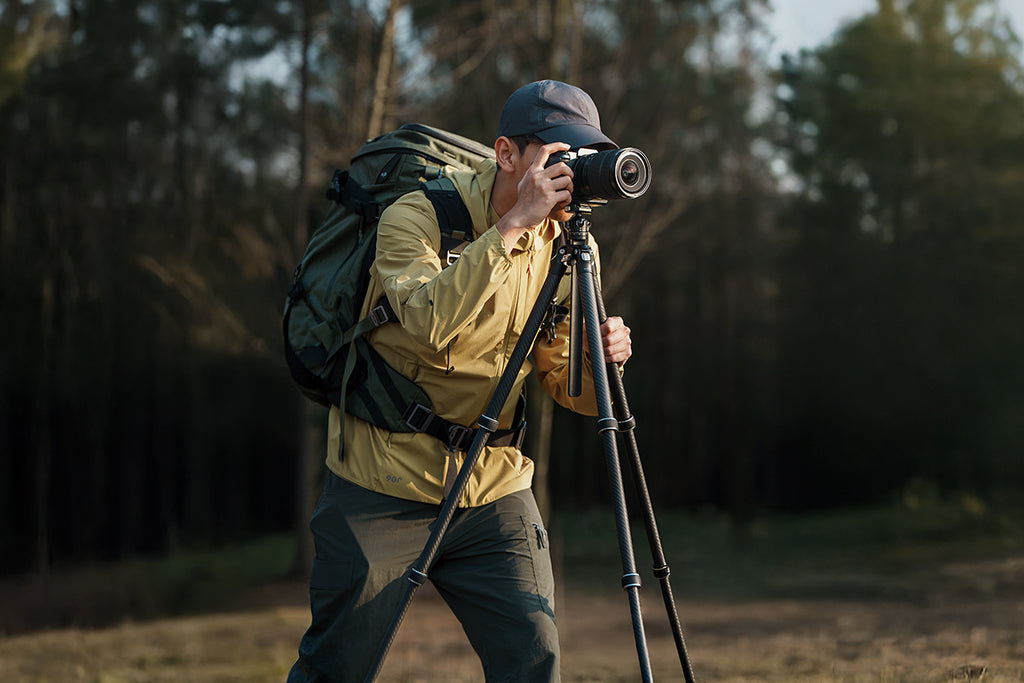
1. The Physics of Torque: Why Payload Ratings Lie
A common mistake we observe is choosing a fluid head based solely on its static payload rating. If a head is rated for 6kg and your camera rig weighs 4kg, it should work, right? In reality, for wildlife shooters using 400mm, 600mm, or 200-600mm lenses, the weight is only half the story. The true enemy is Torque.
The Biomechanical Analysis of Leverage
When you extend a long lens, you are creating a massive lever arm. The center of gravity (CoG) shifts far forward of the mounting point. This creates a rotational force that the fluid head’s tilt drag and counterbalance must counteract.
We use a fundamental calculation to estimate this stress: Torque ($\tau$) = Mass ($m$) $\times$ Gravity ($g$) $\times$ Lever Arm ($L$)
Consider a typical high-performance travel kit: a Sony A7IV paired with a 200-600mm lens, totaling approximately 3.2kg. If the center of gravity is 0.35 meters from the pivot point, the torque generated is:
- 3.2kg $\times$ 9.81 $m/s^2$ $\times$ 0.35m $\approx$ 11.0 Nm
Logic Summary: Our analysis assumes a horizontal camera position (maximum moment). This 11.0 Nm load represents a significant portion of the mechanical limit for compact travel heads. For reference, this torque level can exceed the sustainable static holding limit for a human wrist (approx. 1.9 Nm) by over 500%, explaining why a high-quality fluid head is an ergonomic necessity, not a luxury.
The 1.5x - 2x Heuristic
To prevent "drop" (the camera falling forward when you let go) or "creep" (a slow tilt during a shot), we recommend a professional heuristic: For telephoto work, select a head with a payload rating at least 1.5 to 2 times the total weight of your camera and lens. This extra headroom ensures the internal springs and fluid chambers are operating within their linear range, providing smooth starts and stops rather than jerky "stiction."
2. Fluid Damping Mechanics and Environmental Resilience
The "fluid" in a fluid head isn't just a marketing term; it refers to the internal chambers filled with specialized silicone oil that provides resistance. However, this resistance is not a fixed constant.
Temperature and Viscosity
Environmental factors are often underestimated. According to technical documentation on Thermal & Environmental Testing, temperature extremes noticeably alter fluid viscosity. In the freezing dawn of a mountain shoot, the oil thickens, making the head feel stiff or "gummy." Conversely, in tropical heat, the damping may feel too light.
Field Practice: Perform final tension and drag adjustments on location after the gear has acclimatized for 15–20 minutes. This allows the fluid to reach ambient temperature, ensuring your drag settings remain consistent throughout the shoot.
Tracking vs. Sweeping
Experienced shooters back off the drag significantly when tracking fast-moving subjects like birds in flight. This relies more on manual technique than mechanical resistance. However, for slow, sweeping pans of distant herds, a medium-to-high drag setting is essential to eliminate micro-jitters that are magnified at 600mm.
3. The Stability Pyramid: Carbon Fiber vs. Aluminum
For the travel videographer, the choice between carbon fiber and aluminum tripod legs is often framed as a weight issue. However, our scenario modeling reveals a more complex relationship between material science and field performance.
Modeling Stability and Vibration
We simulated a 3.2kg telephoto rig on a 1.1kg carbon fiber travel tripod (typical of the Ulanzi Zero Y class) versus a standard aluminum setup. The results highlight a critical "Weight Paradox."
| Metric | Carbon Fiber (1.1kg) | Aluminum (2.4kg) | Advantage |
|---|---|---|---|
| Vibration Settling Time | ~1.4 seconds | ~6.6 seconds | Carbon Fiber (78% faster) |
| Natural Frequency | ~16.8 Hz | ~8.0 Hz | Carbon Fiber (Higher/Better) |
| Critical Tipping Wind Speed | ~12.6 m/s (45 km/h) | ~18.5 m/s (66 km/h) | Aluminum (More Stable) |
Method & Assumptions:
- Model Type: Deterministic static equilibrium and SDOF damped vibration model.
- Inputs: 3.2kg payload, 1.6m height, 0.06m² frontal area (telephoto lens).
- Boundary Conditions: Assumes steady-state wind perpendicular to the leg axis; ignores ground resonance.
- Logic: Carbon fiber's higher specific stiffness allows it to settle vibrations nearly 5 times faster than aluminum, which is vital for high-resolution sensors. However, its lower mass makes it more prone to tipping in high winds.
The Pro Insight: If you choose a lightweight carbon fiber system for travel, you must carry a way to add ballast. Hanging a backpack from the center column hook isn't just a suggestion—it's a requirement to survive coastal or savannah winds.
4. Workflow ROI: The Ecosystem Shift
In professional wildlife videography, the "golden hour" is often only a few minutes long. Speed of deployment is a mission-critical metric. This is where modular quick-release (QR) systems like the Falcam F38 or F50 provide a quantifiable return on investment.
The Financial Logic of Seconds
We can calculate the "Workflow ROI" of switching from traditional screw-thread mounting to a high-speed quick-release ecosystem.
- Traditional Mounting: ~40 seconds per swap (finding the thread, tightening, checking).
- Quick-Release (F38/F50): ~3 seconds per swap (click-and-lock).
- Time Saved: 37 seconds per transition.
For a professional creator performing 60 swaps per shoot (switching between tripod, monopod, and gimbal) across 80 shoots a year, this saves approximately 49 hours annually. At a professional rate of $120/hr, the system pays for itself many times over in recovered billable time.
Material Integrity: Aluminum vs. Carbon Fiber
A critical distinction must be made regarding QR plates. While tripod legs benefit from carbon fiber's damping, Quick Release plates (like the Falcam series) must be precision-machined from Aluminum Alloy (6061 or 7075). Carbon fiber is excellent for tubes but lacks the shear strength and machining tolerances required for the "zero-play" interface of a wedge-lock system. Aluminum provides the necessary rigidity and durability for the high-pressure contact points of a fluid head.
Safety Note: Aluminum acts as a "thermal bridge." In extreme cold, an aluminum plate can conduct heat away from your camera's battery. We recommend attaching plates to your camera indoors before heading out to minimize thermal shock to the electronics.
5. Mission-Critical Safety and Setup
When your gear is perched on a tripod in a remote location, trust in the interface is paramount. A single failure—a plate slipping or a lock not engaging—can result in a catastrophic drop.
The "Pre-Shoot Safety Checklist"
Aligned with the 2026 Creator Infrastructure Report, we advocate for a standardized "Tactile-Audible-Visual" (TAV) workflow:
- Audible: Listen for the distinct "Click" of the locking mechanism.
- Tactile: Perform the "Tug Test." Pull up on the camera rig immediately after mounting to ensure the secondary safety lock is engaged.
- Visual: Verify the status of the locking pin or indicator (usually an orange or silver mark) to confirm the system is in the "Locked" position.
Logistics and "Visual Weight"
For international travel, modular systems like the F22 or F38 have a lower "Visual Weight." Bulky cinema-standard plates often attract the attention of airline gate agents, leading to forced gate-checking of gear. A compact, streamlined support system is more likely to pass as "personal items," keeping your critical tools in the cabin with you. Always ensure your setup complies with IATA Lithium Battery Guidance if using powered heads or accessories.
Summary of Selection Criteria
To choose the right fluid head for your next wildlife expedition, use this decision matrix:
- Determine Actual Torque: Don't just weigh the rig. Measure the distance from the mount to the lens hood.
- Apply the 1.5x Rule: Ensure the head's rated payload is significantly higher than your rig's weight.
- Match Material to Environment: Choose Carbon Fiber for vibration-sensitive high-resolution work, but always carry ballast for wind stability.
- Standardize the Interface: Use a unified quick-release system (like the Arca-Swiss compatible F38) to ensure cross-platform compatibility across all your support gear.
- Verify Standards: Ensure your connections meet ISO 1222:2010 for tripod screw connections to avoid thread stripping or mismatching.
By treating your support system as infrastructure rather than just an accessory, you build a workflow that is resilient, efficient, and capable of capturing the fleeting moments that define wildlife cinematography.
Disclaimer: This article is for informational purposes only. High-altitude or extreme-environment photography involves inherent risks to equipment and personnel. Always consult manufacturer specifications for specific load limits and safety protocols.
References & Authoritative Sources
- ISO 1222:2010 Photography — Tripod Connections
- The 2026 Creator Infrastructure Report: Engineering Standards, Workflow Compliance, and the Ecosystem Shift
- IATA Lithium Battery Guidance Document (2025)
- EBU R 137 / TLCI-2012 (Television Lighting Consistency Index)
- ISO 13753: Mechanical vibration and shock — Method for measuring vibration attenuation
