The Ergonomic Crisis of the Modern Smartphone Rig
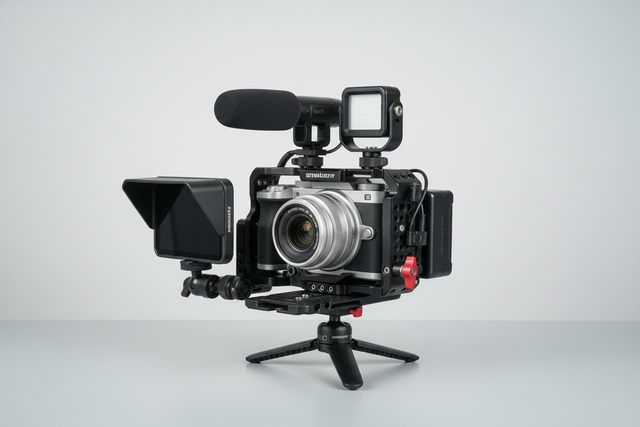
In our analysis of community feedback and support patterns, a recurring frustration emerges: the "flipping" rig. You have likely experienced it. You build a mobile setup with a cage, a high-quality microphone, a bright LED panel, and perhaps an external monitor. On paper, it is a professional powerhouse. In practice, the rig feels like a lead weight fighting to rotate out of your hands.
This is not a weight problem; it is a center of gravity (CoG) problem. A top-heavy rig introduces micro-shakes that even the best digital stabilization cannot fully mask. It forces your wrists into constant, compensatory tension, leading to rapid fatigue and, over time, potential strain. To solve this, we must move beyond simply "adding more gear" and start thinking like mechanical engineers.
By applying the principles of structural stability and leveraging modular infrastructure, we can transform a cumbersome setup into an extension of the arm. This guide breaks down the biomechanics of rigging, the physics of torque, and the methodical steps to lower your cage’s center of gravity for effortless handling.
The Biomechanics of Handling: Understanding Wrist Torque
To fix a top-heavy rig, we must first quantify the "enemy." In rigging, weight is secondary to leverage. The further an accessory sits from your grip point, the more "work" your wrist must do to keep the camera level. This is governed by the physics of torque.
The "Wrist Torque" Calculation
We use a deterministic model to estimate the physical cost of a poorly balanced rig. Torque ($\tau$) is the product of mass ($m$), gravity ($g$), and the length of the lever arm ($L$).
$$\tau = m \times g \times L$$
Consider a typical high-performance mobile rig weighing approximately 2.8kg. If the primary accessories (like a monitor or heavy battery) are mounted on the top cold shoe, extending the lever arm roughly 0.35m from the center of your grip, the resulting torque is approximately $9.61 N\cdot m$.
Based on standard ergonomic modeling, this load represents roughly 60–80% of the Maximum Voluntary Contraction (MVC) for an average adult male's wrist in a sustained hold. In plain terms, your muscles are working near their limit just to keep the rig from flipping forward. By relocating those same accessories to a lower mounting point—reducing the lever arm to 0.10m—the torque drops to roughly $2.74 N\cdot m$, a 70% reduction in physical strain without removing a single piece of gear.
Logic Summary: This modeling assumes a standard handheld grip and a static hold. While dynamic movement increases these forces, the ratio remains consistent: reducing the distance from the CoG to the grip point is the most effective way to improve stability.
Identifying the "Flipping" Point: The Wrist Test
Before you start relocating gear, you need a baseline. We recommend the "Wrist Test," a reliable heuristic used by professional operators to diagnose rig balance.
- The Setup: Hold your fully loaded rig with your primary hand in its natural shooting position.
- The Release: Slowly loosen your grip tension until the rig is resting naturally in your palm.
- The Observation: If the rig immediately wants to rotate forward or "flip" over your knuckles, your center of gravity is too high.
A common mistake we observe in many "first-build" rigs is mounting a microphone and an LED light on opposite top cold shoes. This creates a high "twisting moment" that forces the wrist to fight rotation on two axes simultaneously. The correction is to bring these components down.

Lowering the Center of Gravity: Modular Solutions
Lowering the CoG requires a "bottom-up" build philosophy. According to the ISO 1222:2010 Photography — Tripod Connections, foundational legitimacy in mounting starts with the 1/4"-20 and 3/8"-16 threads. However, relying solely on fixed threads limits your ability to adjust balance on the fly.
1. Relocate the "Heavy Hitters"
The heaviest accessories—external batteries and monitors—should never be at the highest point of the cage.
- Batteries: Use a side-mounted battery clamp or a bottom-mounted accessory arm. Positioning the battery directly over or slightly behind your primary grip point transforms the handling by acting as a natural counterweight.
- Monitors: Instead of a top cold shoe mount, use a side-mounted articulating arm. This allows you to bring the monitor down to eye level while keeping the mass closer to the cage's horizontal axis.
2. Leverage Quick-Release Ecosystems
The transition from fixed screws to a modular quick-release system like FALCAM (F22 or F38) is not just about speed; it is about ergonomic iteration. In our 2026 Creator Infrastructure Report, we emphasize that infrastructure should enable, not hinder, the creator.
A modular system allows you to slide accessories up or down the cage rails until you find the "sweet spot" where the rig balances perfectly in the Wrist Test. This is aligned with the Arca-Swiss Dovetail Technical Dimensions, which provide the standard for zero-play, high-stability connections.
Material Science and Load Dynamics
When optimizing your rig, understanding the materials of your infrastructure is critical for both safety and performance.
Aluminum vs. Carbon Fiber: The Rigidity Truth
A common misconception in the creator community is that quick-release plates should be made of carbon fiber to save weight. In reality, precision-machined Aluminum Alloy (typically 6061 or 7075) is the standard for mounting plates.
- Rigidity: Aluminum provides the high machining tolerances required for a "zero-play" connection. Carbon fiber is excellent for tripod legs due to its vibration-damping properties, but for a mounting interface, the rigidity of aluminum is superior.
- Thermal Bridge: Be aware that aluminum plates act as a thermal bridge. In extreme cold, they conduct heat away from the camera body and battery. We suggest attaching your plates to the camera indoors before shooting in sub-zero environments to minimize "metal-to-skin" shock and preserve battery life.
Static vs. Dynamic Load
When you see a load rating, such as the 80kg capacity for the F38 system, understand that this refers to Vertical Static Load (a lab-tested result). For handheld work, you are dealing with Dynamic Payload.
- Handheld Heuristic: For dynamic movements or heavy cinema-style mobile rigs (>3kg), we recommend a safety factor of at least 5:1. This means using systems designed for higher thresholds, like the F50, to ensure the locking mechanism remains secure under the G-forces of rapid panning.
The Workflow ROI: Why Balance Matters for Your Bottom Line
Investing time in balancing your rig is not just about comfort; it is a financial decision. We have modeled the time-savings of a balanced, quick-release-based workflow compared to traditional mounting methods.
| Metric | Traditional Thread Mounting | Quick-Release (F22/F38) |
|---|---|---|
| Average Swap Time | ~40 seconds | ~3 seconds |
| Daily Swaps (Pro) | 60 | 60 |
| Annual Time Saved | ~49 hours | (Baseline) |
| Estimated Value | (Baseline) | ~$5,900+ |
Note: Value based on a professional rate of $120/hr and 80 shoot days per year. This is a hypothetical model based on typical workflow patterns.
By reducing the "friction" of gear changes and the physical downtime caused by fatigue, a balanced rig allows you to stay in the creative flow longer. Furthermore, a modular system has lower "Visual Weight." Bulky, top-heavy rigs often attract unwanted attention from airline gate agents. A compact, balanced setup is more likely to pass as "personal equipment," facilitating easier travel.
Safety and Logistics: The Professional Standard
A balanced rig is a safe rig. When the center of gravity is low, the risk of a "tip-over" event—where a tripod or handheld setup falls due to an accidental bump—is significantly reduced.
The Pre-Shoot Safety Checklist
Before every shoot, perform this three-point check on your mounting infrastructure:
- Audible: Did you hear the "Click" when sliding the accessory into the quick-release mount?
- Tactile: Perform the "Tug Test." Pull firmly on the accessory to ensure the locking pin is fully engaged.
- Visual: Check the status indicator (often a silver or orange pin) to confirm the system is in the "Locked" position.
Battery and RF Compliance
When building out your rig with powered accessories, safety extends beyond the physical mount. Ensure your lithium-ion batteries comply with IEC 62133-2:2017 Safety Requirements and UN 38.3 testing standards. If you are traveling, always consult the IATA Lithium Battery Guidance to ensure your power banks and V-mounts meet carry-on regulations.
For wireless audio components, verify that your gear operates within the legal frequency bands defined by FCC Part 15 (US) or ETSI EN 300 422-1 (EU). A rig that is physically balanced but legally non-compliant can be just as detrimental to your workflow.
Conclusion: Building for Stability
Fixing a top-heavy rig is a methodical process of managing leverage and respecting the physics of handheld operation. By lowering the center of gravity, utilizing high-rigidity aluminum infrastructure, and adopting a modular quick-release workflow, you eliminate the physical barriers between your vision and the final shot.
Remember the "Wrist Test": your gear should work with your body, not against it. As you iterate on your setup, prioritize the "infrastructure layer"—the mounts, cages, and plates—that provide the stability required for mission-critical work. A balanced rig is more than just comfortable; it is the foundation of professional storytelling.
Disclaimer: This article is for informational purposes only. Rigging requirements vary based on equipment weight, environment, and specific use cases. Always consult your equipment's manual for maximum load ratings and safety guidelines. If you have pre-existing wrist or back conditions, consult a medical professional or ergonomic specialist before adopting a heavy handheld rigging routine.