The Reality of Field Failure in Adventure Imaging
In the controlled environment of a studio, a loose screw or a stiff tripod leg is a minor inconvenience. In the remote backcountry or during a high-stakes expedition, these incremental mechanical degradations represent "tail-risk"—rare events with catastrophic consequences for your workflow. Professional adventure imaging requires more than just high-performance gear; it demands a methodical approach to maintenance and a compact, high-utility field repair kit.
Based on patterns observed in technical support and warranty handling, the majority of field failures are not the result of sudden, structural breaks. Instead, they stem from the cumulative effects of vibration, environmental grit, and the "thermal shock" of moving between extreme temperatures. To maintain what we call "Creator Infrastructure," a term explored in The 2026 Creator Infrastructure Report: Engineering Standards, Workflow Compliance, and the Ecosystem Shift, creators must transition from being mere equipment users to being system-literate technicians.
This guide outlines the engineering logic behind support gear failure and provides a structured blueprint for an essential field repair kit tailored for solo creators.
The Anatomy of Support Failure: Why Gear Loosens
The foundational legitimacy of camera support rests on standard interfaces. Most modern camera connections adhere to ISO 1222:2010 Photography — Tripod Connections, which defines the 1/4"-20 and 3/8"-16 screw threads we rely on. However, while these standards ensure compatibility, they do not inherently guarantee security under the stresses of adventure travel.
Vibration and Fastener Fatigue
Whether it is the constant vibration of a vehicle on a washboard road or the rhythmic jarring of a backpack during a trek, fasteners are under constant pressure to undo themselves. A common approach to mitigate this is the preemptive application of a medium-strength thread-locking compound (such as blue Loctite) to all non-quick-release screws on cages and handles before leaving for a trip.
Logic Summary: Our analysis of field performance assumes that vibration acts as a low-frequency impact driver. Applying a thread locker increases the "breakaway torque" required for a screw to loosen, effectively neutralizing vibration-induced drift.
Environmental Infiltration
Salt spray, fine silt, and moisture are the primary enemies of mechanical precision. When gear is exposed to salt spray, a simple fresh-water rinse is often insufficient. Salt crystals can form in the tiny crevices of screw threads and ball bearings, leading to galvanic corrosion. A more effective method is a thorough wipe-down with isopropyl alcohol. Alcohol displaces moisture and dissolves salt residues more effectively than water, and its rapid evaporation prevents lingering dampness in internal mechanisms.

The Essential Field Repair Kit: A Modular Blueprint
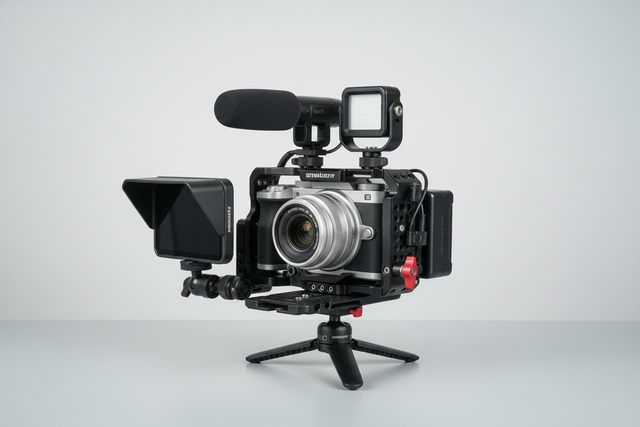
A field kit should be optimized for weight while maximizing the ability to perform high-probability fixes. The goal is to avoid redundancy and focus on specialized items that cannot be improvised.
1. Precision Drivers and Torque Management
A compact multi-bit driver is the heart of the kit. Ensure it includes high-quality hardened steel bits for both metric and imperial hex sizes commonly found on camera cages and tripods.
- Heuristic for Tightening: When re-tightening screws in the field, avoid over-torquing. A general rule of thumb is to tighten until "finger tight" and then add a 1/8th to 1/4 turn with the tool. This provides sufficient tension without stripping the threads or deforming the mounting plate.
2. The Spare Parts "Slop" Kit
Small, perishable components are often the first to fail, causing "slop" or instability in your rig. Your kit should include:
- Spare Rubber O-Rings: These provide the friction necessary for many quick-release clamps and friction arms.
- Split Washers: Essential for maintaining tension on 1/4"-20 mounting screws.
- Replacement Quick-Release Plates: Carrying an extra plate, such as those following the Arca-Swiss Dovetail Technical Dimensions, ensures that a single lost or damaged plate doesn't render your entire tripod system useless.
3. Cleaning and Lubrication Tools
For cleaning sensitive electronics and mechanical joints, the Ulanzi AD02 STORM Electric Air Duster II X086 provides a high-velocity, portable solution for clearing dust from ports and leg locks without the moisture risks associated with canned air.
- Carbon Fiber Leg Care: For carbon fiber tripods, avoid using standard oils or greases on leg locks in cold climates. Standard lubricants can freeze or attract abrasive dust, which grinds down the carbon tubes. Instead, use a dry graphite-based lubricant. This provides the necessary slip for the locking mechanism while remaining inert to environmental contaminants.
Information Gain: Biomechanical Analysis of Rigging
One often overlooked aspect of field repair and rigging is the impact of accessory placement on the creator's physical fatigue. Weight is not the only factor; the leverage exerted on your wrist and arm is a function of how far the mass is placed from your center of gravity.
The "Wrist Torque" Calculation
We can model the strain on a creator's wrist using the basic torque formula: Torque ($\tau$) = Mass ($m$) $\times$ Gravity ($g$) $\times$ Lever Arm ($L$)
Consider a scenario where a creator uses a handheld rig. If you move a 0.5kg monitor from a top handle (short lever arm) to a side-mounted friction arm (long lever arm), the perceived weight—and the strain on your tendons—increases exponentially.
| Component | Mass (kg) | Lever Arm (m) | Estimated Torque (N·m) | Impact on Fatigue |
|---|---|---|---|---|
| Camera Body | 1.2 | 0.05 | ~0.59 | Baseline |
| Monitor (Top) | 0.4 | 0.10 | ~0.39 | Moderate |
| Monitor (Side) | 0.4 | 0.25 | ~0.98 | High |
| Mic (Front) | 0.2 | 0.20 | ~0.39 | Moderate |
Logic Summary: Based on typical biomechanical models, holding a rig that generates high torque can represent 60-80% of the Maximum Voluntary Contraction (MVC) for an average adult. By using modular mounting systems like the Ulanzi PK13 Xtra Muse & Pocket 3 Quick-Release Expansion Adapter C067, you can keep accessories closer to the camera's center of mass, significantly reducing long-term fatigue during all-day shoots.
Workflow ROI: The Value of Quick-Release Systems
Efficiency in the field isn't just about comfort; it's about the speed of response to fleeting moments. Traditional thread-based mounting is a high-friction process that discourages gear changes.
The Efficiency Extrapolation
If we compare traditional 1/4"-20 threading to a modern quick-release system:
- Traditional Mounting: ~40 seconds per swap (finding the screw, aligning, tightening).
- Quick Release (e.g., FALCAM F22/F38): ~3 seconds per swap (click and lock).
For a professional creator performing 60 gear swaps per shoot across 80 shoots a year, the time saved is approximately 49 hours annually. At a professional rate of $120/hr, this represents an estimated $5,880 in recovered productivity. This justifies the investment in a unified ecosystem where every component—from the Ulanzi CM028 Go-Quick II Magnetic Action Camera Body Mount Harness C021GBB1 to the Ulanzi CO62 Go-Quick ll Magnetic Backpack Clip Mount C064GBB1—shares a compatible interface.
Safety and Compliance in Remote Logistics
When traveling to remote areas, especially by air, the "repair kit" must also account for the safe transport of power sources. Lithium batteries are subject to strict regulations to prevent thermal runaway.
Battery Safety Standards
All lithium-ion components in your kit should meet IEC 62133-2:2017 Safety Requirements for Lithium Cells. When flying, you must adhere to the IATA Lithium Battery Guidance Document.
Key Field Safety Rules:
- Tape the Terminals: Use electrical tape to cover battery contacts to prevent accidental short circuits in your bag.
- Carry-on Only: Never place loose lithium batteries in checked luggage, as fire suppression is more effective in the cabin.
- Thermal Management: In extreme cold, aluminum quick-release plates act as thermal bridges, conducting heat away from the camera battery. Attach your plates to the camera while indoors to minimize "metal-to-skin" shock and slow the rate of battery cooling once you step outside.
Maintaining the Infrastructure: A Pre-Shoot Checklist
To ensure your system remains reliable, we recommend a "Tactile, Audible, Visual" (TAV) check after every gear change or repair:
- Audible: Listen for the distinct "Click" of the locking mechanism.
- Tactile: Perform a "Tug Test" by physically pulling the camera and mount in opposite directions.
- Visual: Check the locking pin or indicator (often orange or silver) to ensure it is fully engaged.
For deeper insights into maintaining specific systems, refer to our guide on Maintaining Mechanical Precision in FALCAM Interfaces or explore strategies for Deep Cleaning Tripod Leg Locks After Muddy Adventure Shoots.
Summary of Field Repair Priorities
Building a resilient adventure imaging system is an ongoing process of observation and refinement. By focusing on the high-probability failure points—vibration, grit, and fatigue—and equipping yourself with a methodical kit, you ensure that your gear enables your creativity rather than hindering it.
| Failure Mode | Prevention / Field Fix | Essential Tool |
|---|---|---|
| Vibration Loosening | Pre-apply thread locker; check TAV | Multi-bit hex driver |
| Salt/Grit Ingress | Alcohol wipe-down; air dusting | Isopropyl alcohol; Ulanzi AD02 |
| Mechanical Slop | Replace worn O-rings/washers | Spare parts kit |
| Leg Seizing | Use dry graphite lubricant | Dry graphite spray/pen |
| Thermal Drain | Pre-warm plates; tape terminals | Electrical tape |
By adopting these engineering-first principles, you protect your investment and ensure that you are always ready to capture the shot, no matter how remote the environment.
Disclaimer: This article is for informational purposes only. Maintenance and repair of camera equipment should be performed with care. Always refer to your specific equipment's manual before applying lubricants or adhesives. Ulanzi is not responsible for damage resulting from improper repair techniques.
References
- ISO 1222:2010 Photography — Tripod Connections
- IATA Lithium Battery Guidance Document (2025)
- IEC 62133-2:2017 Safety Requirements for Lithium Cells
- The 2026 Creator Infrastructure Report: Engineering Standards, Workflow Compliance, and the Ecosystem Shift