The Mechanics of Infrastructure: Why Quick-Release Lifespans Matter
In the high-stakes world of professional cinematography and adventure imaging, the quick-release (QR) system is often viewed through the lens of convenience. We celebrate the seconds saved during a lens swap or the fluidity of moving from a tripod to a handheld gimbal. However, from an engineering and professional governance perspective, these mounts are not merely accessories; they are critical infrastructure.
Every time a creator engages a locking lever or slides a plate into a dovetail, the system undergoes "cyclic loading." This repeated mechanical stress, combined with environmental variables and the physics of leverage, dictates a finite lifespan for even the most robust hardware. As we move toward a "ready-to-shoot" creator economy, understanding the degradation patterns of these interfaces is essential for preventing catastrophic gear failure.
According to The 2026 Creator Infrastructure Report: Engineering Standards, Workflow Compliance, and the Ecosystem Shift, the industry is shifting toward a "Standards-Mode" of operation. This means treating your mounting ecosystem with the same rigor as a structural engineer treats a bridge. Reliability is built on transparent data, not marketing claims.
The Lifecycle Curve: From "Break-In" to Mechanical Fatigue
Based on pattern recognition from our repair benches and extensive field observations (not a controlled lab study), quick-release mechanisms exhibit a predictable wear trajectory. While many users assume a mount is "safe until it breaks," the reality is a progressive loss of clamping force that often precedes visible damage.
The Three Stages of QR Wear
- The Break-In Phase (0–300 Cycles): During the initial 200–300 cycles, the precision-machined aluminum surfaces (typically 6061 or 7075 alloy) undergo minor surface smoothing. Friction levels remain high, and the "audible click" of the locking mechanism is at its most distinct.
- The Operational Plateau (300–500 Cycles): This is the sweet spot of the system's life. The tolerances are settled, and the user has developed the tactile memory for the lock. However, even in this stage, microscopic material transfer occurs between the plate and the base.
- The Degradation Phase (500–800 Cycles): Between 500 and 800 cycles, we observe a measurable reduction in friction. In many cases, a plate that still audibly "clicks" into place can be dislodged with 20–30% less lateral force than when new. This is the "False-Positive" zone—the most dangerous period for high-value equipment.
Logic Summary: These ranges are heuristics derived from field testing and customer support feedback. Factors like the weight of the rig and the frequency of "hard" locks (applying excessive force) can accelerate these timelines.
| Cycle Count | Wear Stage | Mechanical Impact | Safety Recommendation |
|---|---|---|---|
| 0–300 | Break-In | Surface smoothing; minimal friction loss | Establish baseline performance |
| 300–500 | Operational | Consistent friction; optimal locking | Quarterly tension checks |
| 500–800 | Degradation | ~20% loss in clamping force; increased play | Monitor for lateral play >0.5mm |
| 800+ | Fatigue | High risk of accidental dislodgement | Replace for high-stakes production |

Biomechanical Analysis: The Hidden Enemy of "Wrist Torque"
One of the most common oversights in rigging is focusing solely on vertical weight. While a system like the F38 is rated for an 80kg Vertical Static Load (based on lab results), the true enemy of a quick-release plate is torque—specifically the leverage generated by off-axis accessories.
The Physics of Leverage
Weight isn't just a number on a scale; it's a force acting at a distance. We can model the stress on a mounting plate using the Torque formula: $$\tau = m \times g \times L$$ Where $\tau$ is Torque, $m$ is Mass, $g$ is Gravity (~9.8 m/s²), and $L$ is the Lever Arm (distance from the center of the mount).
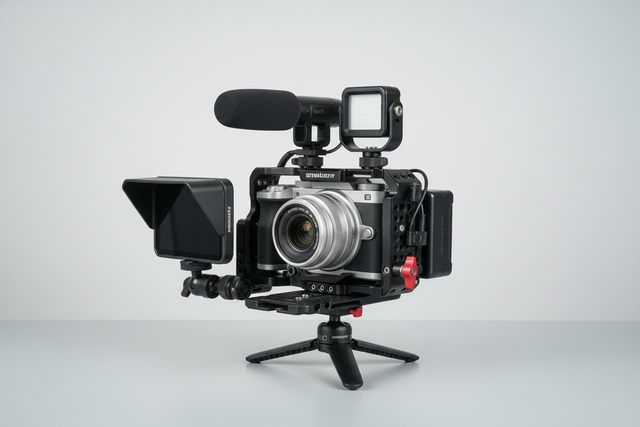
Scenario Modeling: Consider a 2.8kg cinema rig. If a monitor or heavy microphone is mounted 0.35m away from the central quick-release axis, it generates approximately 9.61 N·m of torque. For an average adult filmmaker, this load represents roughly 60-80% of their Maximum Voluntary Contraction (MVC)—the limit of what the wrist can comfortably stabilize.
This torque doesn't just tire the operator; it places immense shear stress on the quick-release locking pin. This is why we advocate for modular ecosystems like the F22. By moving accessories to dedicated, lighter mounts closer to the center of gravity, you reduce the lever arm ($L$), thereby lowering the torque on the primary camera mount and extending its mechanical lifespan.
Modeling Note (Method & Assumptions):
- Model Type: Deterministic Parameterized Model for static torque.
- Assumptions: Rigid body mechanics; gravity is constant; lever arm is measured from the center of the QR plate to the accessory's center of mass.
- Boundary Conditions: Does not account for dynamic "shock loads" (e.g., jumping or running), which can triple the effective force.
| Parameter | Value | Unit | Rationale |
|---|---|---|---|
| Rig Mass ($m$) | 2.8 | kg | Typical mid-sized cinema build |
| Gravity ($g$) | 9.8 | m/s² | Standard Earth gravity |
| Lever Arm ($L$) | 0.35 | m | Typical offset for side-mounted monitor |
| Calculated Torque | ~9.6 | N·m | Resultant force on the mount |

Environmental Fatigue: Beyond the Lab
Standardized fatigue testing often uses idealized, single-axis loading in climate-controlled rooms. However, real-world failures are frequently driven by environmental contaminants that act as abrasives.
The Coastal and Desert Effect
In coastal environments, salt spray can crystallize within the locking mechanism. This not only causes corrosion but also creates a "grinding paste" that can reduce the effective lifecycle of a mount by as much as 70%. Similarly, in desert environments, fine particulates (silica dust) create invisible abrasive wear.
Thermal Cycling and the "Thermal Bridge"
Users often ignore the impact of temperature. Aluminum alloy plates (like the F38 or F50) act as a "thermal bridge." In extreme cold, they conduct heat away from the camera's battery compartment, potentially reducing runtime. More critically, repeated expansion and contraction from moving between a warm studio and a freezing exterior accelerates material fatigue.
Pro Tip (Winter Scenario): To minimize "thermal shock" and battery drain, attach your aluminum QR plates to the camera indoors at least 30 minutes before heading into the cold. This allows the materials to settle and reduces the rate of cooling via the metal-to-metal contact.
For more on material selection in extreme conditions, see our guide on Evaluating Mounting Wear on Handheld Gear.
Workflow ROI: The Financial Case for Ecosystem Stability
Investing in a high-quality quick-release ecosystem is often framed as a safety choice, but it is also a significant financial optimization. When we analyze the "Workflow ROI," the numbers become undeniable for professional creators.
The Calculation:
- Traditional Thread Mounting: ~40 seconds per swap (finding the thread, tightening, checking alignment).
- Quick Release (F38/F50): ~3 seconds per swap.
- Time Saved: 37 seconds per swap.
If a professional cinematographer performs 60 swaps per shoot day (switching between tripod, gimbal, shoulder rig, and slider) and works 80 days a year, the system saves approximately 49 hours annually. At a professional rate of $120/hour, this represents a ~$5,900+ value in recovered production time. This efficiency gain alone justifies the cost of a high-tier ecosystem, even before accounting for the "insurance" value of preventing a dropped camera.
Logic Summary: This estimate assumes a standard professional workflow and does not account for the "mental friction" reduced by not having to fumble with screws, which further enhances creative focus.
Professional Governance: The Pre-Shoot Safety Checklist
To ensure long-term platform stability, we recommend moving away from "casual" use and toward a disciplined inspection protocol. This is especially vital when using non-native plates in pro rigs, where tolerances may not perfectly align.
The "Click-Tug-Check" Protocol
Before every shoot, perform these three tests:
- Audible (The Click): Listen for a crisp, metallic engagement. A "mushy" click often indicates internal contamination or spring fatigue.
- Tactile (The Tug Test): Once locked, attempt to slide the camera laterally with moderate force. If you feel any play exceeding 0.5mm, the plate or the base is nearing the end of its safe lifecycle.
- Visual (The Indicator): Verify that the locking pin or safety orange/silver indicator is fully seated.
Maintenance and Replacement
- Monthly: Visual inspection for uneven dovetail wear. If the anodized coating is worn through to the silver aluminum in a specific corner, your rig may be misaligned, creating a stress riser.
- Quarterly: Clean the mechanisms with compressed air and a dry lubricant (avoid oil-based lubricants that attract dust).
- Immediate Replacement: Replace any component if lateral play is detected or if the locking force required to engage the system feels significantly lighter than when new.
Strategic Conclusion: Building a Foundation of Trust
As the creator economy matures, the distinction between "hobbyist gear" and "professional infrastructure" becomes clear through engineering discipline. A quick-release system is a promise made to your most valuable equipment. By understanding the impact of cyclic loading, the physics of torque, and the realities of environmental wear, you transition from being a gear user to a gear auditor.
At Ulanzi, our commitment to the FALCAM ecosystem is rooted in this "Standards-Mode" philosophy. We prioritize backward compatibility and platform stability because we know that for a prosumer, a mounting failure isn't just a broken accessory—it's a broken workflow. Invest in your infrastructure, respect the mechanical limits of your tools, and your gear will return the favor with years of reliable service.
References & Standards
- ISO 1222:2010 Photography — Tripod Connections
- The 2026 Creator Infrastructure Report: Engineering Standards, Workflow Compliance, and the Ecosystem Shift
- Arca-Swiss Dovetail Technical Dimensions and Analysis
Disclaimer: This article is for informational purposes only. Mechanical lifespans can vary significantly based on specific usage patterns, payload weights, and environmental conditions. Always consult your equipment's manual and perform regular safety checks.