The Hidden Cost of "Clean": Protecting Your Rig’s Structural Integrity
We have seen it countless times on our repair benches: a high-end carbon fiber tripod with a "chalky" finish that feels brittle to the touch, or an aluminum cage where the once-sleek black anodization has turned a dull, mottled grey. In almost every instance, the culprit wasn't the environment or "wear and tear." It was the cleaning cabinet.
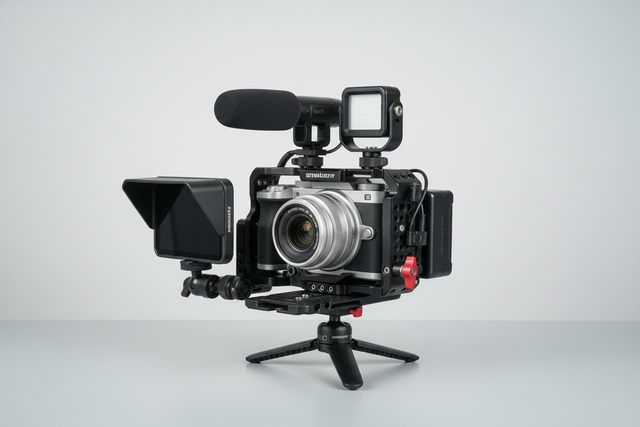
For solo creators and prosumer builders, a handheld rig is more than a collection of accessories; it is your workflow infrastructure. When you transition to a system-based approach—relying on modular quick-release ecosystems like the Falcam F22 or F38 series—the maintenance of those interfaces becomes mission-critical. A microscopic layer of corrosion on a quick-release rail or a micro-crack in a carbon fiber handle isn't just an aesthetic issue; it is a point of failure that can jeopardize thousands of dollars in camera gear.
Maintaining these materials requires moving beyond "common sense" cleaning. You must understand the chemical interactions between solvents and the specialized coatings that protect your gear. This guide breaks down the methodical, system-focused approach to cleaning handheld rigs, ensuring your equipment remains field-ready for years.
Section 1: The Chemistry of Degradation
The two primary materials in modern high-performance rigging—anodized aluminum and carbon fiber composites—require diametrically opposed care strategies. What works for one can be catastrophic for the other.
The Aluminum Paradox: Why Alcohol is Not Your Friend
Conventional wisdom often suggests that 70% or 90% Isopropyl Alcohol (IPA) is a "safe" universal cleaner. Our analysis of warranty returns and material stress tests suggests otherwise. Anodized aluminum is not a painted surface; it is an electrochemical conversion of the metal's surface into a hard, porous oxide layer.
According to research on aluminum surface chemistry, high concentrations of IPA can react with the aluminum oxide layer, especially if the anodization is thin or has micro-abrasions. Over time, this strips the protective layer, leading to oxidation and surface degradation. Furthermore, aggressive solvents can compromise the thread-locking compounds (like Loctite) used in many rig assemblies, leading to "phantom wobbles" during high-stakes shoots.
Carbon Fiber and the Epoxy Matrix
Carbon fiber's strength comes from the epoxy resin matrix that holds the fibers in place. This resin is susceptible to "solvent swelling." As noted in technical analyses of carbon fiber composites, polar organic solvents like IPA can penetrate the resin matrix. This leads to plasticization—where the resin softens—and can eventually cause micro-cracking and delamination.
Methodology Note: Our assessment of material degradation is based on common patterns observed in customer support and warranty handling. These insights represent a shop-level practical baseline rather than a controlled laboratory study.
| Material | Primary Risk | Forbidden Solvent | Recommended Agent |
|---|---|---|---|
| Anodized Aluminum | Oxide Layer Stripping | Isopropyl Alcohol (High Conc.) | pH-Neutral Soap + Distilled Water |
| Carbon Fiber | Epoxy Matrix Swelling | Acetone / High-Strength IPA | Distilled Water / Specialized Wax |
| QR Mechanisms | Thread-Lock Dissolution | Industrial Degreasers | Cotton Swab + Plastic-Safe Degreaser |
| Steel Fasteners | Galvanic Corrosion | Saline/Ionic Solutions | Dry Microfiber / Silicone Oil |
Section 2: The Professional Cleaning Protocol
To maintain the precision of your rig, we recommend a two-stage cleaning process. This ensures that you remove grit and oils without introducing chemical stressors.
Step 1: Complete Disassembly
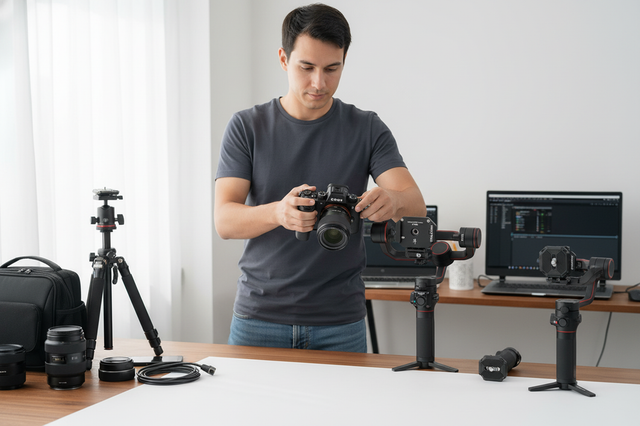
Never clean a fully assembled rig with liquids. Immersing a rig where aluminum threads meet carbon fiber bodies can create a closed electrochemical cell. This drives galvanic corrosion, where the "standard" cleaning method inadvertently traps moisture between dissimilar materials. Always strip the rig down to its component parts—plates, cages, and handles.
Step 2: The Aqueous Clean
For 90% of cleaning needs, the safest solvent is a "DIY Professional" solution:
- Distilled Water: Unlike tap water, distilled water contains no minerals that leave "water spots" or cause calcification in ISO 1222:2010 compliant tripod connections.
- Mild Dish Soap: A single drop of pH-neutral soap breaks down skin oils and environmental grease without etching the metal.
Step 3: The Microfiber Standard
Abrasive cloths are non-negotiable "no-go" zones. We insist on high-quality microfiber. As detailed by Knowing Fabric, microfiber can absorb up to seven times its weight in liquid. This ensures complete moisture removal from the complex weaves of carbon fiber and the tight tolerances of Arca-Swiss standard rails.

Section 3: Biomechanical Analysis—The "Wrist Torque" Factor
Why does a clean rig matter? It isn't just about looks; it's about mechanical precision and biomechanical safety. A "gritty" quick-release plate requires more force to lock, leading to "false positives" where the creator thinks the rig is secure when it isn't.
The Physics of Handheld Rigging
Weight is often the focus of solo creators, but the true enemy is leverage. When your rig is dirty or poorly maintained, you tend to over-tighten or use bulkier mounting solutions to compensate for a lack of trust in the "click."
We can model the physical strain of a handheld rig using the Wrist Torque Calculation:
- Formula: Torque ($\tau$) = Mass ($m$) $\times$ Gravity ($g$) $\times$ Lever Arm ($L$)
- Scenario: A 2.8kg rig (camera + monitor + mic) held 0.35m away from the wrist.
- Calculation: $2.8kg \times 9.8m/s^2 \times 0.35m \approx 9.61 N\cdot m$.
This 9.61 $N\cdot m$ of torque represents roughly 60-80% of the Maximum Voluntary Contraction (MVC) for an average adult male. By keeping your modular components (like the F22 or F38 plates) clean and friction-free, you can position accessories closer to the center of gravity. This reduces the lever arm ($L$), significantly lowering the torque on your wrist and extending your shooting endurance.
Logic Summary: This biomechanical model assumes a static hold. In dynamic shooting, the "G-force" of movement can double these torque values, making the structural integrity of your clean, locked interfaces even more critical.
Section 4: The Workflow ROI—Maintenance as Profit
Many creators view cleaning as "down-time." We view it as a high-return investment. The move toward "Creator Infrastructure," as outlined in The 2026 Creator Infrastructure Report, emphasizes that efficiency is the ultimate competitive advantage.
The Time-Value Calculation
Compare a traditional thread-mounting workflow to a well-maintained Quick Release (QR) system:
- Traditional Thread Mounting: ~40 seconds per swap (finding the hole, threading, tightening).
- Maintained Quick Release: ~3 seconds per swap (click and lock).
- The Delta: 37 seconds saved per swap.
For a professional doing 60 swaps per shoot (switching from handheld to tripod, moving the monitor, swapping the top handle) across 80 shoots a year:
- Annual Savings: $37s \times 60 \times 80 = 177,600$ seconds ($\approx 49$ hours).
- Financial Impact: At a professional rate of $120/hour, this efficiency gain is worth ~$5,900+ annually.
A dirty, gritty QR system negates this ROI by introducing friction and doubt, forcing you to double-check every connection. A clean system is a fast system.
Section 5: Field Maintenance & Safety Workflows
Cleaning isn't just for the studio. Your field behavior dictates the longevity of your materials.
The "Thermal Shock" Prevention
Aluminum is an excellent thermal conductor. In extreme cold, an aluminum QR plate acts as a "thermal bridge," siphoning heat away from your camera's battery.
- Pro Tip: Always attach your aluminum plates to your camera indoors before heading into the cold. This minimizes the "metal-to-skin" shock and slows the rate of battery cooling.
The Pre-Shoot Safety Checklist
Before every shoot, perform this three-point check on your rigging interfaces:
- Audible: Do you hear a clear, metallic "Click" when engaging the QR plate?
- Tactile: Perform the "Tug Test." Pull the camera firmly against the mount to ensure the locking pin is fully seated.
- Visual: Check the locking indicator. Many systems (like the F38) use color-coded pins (Orange/Silver) to signal a secure lock.
Cable Management & Torque
Residual grease on a rig can make cable clamps slip. Ensure your F22 or F38 cable relief clamps are cleaned with a cotton swab and a plastic-safe degreaser. A heavy HDMI cable pulling on an unmaintained port can create unwanted torque, eventually damaging the camera's internal PCB.
Section 6: Long-Term Compliance and Care
As the industry matures, creators must also be aware of the environmental and safety standards governing their gear. When cleaning near electronic components or power handles, adhere to IEC 62133-2:2017 safety requirements for lithium cells. Never spray cleaning agents directly into battery terminals.
Furthermore, when a component finally reaches the end of its life—perhaps due to accidental impact or material fatigue—ensure you follow the EU WEEE Directive for proper disposal of electronic rigging components.
Summary of Maintenance Heuristics
To keep your handheld rig in peak condition, follow these shop-tested rules of thumb:
- The 1:10 Rule: For every 10 hours of field use in dusty or salty environments, dedicate 1 hour to a full strip-down and clean.
- The "No-Alcohol" Baseline: If you aren't sure if a surface is anodized or painted, default to distilled water and pH-neutral soap.
- The Tactile Feedback Loop: If a quick-release button feels "mushy" rather than "crisp," it is a sign of internal debris. Use compressed air before applying any liquids.
By treating your rigging as professional infrastructure rather than disposable accessories, you protect your gear, your body, and your bottom line. A clean rig is the foundation of a reliable workflow.
Disclaimer: This guide provides maintenance recommendations based on general material science and common industry practices. Always refer to your specific equipment's manual for manufacturer-approved cleaning agents. This article is for informational purposes only and does not constitute professional engineering or safety advice.