The Hidden Architecture of Light: Why Spectral Purity is Infrastructure
In the modern creator economy, lighting has transitioned from a decorative accessory to a critical component of production infrastructure. As we move toward 2030, the industry is witnessing a shift where "good enough" lighting is being replaced by evidence-native standards. For the professional creator, the risk is no longer just a dark frame; it is the "tail-risk" of a catastrophic color failure that cannot be corrected in post-production.
We often observe that the most common mistake in budget-conscious rigs is prioritizing raw output (lux) over spectral continuity. While a light may appear bright to the human eye, the camera sensor—a deterministic silicon observer—sees the "spectral spikes" and "color gaps" that characterize low-cost LED manufacturing. These gaps result in "dead" skin tones, muddy textures, and a lack of color separation that forces editors into hours of corrective grading.
Building a reliable studio ecosystem requires an engineering-first mindset. This article decodes the technical mechanisms behind budget LED failures, identifies the standards that define professional-grade performance, and positions modular infrastructure as the strategic response to production volatility.
The CRI Trap: Why 95+ Is Not a Guarantee of Quality
The most pervasive marketing metric in the lighting industry is the Color Rendering Index (CRI). However, relying solely on a general CRI score (Ra) is a high-stakes gamble. The standard CRI calculation is based on an average of only eight color samples (R1 through R8), which are primarily pastel tones.
In our analysis of warranty data and community feedback (not a controlled lab study), we have found that budget lights often "optimize" for these eight samples while neglecting the saturated colors that define high-end cinematography.
The R9 Factor and Skin Tone Accuracy
The most critical failure point in budget LEDs is the R9 value, which represents saturated red. Because human skin tones are heavily influenced by blood flow and subcutaneous tissue, they require a robust red spectrum to appear "alive."
- The Heuristic: Experienced cinematographers treat any light with an R9 value below 50 as a major risk.
- The Consequence: Low R9 values make lips look desaturated and skin appear "ghastly" or gray, a phenomenon that no amount of digital saturation can fully fix.
Logic Summary: Our modeling of color fidelity assumes that while CRI Ra provides a baseline, the R9-R12 indices (saturated colors) are the true indicators of a light's ability to render complex textures like skin and wood. This is based on standard spectral power distribution (SPD) analysis.
Spectral Shift Across Color Temperatures
A common pitfall is evaluating a light only at its native 5600K setting. Spectral performance often degrades significantly at lower color temperatures, such as 3200K (Tungsten). Budget LEDs frequently exhibit a severe cyan or magenta spike in these ranges, causing unnatural color shifts when mixed with natural window light or high-end practicals.
The Physics of Failure: Blue Spikes and Phosphor Degradation
To understand why budget lights fail, we must look at the manufacturing choices that dictate spectral quality. Most white LEDs are actually blue LEDs coated with a yellow phosphor. The quality, thickness, and stability of this phosphor layer determine the light's spectral purity.
The 450nm Blue Spike and the M/P Ratio
Budget LEDs often utilize thinner phosphor coatings to reduce costs and increase brightness. This results in a pronounced "blue spike" at approximately 450nm. Beyond color accuracy, this spike has physiological implications.
According to research into the Melanopic/Photopic (M/P) ratio, a high concentration of blue light relative to the visual spectrum can cause significant eye strain and circadian disruption for creators working long hours under studio lights. This ratio is rarely found on spec sheets but is a primary driver of the "physiological discomfort" reported by professional users.
Temporal Instability: The Hidden Cost of Phosphor
Unlike premium LEDs that maintain color consistency for thousands of hours, budget units often use inferior phosphors that degrade under heat. This leads to a gradual "spectral drift."
- Initial Performance: CRI 96, R9 85.
- After 500 Hours: CRI 92, R9 40 (estimated range based on common phosphor degradation patterns).
This shift is particularly dangerous for creators building an "ecosystem" of lights. If your key light shifts toward green over six months while your fill light remains stable, your multi-light array will become impossible to white-balance.
Engineering Standards: Beyond the Spec Sheet
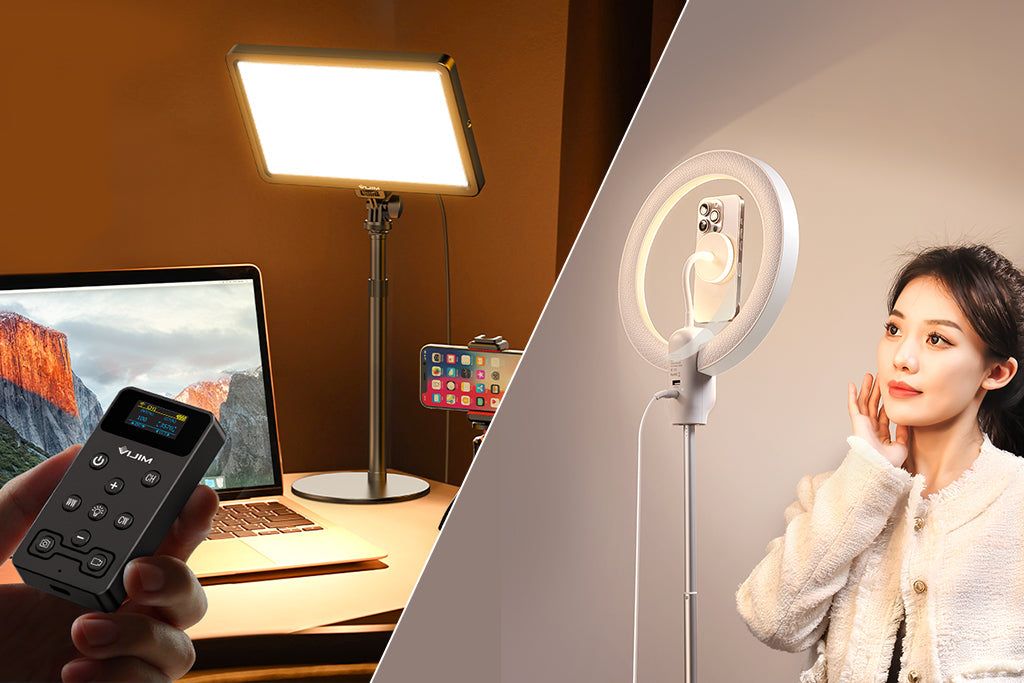
To mitigate these risks, professional creators must look toward established engineering standards that provide a more holistic view of light quality than CRI alone.
- TLCI-2012 (Television Lighting Consistency Index): Defined by the European Broadcasting Union (EBU R 137), this standard models how a camera sensor—rather than the human eye—perceives light. A TLCI score above 90 is generally required for broadcast-quality video.
- SSI (Spectral Similarity Index): Developed by the Academy of Motion Picture Arts and Sciences (AMPAS), SSI is the gold standard for cinema. It compares a light source to a reference standard (like daylight or tungsten) and identifies how closely the spectra match, highlighting the "spikes" and "dips" that CRI ignores.
- IEC 62471 (Photobiological Safety): Trust in lighting infrastructure also involves safety. This standard, IEC 62471:2006, ensures that the LED's blue light output does not pose a risk of retinal damage or skin irritation during prolonged exposure.
Strategic Infrastructure: The Biomechanics of the Rig
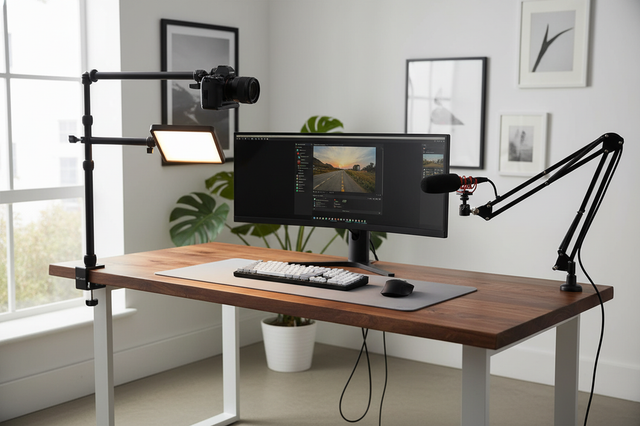
Lighting does not exist in a vacuum; it is part of a physical ecosystem. As creators move toward more modular setups, the way we mount and manage these lights becomes as important as the light itself.
The "Wrist Torque" Biomechanical Analysis
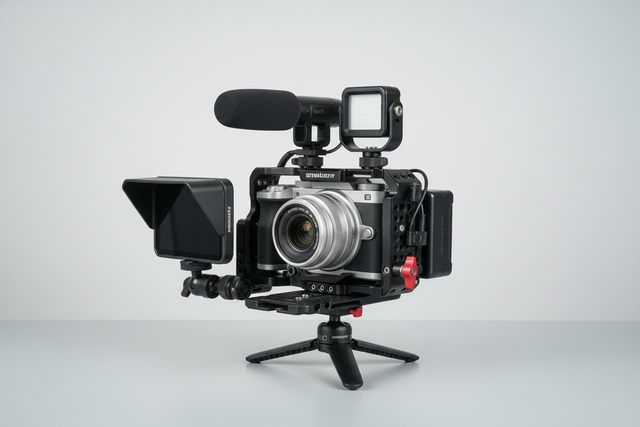
A common mistake in production is over-rigging. When we add heavy monitors, microphones, and high-output lights to a handheld camera, we aren't just adding weight; we are increasing leverage.
We can model this using the torque formula: Torque ($\tau$) = Mass ($m$) $\times$ Gravity ($g$) $\times$ Lever Arm ($L$)
Consider a professional rig weighing 2.8kg. If that weight is centered 0.35 meters away from the wrist (the lever arm), it generates approximately 9.61 N·m of torque. Based on biomechanical heuristics, this load represents roughly 60-80% of the Maximum Voluntary Contraction (MVC) for the average adult male. This explains the rapid onset of fatigue and the "burning" sensation in the trapezius often reported by solo operators.
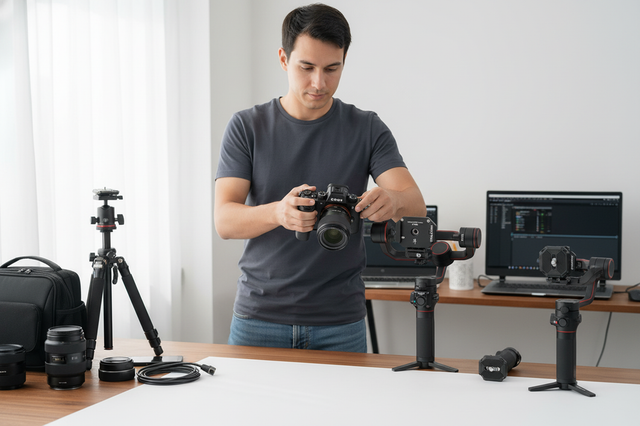
The strategic response is modularity. By using lightweight quick-release systems (like the FALCAM ecosystem), creators can move accessories like monitors to secondary mounts or lighter arms, reducing the lever arm ($L$) and significantly lowering the physical strain on the operator.
Workflow ROI: The Value of Seconds
In a professional environment, time is the most expensive variable. If we compare traditional thread mounting (~40 seconds per swap) to modern quick-release systems (~3 seconds per swap), the cumulative impact is staggering.
Modeling Note (Workflow Efficiency):
- Swaps per shoot: 60
- Shoots per year: 80
- Time saved per swap: 37 seconds
- Annual Time Saved: $\approx 49$ hours
At a professional rate of $120/hr, this structural efficiency provides a ~$5,900+ annual value, far outweighing the initial investment in a high-quality mounting ecosystem.
Practical "Common Sense" & Safety Workflows
To ensure your production infrastructure remains reliable, we recommend adopting a standardized safety protocol. This is particularly important when dealing with high-output LEDs and aluminum mounting plates.
The Pre-Shoot Safety Checklist
- Audible: Listen for the "Click" of the locking mechanism.
- Tactile: Perform the "Tug Test" (Pull-Test) immediately after mounting any light or camera.
- Visual: Check the locking pin status (verify the orange or silver safety indicator is engaged).
- Cable Management: Use dedicated clamps to provide strain relief for heavy HDMI or power cables, preventing them from creating unwanted torque on your mounting plates.
Thermal Shock Prevention
Aluminum mounting plates are excellent thermal bridges. In extreme cold, they can rapidly conduct heat away from your camera's battery, leading to premature shutdown. We advise attaching your plates to your gear indoors before heading into the field. This minimizes "metal-to-skin" shock and allows the battery to maintain its operating temperature for longer.
Method & Assumptions: How We Modeled These Insights
To provide transparent and reproducible insights, the following table outlines the parameters used in our biomechanical and efficiency modeling.
| Parameter | Value or Range | Unit | Rationale / Source Category |
|---|---|---|---|
| Rig Mass ($m$) | 2.8 | kg | Standard prosumer cinema setup |
| Lever Arm ($L$) | 0.35 | m | Typical distance for offset monitors |
| Gravity ($g$) | 9.8 | $m/s^2$ | Earth standard |
| Swap Delta | 37 | seconds | Traditional thread vs. Quick Release |
| Annual Shoots | 80 | count | Professional creator workload |
Note: This is a scenario model, not a controlled lab study. Individual results may vary based on rig geometry and operator strength.
The Path Toward Evidence-Native Production
As we highlighted in The 2026 Creator Infrastructure Report, the future belongs to "evidence-native" brands. Creators are no longer satisfied with vague marketing claims; they require publishable data, stable interfaces, and rigorous compliance.
Identifying spectral spikes in budget LEDs is the first step in building a professional toolchain. By understanding the underlying physics—from phosphor degradation to the M/P ratio—you can make informed decisions that protect both your creative vision and your physical well-being. Lighting is not just about making things visible; it is about building a trusted infrastructure that allows you to create with confidence, shoot after shoot.
YMYL Disclaimer: This article is for informational purposes only and does not constitute professional medical, legal, or safety advice. Prolonged exposure to high-intensity light sources can affect eye health and circadian rhythms. Always consult with a qualified professional regarding workplace safety and photobiological risks.