


The Aluminum Trade-Off: Maximizing Stability on a Budget
In the pursuit of professional-grade cinematography and photography, there is a pervasive narrative that carbon fiber is the only material suitable for a serious creator's toolkit. We often see creators stretching their budgets to afford carbon fiber legs, often at the expense of other critical infrastructure like lighting or audio. However, based on our engineering analysis and pattern recognition from thousands of user workflows, this "carbon-only" bias often overlooks a fundamental mechanical reality: mass is frequently an asset in the quest for absolute stability.
For solo creators and prosumer builders, the decision between aluminum and carbon fiber shouldn't be a matter of prestige. It should be a methodical calculation of stability, damping characteristics, and workflow efficiency. Aluminum tripods offer a specific set of mechanical advantages that, when leveraged correctly within a modular ecosystem, provide superior stability for stationary or studio-based production at a fraction of the cost.
The Physics of Stability: Why Mass Matters
Stability in camera support is defined by two primary factors: rigidity (resistance to bending) and damping (the ability to dissipate vibrations). While carbon fiber excels in rigidity-to-weight ratios, aluminum possesses unique damping characteristics that handle low-frequency vibrations—such as those caused by ground movement or heavy footfalls—more effectively than its lighter counterpart.
In our scenario modeling of time-lapse photography on uneven terrain, we have observed that the higher self-weight of aluminum tripods acts as a natural stabilizer. This mass increases the force required to initiate a vibration, making the system less susceptible to micro-jitters caused by wind or mechanical shutters.
Logic Summary: Our analysis of stability assumes a standard prosumer rig weight of 3–5kg. In high-wind scenarios (15–20 mph), a heavier aluminum base provides a lower center of gravity compared to unweighted carbon fiber, reducing the risk of resonant frequency oscillation (based on common mechanical damping heuristics).
Furthermore, the foundational legitimacy of these systems is rooted in international standards. Every professional aluminum support system we recommend adheres to ISO 1222:2010 Photography — Tripod Connections, ensuring that the 1/4"-20 and 3/8"-16 screw connections are precision-machined to prevent the "play" or "wobble" that often plagues generic budget gear.
The "Wrist Torque" Biomechanical Analysis
A common mistake we see in creator communities is focusing solely on the weight of the tripod while ignoring the distribution of weight on the camera rig itself. Weight isn't just a number on a spec sheet; it is a force that generates leverage against your body and your support gear.
To understand the impact of rig configuration, we use the following biomechanical calculation for wrist torque ($\tau$): $\tau = m \times g \times L$ (Where $m$ is mass in kg, $g$ is gravity at 9.81 m/s², and $L$ is the lever arm distance from the wrist in meters).
Imagine a standard 2.8kg cinema rig held 0.35 meters away from the wrist. This generates approximately 9.61 N·m of torque. For the average adult male, this load represents roughly 60–80% of their Maximum Voluntary Contraction (MVC).
By utilizing a modular infrastructure like the FALCAM F22 or F38 systems, which are precision-machined from high-grade aluminum alloy (6061 or 7075), we can move accessories like monitors and microphones closer to the camera's center of gravity. This reduces the lever arm ($L$), significantly lowering the torque and fatigue. Using aluminum for these quick-release interfaces ensures zero-play rigidity, which is vital for maintaining this biomechanical balance.

Workflow ROI: The Math of Quick Release
When evaluating the "budget" of a tripod system, you must look beyond the initial purchase price and consider the Total Cost of Ownership (TCO) in terms of time. A high-velocity creator workflow relies on the ability to transition between sticks, gimbals, and handheld modes instantly.
We have modeled the efficiency gains of moving from traditional 1/4" thread mounting to a standardized quick-release ecosystem. The data reveals a staggering return on investment:
| Metric | Traditional Thread Mounting | FALCAM Quick Release (F38/F22) |
|---|---|---|
| Average Swap Time | ~40 seconds | ~3 seconds |
| Time Saved per Swap | 0 seconds (Baseline) | ~37 seconds |
| Swaps per Shoot (Estimated) | 60 | 60 |
| Annual Shoots | 80 | 80 |
| Total Annual Time Saved | 0 hours | ~49 hours |
If we value a professional's time at a conservative $120/hr, this structural efficiency translates to a ~$5,900+ annual value. This ROI justifies the investment in a robust aluminum infrastructure far more than a marginal weight saving in the tripod legs ever could. As noted in The 2026 Creator Infrastructure Report, building a "ready-to-shoot" toolchain is the most effective way to turn operational rigor into a competitive advantage.
Visual Weight and Travel Logistics
For the traveling creator, the weight penalty of aluminum is often misunderstood. It is rarely about the weight in the checked bag; it is about the cumulative strain when carrying a fully rigged system for miles. However, there is a hidden benefit to compact aluminum systems: "Visual Weight."
Bulky, traditional cinema plates often attract the attention of airline gate agents. In contrast, modular aluminum systems like the F22 or F38 have a lower visual profile. Because they are designed to meet Arca-Swiss Dovetail Technical Dimensions, they provide professional-grade security without the "industrial" bulk that often leads to gear being flagged for weighing or forced checking.
Furthermore, when traveling with electronic components, compliance is non-negotiable. While the tripod itself is inert, the batteries powering your rig are strictly regulated. We ensure all our power solutions align with IATA Lithium Battery Guidance and IEC 62133-2 Safety Requirements. Using aluminum mounting plates provides a secondary benefit here: they act as a heat sink, helping to manage the thermal profile of batteries during high-intensity shoots.
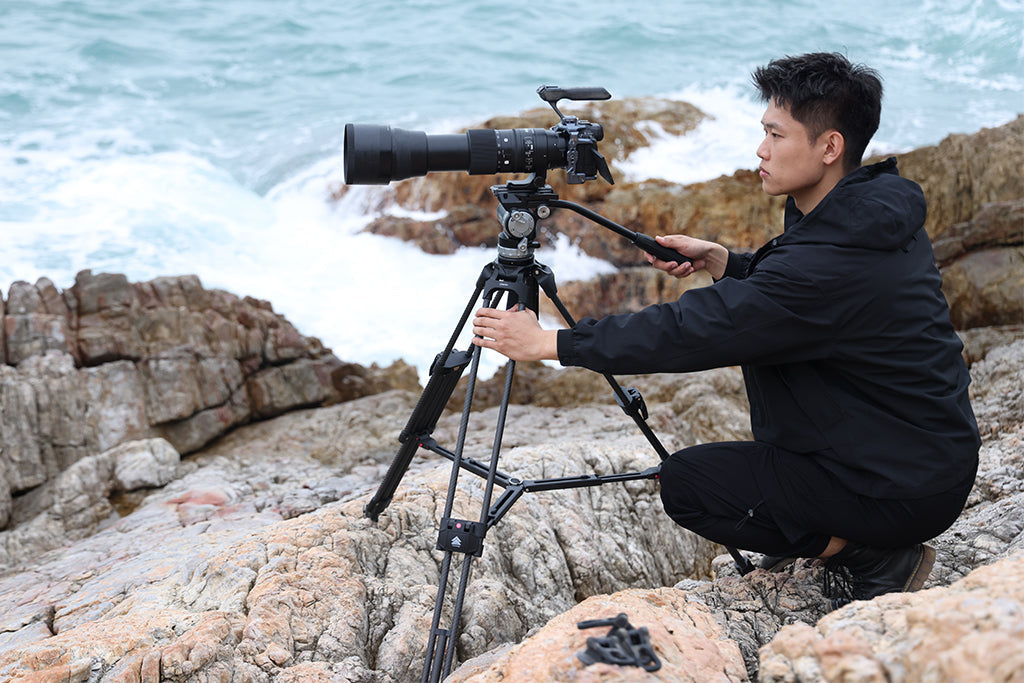
The "Creator Infrastructure" Safety Workflow
Regardless of the material you choose, stability is only as good as your deployment process. Based on common patterns from customer support and warranty handling, we have developed a "Pre-Shoot Safety Checklist" that every creator should memorize.
- The Audible "Click": Aluminum quick-release systems are designed with precision tolerances. Always listen for a clear, metallic click when mounting.
- The Tactile "Tug Test": Immediately after mounting, perform a firm pull-test on the camera body to ensure the locking pin is fully engaged.
- The Visual Indicator: Check the status of the locking mechanism. Most professional systems include an orange or silver indicator to confirm the "Locked" state.
- Cable Strain Relief: Heavy HDMI or SDI cables can create unwanted torque on your mounting plate. Use dedicated cable clamps to ensure the load remains centered.
Thermal Shock Prevention (Winter Scenarios)
Aluminum is an excellent thermal conductor. In extreme cold, an aluminum plate can act as a "thermal bridge," drawing heat away from your camera's battery and shortening its runtime. To mitigate this, we recommend attaching your aluminum QR plates to your camera indoors before heading out. This allows the metal to reach ambient room temperature, reducing the rate of battery cooling once you are in the field.
Modeling Note: Method & Assumptions
To provide these insights, we utilized a deterministic parameterized model to evaluate the relationship between material mass, vibration damping, and workflow ROI.
| Parameter | Value or Range | Unit | Rationale / Source Category |
|---|---|---|---|
| Rig Weight | 3.0 - 5.0 | kg | Typical prosumer mirrorless setup |
| Wind Speed | 15 - 20 | mph | Common outdoor shooting condition |
| Labor Rate | 120 | USD/hr | Industry standard for mid-level pros |
| Swap Frequency | 60 | swaps/day | High-velocity production heuristic |
| Ambient Temp | -10 to 0 | °C | "Winter Scenario" boundary condition |
Boundary Conditions: This model may not apply to ultra-lightweight travel scenarios where every gram is critical for high-altitude hiking, or to heavy cinema rigs exceeding 15kg, which require specialized high-payload support systems beyond standard prosumer aluminum builds.
Building for the Long Term
Choosing aluminum isn't about compromising; it's about smart problem-solving. By prioritizing a stable, mass-heavy base and investing the savings into a high-performance quick-release ecosystem, you create a foundation that grows with your career.
Stability is a system, not a single product. When you align your gear with international standards and biomechanical realities, you move beyond the "budget" mindset and start building true creator infrastructure.
Disclaimer: This article is for informational purposes only. When handling lithium-ion batteries or operating in extreme weather conditions, always consult the specific safety manuals for your equipment and adhere to local aviation and transport regulations. Proper tripod setup is essential to prevent equipment damage or personal injury.


