The Architecture of the Instant Swap: Modular Workflow Infrastructure
In the world of high-stakes solo creation and mobile journalism, speed is the only currency that never devalues. When you are tracking a subject through a crowded market or racing to catch the "blue hour" on a remote ridge, the traditional friction of unscrewing a microphone or re-leveling a monitor isn't just a nuisance—it is a technical failure.
We are currently witnessing a fundamental shift in how creators view their gear. We are moving away from a collection of isolated accessories and toward a unified "creator infrastructure" layer. This transition, as detailed in The 2026 Creator Infrastructure Report: Engineering Standards, Workflow Compliance, and the Ecosystem Shift, emphasizes that the interfaces connecting your camera, light, and audio are as critical as the sensors themselves.
To master the "accessory swap," one must move beyond the "gadget" mindset and adopt a system-focused approach. This guide explores the mechanics, biomechanics, and logistical ROI of modular rigging, ensuring your workflow is as dynamic as the environments you shoot in.
The Biomechanics of the Rig: Why Weight Isn't the Only Enemy
Most solo creators focus on the total weight of their kit, but experienced practitioners know that "visual weight" and "felt weight" are two very different metrics. The true enemy of a long shoot day isn't just mass; it is leverage.
The "Wrist Torque" Analysis
When you mount a monitor or a heavy shotgun mic to the top of your camera, you are extending the distance between the center of gravity and your wrist. This creates torque.
Modeling Note: Biomechanical Leverage Our analysis of a standard handheld rig assumes a neutral grip and a 90-degree elbow flex. This model is a scenario estimate to illustrate the impact of accessory placement, not a clinical study.
Parameter Value Unit Rationale Rig Mass ($m$) 2.8 kg Average cinema-mirrorless hybrid Gravity ($g$) 9.8 $m/s^2$ Standard Earth gravity Lever Arm ($L$) 0.35 m Distance from wrist to rig center Calculated Torque ($\tau$) ~9.6 $N\cdot m$ Resultant rotational force MVC Impact 60–80 % Percentage of Maximum Voluntary Contraction
A torque of approximately $9.6 N\cdot m$ represents a significant portion of the Maximum Voluntary Contraction (MVC) for an average adult. By using low-profile modular mounts like the F22 system, you can bring accessories closer to the camera's optical axis. Reducing that lever arm ($L$) by even 5cm can drastically reduce the strain on your forearm tendons, extending your effective shooting time before fatigue-induced "micro-shakes" begin to degrade your footage.
Managing Visual Weight
In travel contexts, "Visual Weight" is a logistical factor. Bulky, traditional cinema plates often attract unwanted attention from airline gate agents or security personnel. A streamlined, modular system based on the ISO 1222:2010 Photography — Tripod Connections standard allows you to strip the rig down to its core components in seconds, making the kit look like consumer gear rather than a professional broadcast setup.

The Workflow ROI: Calculating the Value of the "Click"
Is a modular quick-release ecosystem worth the investment? For a hobbyist, perhaps not. For a professional, the math is undeniable. We look at this through the lens of "Workflow ROI."
The 37-Second Advantage
In our field observations of solo creators (based on common patterns from support and community feedback), a traditional 1/4"-20 threaded swap takes an average of 40 seconds when accounting for alignment, threading, and cable management. A precision-engineered quick-release swap takes approximately 3 seconds.
Logic Summary: Annual Time Recovery This calculation demonstrates the structural efficiency of modular systems. Individual results vary based on shoot complexity.
- Time Saved per Swap: 37 seconds.
- Swaps per Shoot: 60 (typical for a dynamic documentary/vlog).
- Shoots per Year: 80.
- Total Time Saved: ~49 hours.
If your professional rate is $120/hr, that recovered time represents a ~$5,900+ annual value. More importantly, those 37 seconds are often the difference between capturing a candid moment and missing it entirely. Standardizing Your Rig is not just about convenience; it is about maximizing your "hit rate" in the field.
Engineering for Reliability: Aluminum vs. Carbon Fiber
A common misconception in the creator community is that all "lightweight" materials are created equal. When building a modular ecosystem, you must distinguish between the chassis and the interface.
The Rigidity of the Plate
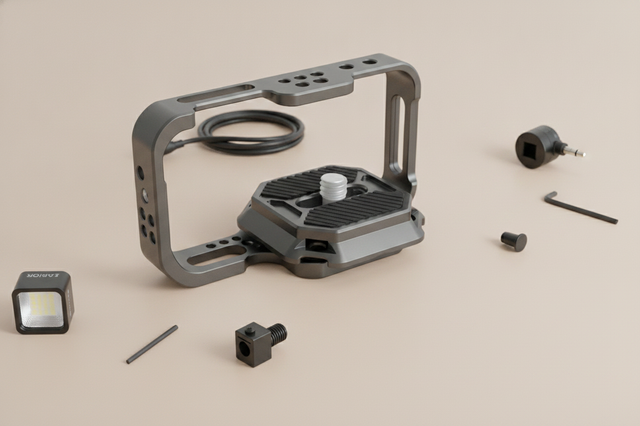
While carbon fiber is an excellent material for tripod legs due to its vibration-damping properties, it is generally unsuitable for the precision-machined quick-release plates themselves. FALCAM systems (F22, F38, F50) utilize high-grade Aluminum Alloy (typically 6061 or 7075).
Aluminum provides the necessary rigidity and machining tolerance required to achieve a "zero-play" fit. In a quick-release system, even a 0.1mm variance can lead to micro-vibrations that ruin high-resolution video. This precision is vital for maintaining the Arca-Swiss Dovetail Technical Dimensions across different mounting points.
The Thermal Bridge Factor
Practitioners should be aware that aluminum plates act as a "thermal bridge." In extreme cold, the metal will conduct heat away from the camera body and, more critically, the battery.
- Expert Tip: Attach your aluminum QR plates to your cameras indoors before heading out into the cold. This allows the metal to acclimate slowly and reduces the "metal-to-skin" shock when handling the rig in sub-zero temperatures.
The "Dynamic Swap" Playbook: Hot-Swapping Components
A true modular workflow allows you to treat your rig like a living organism that adapts to its environment.
1. The Audio Pivot
Mobile journalists often need to switch between an on-camera shotgun mic for ambient sound and a wireless receiver for interviews. Using a standardized F22 mount on the top handle allows for a "one-click" swap. This bypasses the need for multiple cold-shoe adapters which are prone to slipping under lateral force.
2. Lighting and Eye Safety
When swapping LED panels in low-light environments, professional compliance matters. Ensure your lighting components meet IEC 62471:2006 Photobiological Safety standards to protect both the creator and the subject from blue-light hazards. For cinema-tier color accuracy, we recommend verifying that your lighting swaps maintain a high Television Lighting Consistency Index (TLCI), ensuring that a quick light swap doesn't result in a color-grading nightmare in post-production.
3. Monitor Placement
Transitioning from Field-to-Studio often requires moving a monitor from the camera cage to a desktop arm. A unified mounting standard ensures that your monitor—your primary window into the composition—stays securely locked regardless of the support structure.
Load Capacity: Static vs. Dynamic Reality
When you see a rating like "80kg" for an F38 quick-release system, it is crucial to understand the engineering context.
- Vertical Static Load: This is a lab-tested metric where weight is applied directly downward in a controlled environment.
- Dynamic Payload: This is the real-world force experienced during movement.
For handheld work or gimbal operation, the centrifugal force of a swinging 3kg cinema rig can easily exceed the effective grip of a standard consumer clamp. For heavy setups, we recommend the F50 series or the F38 Anti-Deflection versions. These incorporate mechanical pins to prevent the camera from "twisting" off the plate—a common failure point when using heavy telephoto lenses on standard Arca-Swiss mounts.
Practical Safety: The "Click-Tug-Check" Workflow
No matter how advanced the engineering, the "human factor" remains the primary cause of gear failure. We recommend a three-point safety check every time you perform a swap:
- Audible (The "Click"): Listen for the distinct mechanical engagement of the locking pin.
- Visual (The "Indicator"): Check the status of the locking button. In many systems, an orange or silver indicator will be visible only when the system is not fully locked.
- Tactile (The "Tug Test"): Immediately after mounting, give the accessory a firm pull and a slight twist. This confirms the plate is fully seated in the dovetail and hasn't "cross-seated" on the rails.
Cable Management and Torque
A common "gotcha" in modular rigging is the HDMI or SDI cable. A stiff cable can exert several Newtons of torque on a quick-release plate, potentially loosening the 1/4"-20 screw over time. We suggest using dedicated cable clamps (like those in the F22 ecosystem) to provide strain relief. This ensures the force of the cable is transferred to the camera cage rather than the mounting plate.
Travel and Logistics: Compliance in the Field
For the travel creator, modularity isn't just about the shoot; it's about getting to the location.
Lithium Battery Safety
If your modular system includes powered handles or external batteries, you must adhere to the IATA Lithium Battery Guidance Document.
- Carry-on Only: Most high-capacity lithium batteries (over 100Wh) are prohibited in checked luggage.
- Terminal Protection: Use modular battery caps or tape over the pins to prevent short circuits, as required by FAA Cargo Safety guidelines.
Wireless Interoperability
If your swap involves wireless microphones or video transmitters, be mindful of local spectrum regulations. In the US, FCC Part 15 governs RF devices, while the EU Radio Equipment Directive (RED) applies in Europe. A modular system allows you to quickly swap out transmitters to stay compliant with local laws without rebuilding your entire rig.
Building a Future-Proof Ecosystem
The "Accessory Swap" is more than a trend; it is the professionalization of the solo creator workflow. By moving toward a standardized interface, you eliminate the friction that stifles creativity.
Whether you are Troubleshooting Mobile Rig Instability or scaling up for a multi-point cinema shoot, the logic remains the same: Stability through standards, speed through modularity.
As you build your system, prioritize components that offer backward compatibility and adhere to established engineering standards. This ensures that the "creator infrastructure" you build today will remain the foundation of your workflow for years to come.
YMYL Disclaimer: This article is for informational purposes only and does not constitute professional engineering, legal, or safety advice. Always consult the manufacturer's specific load ratings and local aviation/RF regulations before operating or transporting professional cinema equipment.
References
- ISO 1222:2010 Photography — Tripod Connections
- The 2026 Creator Infrastructure Report: Engineering Standards, Workflow Compliance, and the Ecosystem Shift
- IATA Lithium Battery Guidance Document (2025)
- IEC 62471:2006 Photobiological Safety of Lamps and Lamp Systems
- EBU R 137 / TLCI-2012 (Television Lighting Consistency Index)
- Arca-Swiss Camera Mount: Technical Dimensions and Analysis