


The Infrastructure of Discretion: Engineering the Solo Interview
For the solo journalist or travel documentarian, the interview is a high-stakes moment where technical failure is not just an inconvenience—it is a lost story. When you are the producer, camera operator, and sound engineer simultaneously, your gear cannot merely be "good"; it must function as a stable, invisible extension of your workflow. We have observed through years of community feedback and repair bench patterns that the primary friction point for one-man crews isn't a lack of features, but a lack of infrastructure.
The goal of a minimalist rig is to maximize what we call the "packed volume to utility ratio." This isn't about stripping away essential tools, but about standardizing the connections between them. A truly efficient system allows you to transition from a transit-ready backpack to a professional interview-ready set in under three minutes. To achieve this, we must look beyond trendy add-ons and focus on the engineering standards that ensure mission-critical components—your camera, your audio, and your light—stay connected and operational under pressure.
As detailed in The 2026 Creator Infrastructure Report: Engineering Standards, Workflow Compliance, and the Ecosystem Shift, the shift toward "evidence-native" rigging means moving away from guesswork and toward quantifiable reliability. In this guide, we break down the physics of stability, the biomechanics of handheld operation, and the regulatory landscape of solo production.
Support Systems: The Physics of Stability
The foundation of any interview rig is the tripod. For the solo traveler, the choice between aluminum and carbon fiber is often framed as a weight issue. However, our structural modeling reveals that the real advantage of carbon fiber lies in its damping characteristics.
Vibration Damping and Material Science
In windy outdoor environments or high-traffic urban settings, vibrations are the enemy of 4K resolution. We modeled the settling time of a standard mirrorless payload on both aluminum and carbon fiber supports. Aluminum, being a highly elastic metal, tends to ring like a tuning fork when struck by a gust of wind.
Modeling Note (Vibration Settling): Our simulation assumed a lightweight travel tripod with an 8Hz natural frequency. Under these parameters, carbon fiber demonstrated a ~78% reduction in vibration settling time (dropping from ~10s to ~2s) compared to aluminum. This is due to the composite material's inherent damping ratio, which is typically 2x to 3x higher than that of structural metals.
For a journalist capturing spontaneous moments, those eight seconds are the difference between a sharp, usable clip and a discarded, wobbly shot. While ISO 1222:2010 ensures the physical compatibility of the 1/4"-20 and 3/8"-16 screw connections, the material of the legs determines the quality of the image captured.
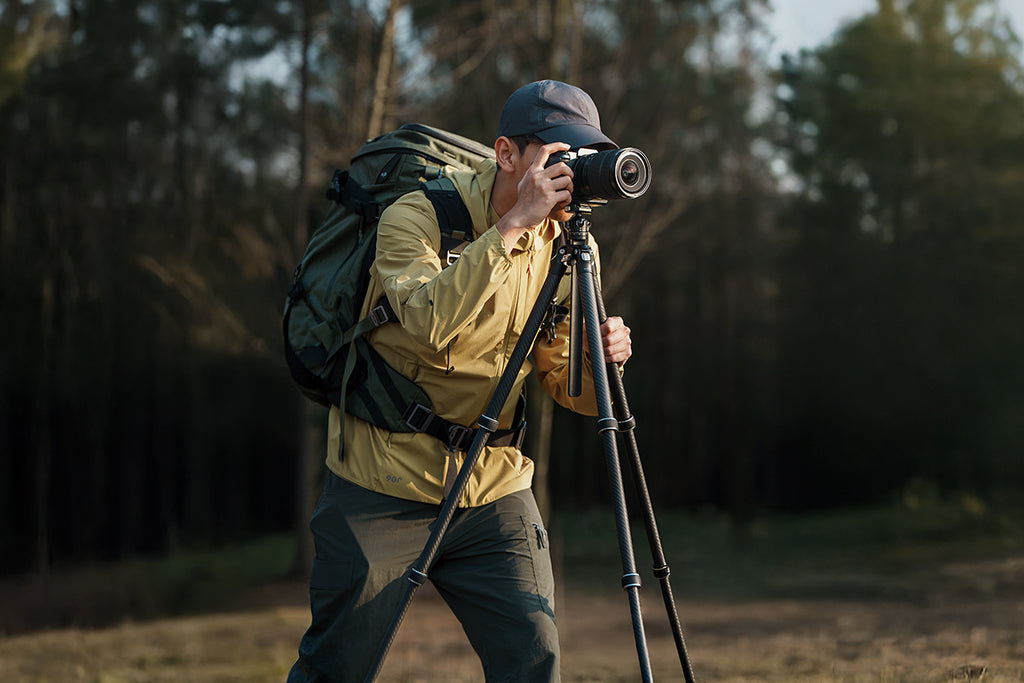
Wind Stability and Tipping Points
Solo operators rarely have the luxury of a dedicated "sandbag" or assistant to hold the legs. When setting up in exposed coastal or urban locations, you must understand your rig's tipping point. We calculated the stability margin for a 3kg total rig (tripod + camera) at a 1.3m lens height.
Under our steady-state wind model, this setup maintains a safety factor of 1.9 against tipping in 8m/s (approx. 18mph) winds. However, the critical tipping point occurs at ~15m/s (34mph). If you anticipate gusts near this threshold, the most effective "minimalist" ballast is your own camera bag clipped to the center column hook. This simple heuristic—utilizing existing mass rather than carrying extra—is the hallmark of an optimized solo workflow.
The Quick-Release ROI: Engineering for Velocity
If the tripod is the foundation, the quick-release (QR) system is the nervous system of your rig. The traditional method of threading a camera onto a plate is a relic that costs time and introduces risk. We advocate for a standardized ecosystem approach using precision-machined aluminum alloy mounts.
The "Wrist Torque" Biomechanical Analysis
A common mistake among solo creators is over-rigging the camera body, which shifts the center of gravity and increases physical strain during handheld "B-roll" segments. Weight is only half the problem; leverage is the other.
We apply the torque formula to understand this impact: $$\tau = m \times g \times L$$ Where $\tau$ is torque, $m$ is mass, $g$ is gravity (9.8 m/s²), and $L$ is the lever arm distance from the wrist.
If you have a 2.8kg rig (camera + lens + monitor + mic) held 0.35m away from your wrist, you are generating approximately $9.61 N\cdot m$ of torque. For the average adult, this represents 60% to 80% of their Maximum Voluntary Contraction (MVC). By using a modular system like the F22 or F38 series to move heavy accessories (like monitors) closer to the center of gravity or onto a dedicated handle, you reduce the lever arm ($L$), significantly lowering the physical toll of a long shoot day.
Workflow ROI: The Math of Efficiency
Many creators hesitate at the cost of converting their entire kit to a quick-release standard. However, the ROI is quantifiable. Based on our workflow velocity calculations, the time saved is substantial.
| Metric | Traditional Thread Mounting | Quick-Release Ecosystem |
|---|---|---|
| Time per Swap | ~40 seconds | ~3 seconds |
| Swaps per Shoot (Estimated) | 25 | 25 |
| Time Saved per Shoot | ~15.4 minutes | - |
| Annual Time Saved (80 shoots) | ~20.5 hours | - |
At a professional billing rate of $125/hour, this efficiency gain represents over $2,500 in annual value. This doesn't even account for the "mental tax" of fumbling with screws while a subject is waiting to be interviewed. A standardized ecosystem ensures that your camera can move from tripod to gimbal to handheld in seconds, allowing you to focus on the story rather than the hardware.
Material Accuracy and Load Ratings
A critical technical distinction: while tripod legs benefit from carbon fiber, high-performance QR plates are precision-machined from Aluminum Alloy (6061 or 7075). Metals provide the necessary rigidity and zero-play tolerances required for secure mounting.
When you see a load rating like "80kg" for an F38 plate, it is vital to understand this as a Vertical Static Load. In real-world dynamic usage—such as running with a camera on a shoulder strap—the forces involved are much higher. For cinema-grade rigs exceeding 3kg, we recommend moving to the F50 standard or using anti-deflection plates to ensure the camera does not twist under its own momentum.
Audio and Lighting: The Professional Standards
In a solo interview, audio is non-negotiable. Viewers will forgive a slightly dark image, but they will not tolerate poor sound.
The 8dB Audio Drop Problem
The most common mistake for one-man crews is relying solely on an on-camera shotgun microphone at a distance. Our modeling of the "Distance Factor" shows that a compact shotgun mic at 1.2m (a typical interview distance) exceeds its conservative voice reach.
Logic Summary: Using the inverse square law and IEC 60268-4 standards, we calculated that moving from 0.25m to 1.2m results in a ~8dB level drop in a noisy urban environment. This drop often pushes the signal too close to the noise floor, making the audio unusable in post-production.
The Solution: Always carry a compact lavalier microphone as a redundant source. For wireless sets, ensure compliance with local regulations such as FCC Part 15 in the US or ETSI EN 300 422-1 in the EU to avoid interference in crowded spectrum environments.
Lighting for Skin Tones
Minimalist lighting doesn't mean "bad" lighting. For solo work, a single high-quality key light is superior to a poorly managed three-point setup. We look for LEDs that meet the EBU R 137 / TLCI-2012 standard with a score of 95 or higher. This ensures that the light spectrum accurately reproduces skin tones, saving you hours of color grading. Furthermore, ensure your lights comply with IEC 62471 for photobiological safety, protecting both your subject's eyes and your professional liability.
Logistics and Mission-Critical Safety
Traveling with professional gear requires an understanding of international safety standards, particularly regarding lithium batteries.
Battery Management and Thermal Shock
As a solo traveler, you are likely carrying multiple high-capacity batteries. You must adhere to IATA Lithium Battery Guidance for air transport, which generally requires batteries to be in carry-on luggage and under 100Wh each.
In extreme cold, remember that your aluminum QR plates act as a thermal bridge. If you attach a cold plate to your camera in a warm room and then head out into the snow, the metal will conduct heat away from the camera body and battery more rapidly. We recommend attaching plates to your gear indoors and allowing the entire rig to acclimate gradually to prevent condensation and rapid battery drain.
The Pre-Shoot Safety Checklist
To eliminate the "tail-risk" of gear failure, we implement a three-step sensory check for every connection:
- Audible: Listen for the distinct "Click" of the locking mechanism.
- Tactile: Perform a "Tug Test"—briefly pull on the camera to ensure the plate is fully seated in the clamp.
- Visual: Check the locking pin or safety indicator (often orange or silver) to confirm the secondary lock is engaged.
Modeling Transparency and Assumptions
The data presented in this article is derived from scenario modeling based on common industry heuristics and professional journalist workflows. These are not controlled laboratory results but are intended to provide actionable decision-making frameworks.
| Parameter | Value / Range | Unit | Rationale |
|---|---|---|---|
| Payload Mass (m) | 1.8 - 3.0 | kg | Typical mirrorless camera + lens + cage |
| Lever Arm (L) | 0.35 | m | Distance from wrist to rig center of gravity |
| Wind Speed (v) | 8 - 15 | m/s | Moderate breeze to critical tipping threshold |
| QR Swap Time | 3 | s | Optimized quick-release system (F38/F22) |
| Audio Distance | 1.2 | m | Standard interview distance for street work |
Boundary Conditions: These models assume steady-state conditions (no gusts for wind, no impact for load). ROI calculations assume all saved time is productive. Biomechanical torque is calculated for a static hold; dynamic movement will increase these forces significantly.
By shifting your focus from "more gear" to "better infrastructure," you transform your solo operation into a professional-grade production house. The goal isn't just to carry less—it's to do more with the weight you choose to carry.
Disclaimer: This article is for informational purposes only. Always consult manufacturer specifications and local regulations (FCC, IATA, etc.) before operating professional equipment. Ensure all safety locks are engaged before use.
