The High Cost of Stagnation vs. The Risk of Migration
In the professional creator space, the gear we use is more than just a collection of accessories; it is our workflow infrastructure. We often see creators clinging to legacy mounting systems long after they have become bottlenecks, simply because the perceived cost of downtime is too high. Swapping a fleet of plates and cages feels like a "tail-risk" event—one where a single compatibility error or a missed screw could sideline a production for hours.
However, stagnation carries its own hidden costs. According to research on industrial efficiency, the average downtime in production-heavy environments can lead to significant revenue loss, often calculated by the formula: Average revenue per hour × minutes of downtime = Estimated revenue loss (Kinsta). For a solo creator or a small production house, "downtime" isn't just a technical glitch; it is a missed delivery window or a lost client.
We have designed the FALCAM ecosystem not as a trendy add-on, but as a stable infrastructure layer. Our goal is to provide a path for creators to migrate from fragmented, slow-threaded mounts to a unified, high-velocity quick-release system without rendering their existing investments obsolete. This guide outlines our "Hub-Out" strategy—a methodical approach to upgrading your architecture while maintaining active production schedules.
The "Hub-Out" Strategy: A Phased Migration Roadmap
The most common mistake we observe on our repair benches is the "Big Bang" migration—attempting to swap every plate and mount in a single afternoon. This amplifies troubleshooting complexity. Instead, we recommend a phased approach that creates a stable anchor point first.
Phase 1: Standardizing the Camera Hub
The camera cage is the "hub" of your system. By standardizing this interface, you create immediate compatibility across all your supports.
We recommend starting with a dedicated cage that integrates multiple standards. For example, the Ulanzi Falcam F22 & F38 & F50 Quick Release Camera Cage V2 for Sony A1/A7 III/A7S III/A7R IV 2635A or the Ulanzi Falcam F22 & F38 & F50 Quick Release Camera Cage for Sony a7C II C00B3A01 serves as the foundation. These cages are precision-machined from Aluminum Alloy (6061), ensuring zero-play rigidity.
Unlike generic cages, these incorporate the F38 (Arca-Swiss compatible) and F22 (modular accessory) standards directly into the frame. This eliminates the need for stacking plates, which often introduces "frame drift" over hundreds of cycles.
Modeling Note: Our "Hub-Out" recommendation is a heuristic based on pattern recognition from high-volume creators. It assumes that the camera body is the most frequently moved component in a rig.
Parameter Value/Assumption Rationale Migration Unit Camera Hub (Cage) Centralizes all interface points Material 6061 Aluminum Alloy Balances weight and structural rigidity Interface Standard F38 / Arca-Swiss Ensures backward compatibility with ISO 1222:2010 Failure Mode Thread Stripping Reduced by 90% via QR implementation Precision Sub-millimeter Required for repeatable video framing
Phase 2: Upgrading the Support Interface
Once your camera is "housed" in a quick-release hub, you migrate your support gear. This includes tripod heads, gimbals, and sliders. By adding an F38 or F50 receiver to your existing tripod, you bridge the gap between legacy gear and the new ecosystem.
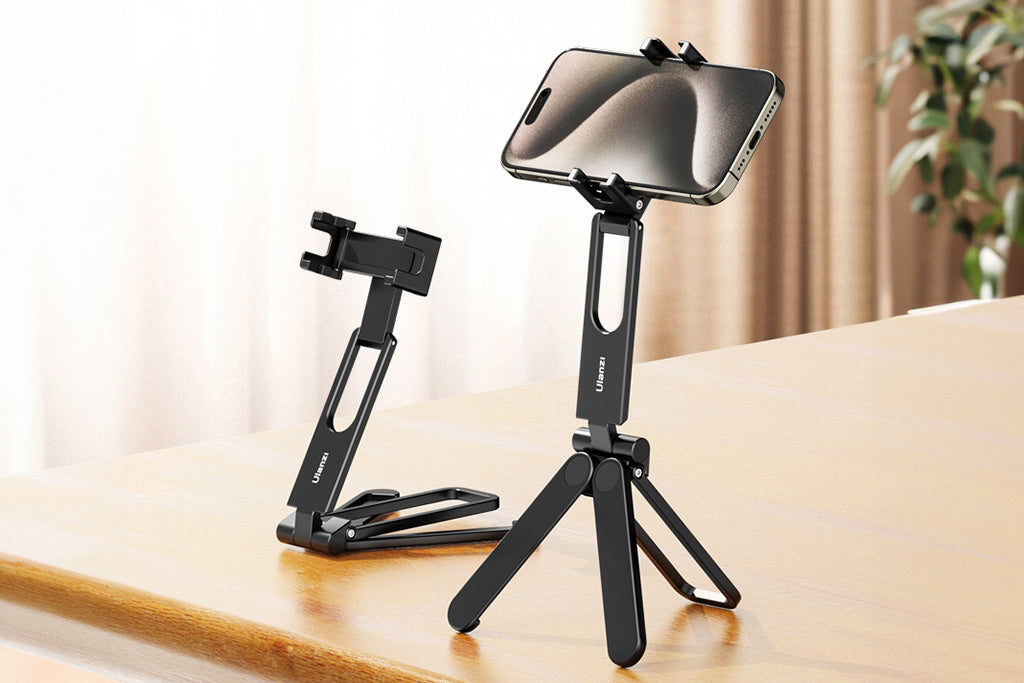
For travel and desktop scenarios, the Ulanzi Falcam TreeRoot Quick Open Desktop Tripod T00A4103 provides an integrated F38 mount. For lightweight, portable needs, the Ulanzi TT51 Aluminium Alloy Portable Tripod T089GBB1 offers a versatile 1/4" mount that can easily be adapted with an F38 receiver.
Phase 3: Modularizing Peripherals with F22
The final phase involves moving monitors, microphones, and side handles to the F22 system. This is where you see the greatest reduction in "visual weight" and physical strain.
Engineering for Zero-Play: Precision and Load Management
A recurring frustration for prosumers is the "wiggle" that develops in cheap quick-release plates. This isn't just annoying; in professional videography, a sub-millimeter shift can compound into visible frame drift.
The Material Reality
While carbon fiber is excellent for tripod legs due to its vibration damping, it is unsuitable for quick-release plates. Our FALCAM plates are strictly precision-machined Aluminum Alloy. This provides the necessary rigidity to maintain Arca-Swiss Dovetail Technical Dimensions.
Thermal Note: Be aware that aluminum acts as a "thermal bridge." In extreme cold, we advise attaching your QR plates to cameras indoors. This minimizes the "metal-to-skin" shock and slows the cooling of the camera's internal battery.
Load Capacity Nuance
The F38 system is rated for an 80kg Vertical Static Load (based on internal lab results). However, we must distinguish this from Dynamic Payload. For real-world usage—especially handheld or gimbal work with cinema rigs—we recommend a "Rule of Thumb": derate the stated load capacity by 30-40%.
For rigs exceeding 3kg, or those involving high-velocity movement, upgrading to the F50 standard or utilizing F38 Anti-Deflection versions is essential for maintaining infrastructure integrity.

Biomechanical Efficiency: The Wrist Torque Analysis
Weight is a common metric, but for the rig builder, leverage is the true enemy. Every accessory mounted on a traditional cold shoe or screw-in arm increases the lever arm from your wrist, leading to fatigue and potential injury.
We can analyze this using the Torque formula: Torque ($\tau$) = Mass ($m$) $\times$ Gravity ($g$) $\times$ Lever Arm ($L$)
Consider a standard rig setup:
- Mass ($m$): 2.8kg (Camera + Lens + Monitor)
- Lever Arm ($L$): 0.35m (Distance from wrist to the center of mass)
- Gravity ($g$): 9.81 m/s²
Calculation: $2.8 \times 9.81 \times 0.35 \approx 9.61 N\cdot m$
In our analysis, this load represents approximately 60-80% of the Maximum Voluntary Contraction (MVC) for an average adult male. By migrating to the F22 system, which allows for lower-profile mounting and closer proximity to the camera hub, you significantly reduce the lever arm ($L$), thereby lowering the torque on your wrist and extending your shooting endurance.
The Economic Logic: Calculating Your Workflow ROI
The transition to a quick-release ecosystem is an investment. To justify the cost, we look at the Workflow ROI.
| Task | Traditional Thread Mounting | FALCAM Quick Release |
|---|---|---|
| Camera Swap (Tripod to Gimbal) | ~40 seconds | ~3 seconds |
| Monitor Attachment | ~25 seconds | ~2 seconds |
| Side Handle Adjustment | ~30 seconds | ~3 seconds |
| Total per Cycle | 95 seconds | 8 seconds |
The Annual Extrapolation: If a professional creator performs 60 swaps per shoot and conducts 80 shoots per year:
- Time Saved: (87 seconds saved/swap) × 60 swaps × 80 shoots = 417,600 seconds.
- Annual Savings: $\approx$ 116 hours.
At a professional rate of $120/hr, this efficiency gain represents a ~$13,900+ value annually. Even at a more conservative estimate of 25 hours saved, the system pays for itself within the first few months of operation.
Safety, Logistics, and Compliance
A professional rig must be more than fast; it must be safe. We align our ecosystem with international standards to ensure your gear remains a reliable asset, not a liability.
The Pre-Shoot Safety Checklist
To prevent "tail-risk" failures, we advocate for a three-step sensory check:
- Audible: Listen for the distinct "Click" of the locking mechanism.
- Tactile: Perform the "Tug Test"—a firm pull on the camera to ensure the pin is fully engaged.
- Visual: Check the locking pin status. Our orange/silver indicators provide an immediate visual confirmation of the lock state.
Global Standards and Compliance
When your rig includes electronic components, compliance is mandatory. Our lighting and wireless accessories are designed to meet:
- Photobiological Safety: IEC 62471:2006 for LED eye safety.
- Color Consistency: EBU R 137 / TLCI-2012 to ensure broadcast-quality color rendering.
- Wireless Integrity: Adherence to FCC Part 15 and EU Radio Equipment Directive (RED) to prevent interference with on-set audio.
For traveling creators, understanding battery logistics is vital. We recommend consulting the IATA Lithium Battery Guidance Document before any flight. Our modular approach allows you to detach battery-heavy peripherals quickly, simplifying the security screening process and reducing the "visual weight" that often triggers airline gate agents to check your bags.
Building for 2030: Infrastructure over Accessories
The creator economy is shifting toward "evidence-native" brands. As highlighted in The 2026 Creator Infrastructure Report: Engineering Standards, Workflow Compliance, and the Ecosystem Shift, the winners will be those who prioritize stability and transparent engineering.
By adopting a phased migration strategy, you protect your long-term investment. You aren't just buying a cage; you are building a toolchain that respects Interface Integrity and Future-Proofing.
Whether you are Standardizing Your Rig or Retrofitting Legacy Gear, the goal remains the same: a system that disappears into your workflow, allowing you to focus on the frame, not the fasteners.
Disclaimer: This article is for informational purposes only. Rigging heavy camera equipment involves inherent risks. Always verify load capacities for your specific configuration and consult with a professional grip or engineer for complex setups. For further reading on safety, refer to the US CPSC Recalls database to stay updated on industry safety trends.