A matching Falcam F22 plate and receiver let you mount and unmount a field monitor from a camera cage without unscrewing hardware on every setup change. That quick-release path only works when the exact plate, receiver, handle, and cage interfaces are verified together, along with a load limit that fits the whole chain. Skip that check and a rig that looks locked can still tilt the moment you tap the touchscreen.
We'll build the shortest verified chain first, then walk through configuration, a pre-shoot lock and angle test, and what to check when tapping causes movement.
Start With the F22 Chain and Its Load Boundary
Before you touch a wrench, list every part in the chain: the monitor, the ergonomic handle, the camera cage, the F22 plate, the F22 receiver, and the fasteners and cables that connect them. This inventory step, not tightening or trial-fitting, tells you whether the setup can work at all.
Each component carries its own limit, and none of them raises another one. The F22 2543 monitor mount lists a 2.5 kg (5.5 lb) safety payload, 360-degree pan, and +60/+90-degree tilt adjustment, but that figure only covers the 2543 itself, not the monitor, handle, or cage stacked underneath it. If you're building on the XJ01 Uka C116 cage, its NATO rail, cold shoe, ARRI locating mounts, and 1/4-inch and 3/8-inch threads give you several attachment options, but its own safe load capacity is 1 kg (2.2 lb), a separate ceiling that the mount rating cannot override.
If any part of the chain, especially the handle, doesn't have a confirmed model number or published limit, stop before assembling further. A confident compatibility call needs every figure in hand, not just the biggest one on the box.
Choose the Shortest Supported Arrangement
The monitor should release from whichever point matches how you actually shoot: straight off the cage, or through an ergonomic handle in between. Pick the shortest verified path, because every added adapter is another interface that has to be checked.

If you shoot handheld and reposition often, releasing directly at the cage keeps the chain short and reduces the leverage acting on the connection. If you need the monitor angled off to the side or above a grip, an ergonomic handle can sit between the cage and the monitor, but only when its own plate, receiver, adjustment arm, and load rating are confirmed for that monitor's weight.
The F22A4107 side handle is a case in point. The listed record names model F22A4107 with a Micarta grip, adjustable arm, and universal cage plate, but the product URL itself points to F22A4106. Treat that mismatch as a flag: confirm the exact model and plate you received before trusting it in the chain, not after.
Whichever point you choose, reject the arrangement if the plate doesn't seat cleanly, if there's rotational play, or if stacking a second adapter is the only way to make the geometry work. A chain with fewer verified joints beats one with more unverified ones.
Configure the Cage-to-Handle Quick-Release Path
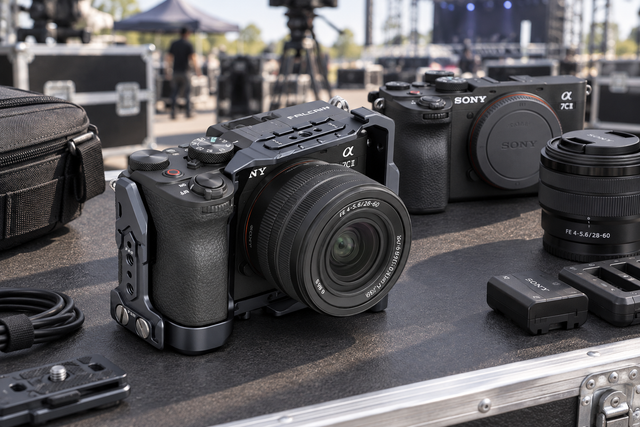
Build the chain in order, starting from the cage and working out to the monitor, instead of adding parts as you go. Falcam's own system is designed around a slide-in, slide-out motion to quickly mount and unmount a field monitor from your camera cage, but that only holds once each connection below is seated correctly.
- Unload the camera and lay out the cage, handle (if used), F22 plate, F22 receiver, and monitor so you can see the correct mounting orientation before attaching anything.
- Secure the cage-side or handle-side interface first, using the mounting point you verified earlier, whether that's a NATO rail, cold shoe, ARRI mount, or threaded hole.
- Attach the F22 plate to the monitor side and the matching F22 receiver to the cage or handle side. A generic cage mount is not automatically F22-compatible.
- Slide the plate into the receiver until it seats. Falcam describes a wedge pin locking into a groove on the plate through this "press and push" motion, which is what lets you skip repeated screwing on later swaps (slide-in, slide-out F22 release).
- Set the monitor's pan and tilt to your working angle before you route any cables, so the position doesn't depend on cable tension.
- Route HDMI or SDI cables with enough slack to reach the monitor without pulling sideways on the mount, then secure them along the handle or cage.
- Move to the pre-shoot test below before relying on this chain in production.
Run the Lock, Angle, Clearance, and Touch Test
A visible plate is not proof that the connection is locked. Run these checks before you start recording, and treat any failure as a reason to stop, not tighten.
- Engagement: you should feel or hear a distinct click as the plate seats; anything gritty or soft means it isn't fully engaged.
- Pull test: apply a firm, one-second pull in the direction you'd use to remove the monitor. It should not move.
- Visual lock: where the design includes a visible lock indicator or lever, confirm it has returned to its locked position.
- Angle and play: check that the monitor holds the pan and tilt angle you set, with no rotational wobble at the joint.
- Cable clearance: confirm HDMI or SDI cables have slack and can't pull sideways on the mount when you move the rig.
- Light touch: tap the touchscreen the way you would during a shoot. Any shift in angle is a failed test, even if the monitor stays attached.
Pass every check before the camera rolls. A single failed item means the chain still needs work, covered next.
When Touchscreen Tapping Makes the Monitor Tilt
Movement under a light tap almost always traces back to one of three places: the connection itself, the fasteners and cables around it, or a load the chain wasn't built to carry. Work through them in that order instead of guessing.
1. Engagement and lock
Start here before anything else. Re-seat the F22 plate and confirm the release control has returned fully to its locked position, not partway.
- Remove the plate, check for debris or a bent wedge pin, and reseat it until you hear the click.
- Any gritty motion or a millimeter of rotational play at the joint means the plate and receiver are mismatched, not just loose. Falcam's own fit guidance treats click, play, and gritty-engagement cues as signs of an incompatible pairing, not a wear issue to tighten away.
2. Fasteners, cables, and leverage
If engagement and lock both check out, look at what's pulling on the connection instead of at the connection itself.
- Confirm every fastener between the cage, handle, and plate is fully seated; a fastener that's snug but not bottomed out can let the whole assembly flex under a tap.
- Remove any sideways pull from HDMI or SDI cables, and avoid stacking a second adapter that adds distance, and leverage, between the cage and the monitor.
- Repeat the angle and light-touch test once cables and fasteners are corrected.
3. Load and compatibility
If movement continues after both checks above, the issue is usually the load or the pairing, not the tightness of any one part.

- Compare the assembled weight against the lowest applicable published limit in the chain, not just the mount's own rating.
- If the handle, plate, receiver, or cage interface isn't documented for this exact combination, treat the pairing as unverified.
- Stop using the chain until you've confirmed or replaced the mismatched component; a higher-rated mount doesn't compensate for a lower-rated cage or handle beneath it.
When This F22 Setup Is Not a Fit
Stop using the rig for production the moment any check above fails, rather than tightening it further. A failed lock, pull test, angle check, or light-touch tap means the chain isn't ready, no matter how solid it looks.
- Stop: unload the monitor if the connection releases on its own, shows rotational play, or shifts during the light-touch test.
- Verify: confirm the exact model and interface of every component, especially a handle or plate whose model number doesn't match its listing.
- Change: swap out a component whose published limit is lower than the assembled weight, or one that has no documented rating at all.
- Retest: rebuild the chain, then repeat the lock, pull, angle, and touch checks before you shoot again.
A rig that passes every check is ready to work. One that doesn't needs a corrected part, not a tighter grip.
FAQs
Which load rating controls a cage-and-handle F22 monitor setup?
The lowest published rating in the assembled hardware stack controls the entire rig. If a camera cage lists a 1 kg (2.2 lb) safe load limit while an F22 monitor mount claims 2.5 kg (5.5 lb), the 1 kg boundary dictates safe operation. Higher individual component ratings do not expand the load capacity of lower-rated supporting structures.
Can an F22 quick-release plate fit into standard Arca-Swiss receivers?
No, F22 quick-release plates use a proprietary compact form factor with specific wedge pins and grooves rather than wider Arca-Swiss dimensions. Attempting to seat an F22 plate into an Arca-Swiss or cold-shoe receiver directly without a purpose-built F22 base creates unsafe wobble and unverified locking.
What causes rotational play when the F22 monitor plate is locked?
Rotational play typically stems from an unseated wedge pin, debris in the receiver groove, or an improperly matched interface variant. If the release mechanism fails to return completely to its home position or exhibits grit, unload the monitor and verify that both mating parts belong to matching F22 hardware.