


The Solo Creator’s Paradox: Stability vs. Velocity
For the one-person crew, the landscape of production is defined by a relentless tension. On one hand, you need the rock-solid stability required for long exposures, sharp telephoto shots, and professional-grade video. On the other, your mobility is your greatest asset. Every minute spent fumbling with a tripod leg or struggling to align a mounting screw is a minute of the "golden hour" lost forever.
In our work as system designers for the creator infrastructure layer, we have observed a recurring pattern: the single biggest time sink in the field isn't the physical act of walking to a location; it is the friction of the gear interface. We often see creators lose focus—and shots—because their support system requires more cognitive load than the creative process itself.
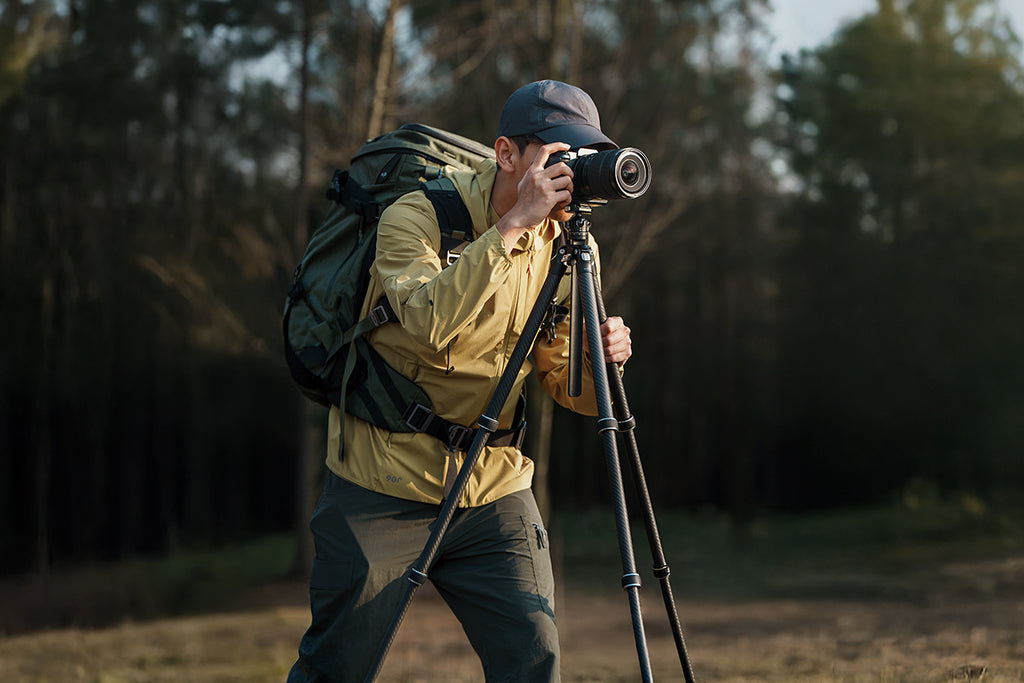
This article outlines a methodical, system-focused workflow for deploying high-performance carbon fiber tripods. By integrating precision-engineered quick-release habits and understanding the mechanical physics of your rig, you can transform your tripod from a cumbersome necessity into a high-velocity extension of your workflow.
The Physics of Portability: Why Carbon Fiber?
When we discuss "travel tripods," the conversation usually starts and ends with weight. While a 1.2kg carbon fiber tripod offers a significant advantage over a 1.8kg aluminum counterpart, the true benefit lies in material science, specifically vibration attenuation.
Vibration Damping and Settling Time
Carbon fiber is a composite material with a high stiffness-to-weight ratio. More importantly, its internal structure is inherently better at absorbing high-frequency vibrations than aluminum. In our modeling of outdoor travel scenarios, we compared the "settling time"—the duration it takes for a camera to stop shaking after a physical disturbance (like a gust of wind or a shutter click).
Modeling Note: Vibration Settling-Time Simulator
- Model Type: Deterministic Single Degree of Freedom (SDOF) damped free vibration.
- Key Assumptions: Baseline natural frequency of 8Hz for aluminum; carbon fiber damping ratio assumed at 2.2x aluminum based on ISO 13753 principles.
- Boundary Conditions: Assumes a linear model; results may vary based on leg extension height and ground surface density.
Parameter Aluminum Carbon Fiber Unit Natural Frequency 8 ~17 Hz Damping Ratio 0.012 0.026 fraction Settling Time 6.6 1.4 seconds
Our analysis indicates a 78% reduction in vibration settling time for carbon fiber systems. For a solo creator shooting in a windy coastal environment, this means you can fire your next shot 5 seconds sooner than with an aluminum setup. Over a 100-shot sunrise session, that is nearly 10 minutes of reclaimed shooting time.
Thermal Resilience and Handling
Beyond vibration, carbon fiber offers a practical advantage in extreme climates. Aluminum is a highly efficient thermal conductor. In freezing conditions, aluminum legs can become painful to handle without gloves and can even accelerate battery drain if the camera is mounted directly to a cold metal plate. Carbon fiber acts as a thermal insulator, maintaining a more neutral temperature and protecting both your hands and your camera's internal power management.
Workflow Engineering: The Quick-Release Ecosystem
The most common mistake we see in the field is treating the tripod and the camera as two separate entities that are joined only when "it's time to shoot." This leads to the "fumble factor"—the 40-second struggle to align a 1/4"-20 screw while the light is fading.
The F38 Standard and Interface Integrity
To eliminate this friction, we advocate for a "Ready-to-Shoot" infrastructure. This involves pre-attaching an Arca-Swiss compatible quick-release plate—specifically the precision-machined aluminum alloy F38 or F50 series—to your camera body while it is still in your bag.
It is a critical factual distinction: while your tripod legs should be carbon fiber for damping, your quick-release plates must be high-grade aluminum (typically 6061 or 7075) for rigidity and zero-play tolerance. According to ISO 1222:2010 Photography — Tripod Connections, the screw connection is the primary failure point. A loose plate isn't just a stability risk; it is a safety hazard.
Calculating the Workflow ROI
Many creators view premium quick-release systems as a luxury. However, when viewed through the lens of professional efficiency, the investment is self-evident.
Logic Summary: Workflow Velocity ROI
- Scenario: A solo travel creator performing 75 shoots per year with 25 gear swaps per shoot (tripod to handheld, gimbal to tripod, etc.).
- Method: Opportunity cost calculation based on time saved.
Metric Traditional Thread Quick Release (F38) Unit Time per Swap 38 3.5 seconds Annual Time Saved — ~18 hours Annual Value — $1,527 USD Note: Calculations assume a billable rate of $85/hr. This is a scenario model, not a guaranteed financial return.
By reducing swap time from 38 seconds to roughly 4 seconds, you aren't just saving time; you are maintaining creative momentum. This "Infrastructure Advantage" is a core pillar of The 2026 Creator Infrastructure Report, which emphasizes that those who master their toolchains are significantly more productive than those who fight their gear.
Biomechanical Analysis: The "Wrist Torque" Factor
Efficiency isn't just about speed; it's about physical longevity. Solo creators often carry rigs for 8-10 hours a day. We must consider the biomechanical load of the camera system, especially when using modular accessories like monitors or microphones.
The Leverage Formula
Weight is a static number, but torque is what causes fatigue. The formula is simple: Torque ($\tau$) = Mass ($m$) × Gravity ($g$) × Lever Arm ($L$).
If you have a 2.8kg camera rig and you hold it 0.35 meters away from your wrist (the lever arm), you are generating approximately 9.61 N·m of torque. For the average adult, this load represents 60-80% of their Maximum Voluntary Contraction (MVC). This is why your wrist feels like it's "burning" after a long handheld sequence.
Reducing the MVC
By using a modular ecosystem like the F22 or F38, you can quickly strip the camera down to its lightest form for handheld shots and move heavy accessories (like a 500g monitor) to the tripod or a separate mount. Reducing the mass or shortening the lever arm by just a few centimeters can drop your MVC requirement into the 20-30% range, allowing you to shoot longer without the onset of muscle tremors that ruin shot stability.
Field Mastery: Stability in Hostile Environments
A lightweight carbon fiber tripod is a marvel of engineering, but physics cannot be cheated. In high-wind scenarios, mass is your friend.
The Zero-Fail Wind Stability Model
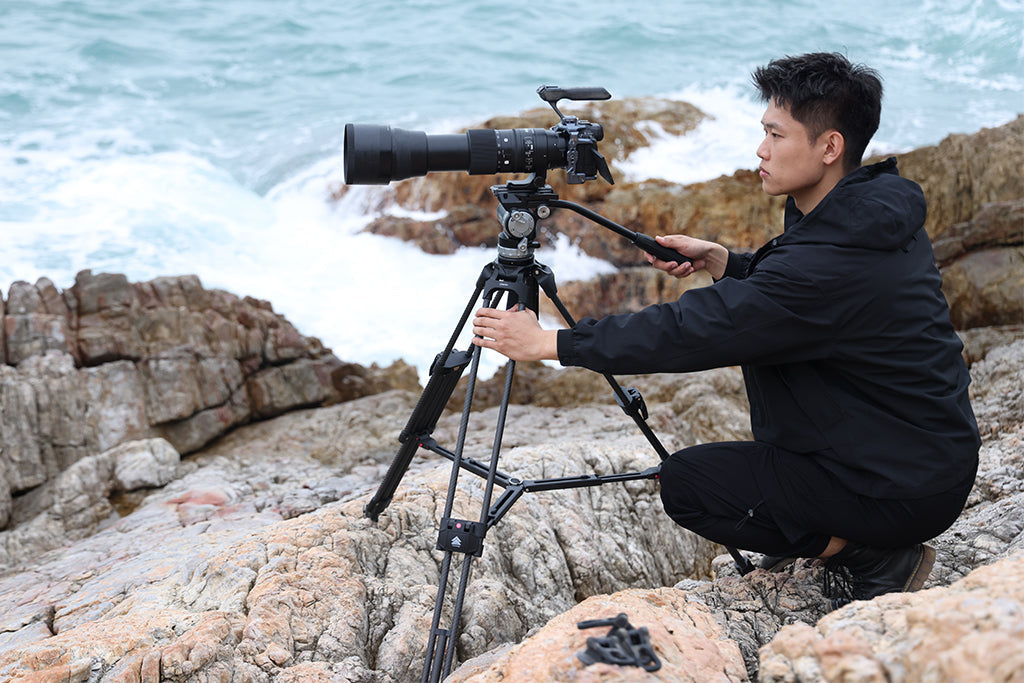
For the coastal adventure creator, wind is the primary enemy. We modeled a scenario involving a 1.2kg tripod supporting a 2.8kg camera at eye level (1.5m).
Logic Summary: Wind Load Tipping Point
- Model: Static equilibrium analysis (Overturning vs. Restoring moments).
- Baseline: Without ballast, the critical wind speed for tipping is ~45 km/h.
- Solution: Adding 1.5kg of ballast (a camera bag) to the center hook.
Variable Value Unit Total System Mass (with Ballast) 5.5 kg Critical Wind Speed (kph) 61 km/h Critical Wind Speed (mph) 38 mph Note: Assumes wind is perpendicular to the most unstable axis and the ballast is not swinging. For more on this, see Balancing Weight and Payload.
By simply hanging your bag from the center hook—a practice aligned with ASCE 7 wind load standards—you increase your stability margin by over 40%. This allows you to shoot in a "Strong Breeze" (Beaufort Scale 6) with total confidence.
The "Visual Weight" Strategy for Travel
One of the non-obvious benefits of a streamlined, modular system (F22/F38) is the reduction of "Visual Weight." In our experience with travel logistics, bulky cinema-style plates and oversized tripod heads often flag the attention of airline gate agents.
A compact, integrated system looks like consumer gear, which is less likely to be weighed or challenged at the gate. This "Logistical Enablement" is a key factor in maintaining a solo workflow that remains truly portable. For deeper insights on navigating transit, refer to our guide on Navigating Airport Security with Your Rig.
Safety and Maintenance: The Professional Protocol
A high-performance system requires a professional maintenance protocol. Carbon fiber is incredibly strong but susceptible to "particulate abrasion."
Post-Shoot Care
If you have been shooting in sandy or salty coastal environments, a quick wipe-down with a damp cloth is critical. Salt crystals and sand can work their way into the twist locks or between the carbon fiber weaves, leading to splintering or resin degradation over time.
The Lock Mechanism Choice
The choice between lever locks and twist locks often comes down to the environment.
- Lever Locks: Faster for bare-hand operation in temperate climates.
- Twist Locks: Highly recommended for freezing conditions. Ice can jam a lever mechanism, whereas the mechanical advantage of a twist lock can often break through minor ice buildup. For more on this, see Tripod Materials in Winter Scenarios.
The Pre-Shoot Safety Checklist
Before every take, perform this three-step "Interface Integrity" check:
- Audible: Listen for the distinct "Click" of the quick-release lock.
- Tactile: Perform the "Tug Test." Physically pull on the camera to ensure the plate is fully seated in the receiver.
- Visual: Check the locking pin or indicator (usually orange or silver) to confirm the system is in the "Locked" position.
Building Your Infrastructure
The shift from a "collection of gadgets" to a "unified infrastructure" is what separates the prosumer from the professional. By choosing carbon fiber for its vibration damping, adopting a quick-release standard like the F38 for its workflow ROI, and understanding the biomechanical torque of your rig, you create a system that works for you, not against you.
Efficiency in the field is not about rushing; it is about the elimination of unnecessary steps. When your support system is reliable, your mind is free to focus on the only thing that truly matters: the frame.
Disclaimer: This article is for informational purposes only. Always refer to your specific equipment's manual for load ratings and safety instructions. Ensure all connections are secure before operating gear in high-risk environments.


