The Hidden Risk of "Set and Forget": Why Support Gear Fails
For many adventure creators, a tripod is viewed as a static tool—a "set and forget" piece of equipment. However, in the high-stakes environment of remote expeditions, your tripod and quick-release system are the primary infrastructure holding thousands of dollars in optical precision. We have observed through patterns in customer support and field repair logs that the most catastrophic gear failures rarely stem from manufacturing defects; they stem from cumulative mechanical fatigue that goes unnoticed until the moment of impact.
The reality of adventure photography involves constant vibration, thermal expansion, and the repeated stress of mounting and unmounting. Whether you are using a lightweight system like the Ulanzi Falcam TreeRoot Quick Open Desktop Tripod T00A4103 for vlogging or a robust Ulanzi F38 Quick Release Video Travel Tripod 3318 for cinema work, your gear is subject to the laws of physics. According to the 2026 Creator Infrastructure Report: Engineering Standards, Workflow Compliance, and the Ecosystem Shift, building a "ready-to-shoot" toolchain requires moving from a mindset of "repairing what breaks" to "preventing what might loosen."

Understanding the Engineering: Why Bolts Loosen
To maintain your gear effectively, you must understand the mechanical forces at play. Most high-performance camera supports utilize 6061-T6 aluminum alloy for its strength-to-weight ratio. While durable, this material has specific failure modes that every professional should recognize.
Vibration and the Loosening Cycle
A common misconception is that a bolt tightened once will stay tight indefinitely. However, research published in MDPI Materials indicates that bolt loosening is highly dependent on vibration frequency. In a lab setting, fasteners under transverse loads can experience failure in as few as $10^4$ to $10^5$ cycles. When you hike with a tripod strapped to a backpack, the rhythmic vibration of your gait acts as a low-frequency, high-amplitude transverse load. Over a six-hour trek, these thousands of micro-vibrations can incrementally back out a fastener that felt secure at the trailhead.
The Danger of Over-Tightening: Galling and Fatigue
While loosening is a risk, the "fix" of over-tightening is often more dangerous. The yield strength of 6061-T6 aluminum is approximately 40,000 psi. When using a standard hex key, it is remarkably easy to exceed this limit by hand. This leads to galling—a form of wear caused by adhesion between sliding surfaces. When threads gall, they essentially cold-weld together, leading to thread pull-out or a permanent seizure.
Logic Summary: Our maintenance philosophy assumes that thread integrity is a finite resource. Every time a bolt is over-tightened, the aluminum undergoes plastic deformation, reducing the clamping force it can provide in the future.
The Biomechanical Reality: Why Wrist Torque Matters
In the field, we often focus on the weight of the camera, but the true enemy of stability and physical health is leverage. When you mount a camera to a head like the Ulanzi U-190 Pro Fluid Video Head E009GBB1, the offset of the center of gravity creates a rotational force that must be countered by the tripod's fasteners and your own wrist.
The Leverage Formula
To understand the stress on your gear, consider the torque formula: $$\tau = m \times g \times L$$
- $\tau$ (Torque): The rotational force (Newton-meters).
- $m$ (Mass): The weight of your camera rig.
- $g$ (Gravity): $9.81 m/s^2$.
- $L$ (Lever Arm): The distance from the pivot point to the center of mass.
If you are holding a 2.8kg rig (a typical mid-range cinema setup) just 0.35 meters away from your wrist, you are generating approximately $9.61 N\cdot m$ of torque. For the average adult, this represents 60-80% of their Maximum Voluntary Contraction (MVC). This high load explains why even minor fastener loosening can lead to a sudden "flop" of the camera head, potentially damaging the lens or the ISO 1222:2010 compliant screw connections.
The Systematic Pre-Hike Checklist
To mitigate these risks, we recommend a methodical three-part inspection before every major expedition. This routine ensures that your "creator infrastructure" remains stable regardless of the terrain.
1. The Visual and Audible Check
- The "Click" Test: When using the F38 ecosystem, always listen for the distinct audible click.
- Visual Indicators: Check the locking pin status. On most Ulanzi systems, an orange or silver indicator provides a visual confirmation of the lock state.
- Nail Polish Marking: A professional field heuristic is to mark key fasteners (like the leg-to-spider bolts) with a small dot of nail polish. If the mark is cracked or misaligned, the bolt has moved and requires attention.
2. The Tactile "Tug Test"
Immediately after mounting your camera to the Ulanzi F38 Quick Release Fluid Video Head E004GBA1, perform a pull-test. Apply firm pressure in multiple directions. If there is any "play" or "micro-wobble," do not proceed. This is often an indicator of debris in the Arca-Swiss rail or a fastener that has reached its fatigue limit.
3. The "Two-Finger Tight" Rule
To prevent the aforementioned thread galling, adopt the Two-Finger Tight rule. When tightening a knob or using a hex tool, apply force using only your thumb and forefinger at the very end of the tool. This naturally limits the torque to a safe range for aluminum components, preventing the stripping of threads while ensuring sufficient clamping force.
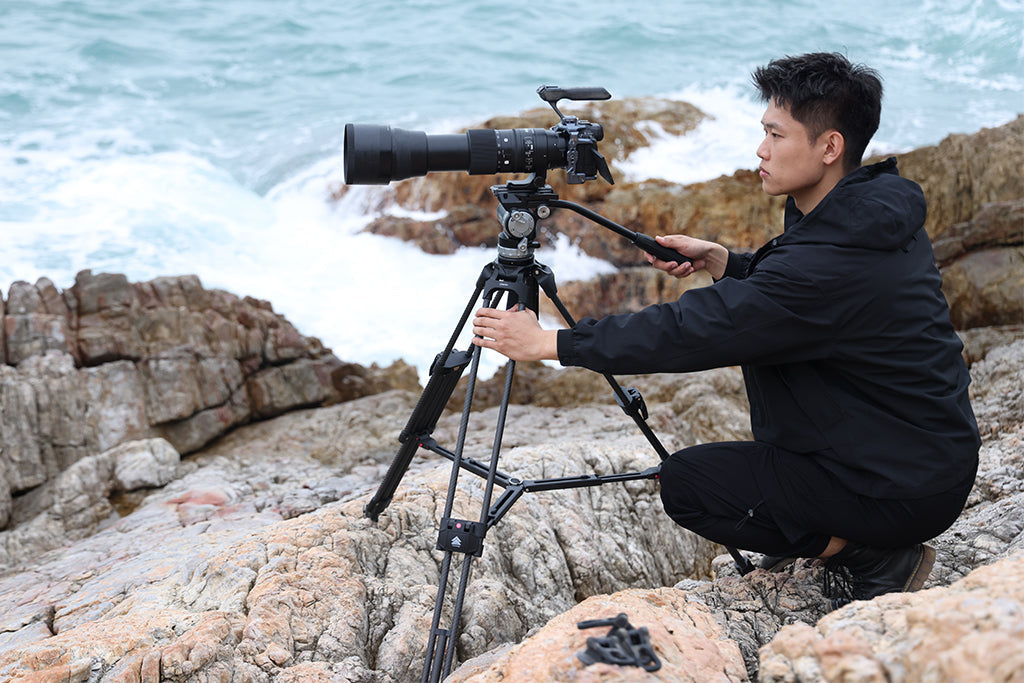
Environmental Variables: Cold, Sand, and Salt
Your maintenance strategy must change based on where you shoot. Different environments introduce unique mechanical stressors.
The "Thermal Shock" Prevention
Aluminum is a highly efficient thermal conductor. In extreme cold, an aluminum quick-release plate acts as a "thermal bridge," drawing heat away from your camera's battery and potentially causing premature shutdown.
- Expert Tip: Attach your quick-release plates to your cameras indoors before heading into the cold. This allows the metal to reach ambient room temperature and minimizes the "metal-to-skin" shock when handling gear in sub-zero conditions.
Sand and Abrasives
In desert or coastal environments, traditional grease is your enemy; it acts as a magnet for abrasive particles.
- The PTFE Solution: For sandy environments, clean your threads thoroughly and apply a light coating of dry PTFE lubricant. Unlike grease, PTFE provides a low-friction surface that does not attract sand, protecting the precision-machined tolerances of your Falcam interface.
The Financial Case for Infrastructure Reliability
Investing time in preventive care isn't just about safety; it’s a high-ROI business decision. For professional creators, the time spent mounting and unmounting gear is "non-productive time."
The Workflow ROI Calculation
Consider the efficiency gain of a standardized quick-release ecosystem like the F38:
| Parameter | Traditional Thread | F38 Quick Release |
|---|---|---|
| Time per Swap | ~40 seconds | ~3 seconds |
| Swaps per Shoot | 60 | 60 |
| Shoots per Year | 80 | 80 |
| Total Annual Time | ~89 hours | ~6.6 hours |
By switching to a systematic quick-release workflow, you save approximately 82 hours annually. At a professional rate of $120/hr, this represents a $9,840 value in recovered productivity. This "found time" allows for more creative exploration and less mechanical friction. For more on this, see our guide on standardizing your rig to eliminate workflow friction.
The "Visual Weight" Advantage
For the travel creator, gear reliability also impacts logistics. Compact, modular systems like the F22 and F38 have a lower "Visual Weight" than bulky traditional cinema plates. This makes your rig appear less "industrial" to airline gate agents, reducing the likelihood of your carry-on being flagged for weighing or forced gate-checking. Maintaining a clean, well-functioning system ensures that your gear remains within the "prosumer" profile that is ideal for international travel.
Appendix: Modeling Note & Assumptions
The data and heuristics provided in this article are derived from scenario modeling and common industry patterns observed in field maintenance. They are intended for informational purposes and do not replace the specific torque requirements provided by individual gear manufacturers.
| Parameter | Value / Range | Rationale |
|---|---|---|
| Aluminum Yield Strength | ~40,000 psi | Standard 6061-T6 specification |
| Loosening Cycle Threshold | $10^4 - 10^5$ | Based on MDPI transverse load studies |
| Anti-Seize Torque Reduction | 10-25% | Standard friction coefficient adjustment |
| MVC (Wrist Torque) | 12-15 N·m | Average adult male voluntary contraction |
| "Two-Finger" Torque | 2-4 N·m | Estimated limit of thumb/forefinger pinch force |
Disclaimer: This guide is for informational purposes only. Mechanical failure can occur even with proper maintenance. Always perform a field repair check and consult a professional technician for complex repairs.
For further reading on maintaining the integrity of your supports, explore our guides on cleaning support gear for studio deployment and caring for travel gear in harsh environments.