


The Friction Paradox: Why High Clamping Force Fails on Wet Rails
For the outdoor cinematographer, a mounting failure is rarely a matter of "if," but "when." In the controlled environment of a studio, a standard clamp performs exactly as the spec sheet dictates. However, on a rain-slicked aluminum rail or a muddy steel pipe in the field, the physics of equipment security changes fundamentally. The single biggest point of failure on wet surfaces isn't actually the clamp’s static grip—it is the resistance to torsional creep under dynamic load.
Conventional wisdom suggests that simply tightening a knurled metal clamp harder will solve the issue. In reality, over-tightening metal-on-metal interfaces in the rain can score the rail’s anodized surface. These microscopic grooves create channels for water to pool, acting as a lubricant that actually reduces the coefficient of friction. To maintain equipment integrity in mission-critical scenarios, we must look beyond sheer force and toward the tribology of the interface.
The Science of Slippage: Understanding Coefficients of Friction
When water or mud enters the interface between a clamp and a rail, it acts as a "boundary lubricant." According to data on Coefficients of Friction, the coefficient of static friction for rubber on steel can drop by more than 50% when wet—plummeting from approximately 0.9 to potentially below 0.4.
| Interface Material | Dry Friction (Approx.) | Wet/Muddy Friction (Estimated) | Risk Level |
|---|---|---|---|
| Rubber on Aluminum | 0.8 - 0.9 | 0.35 - 0.45 | High (Creep likely) |
| Anodized Metal on Metal | 0.2 - 0.3 | 0.1 - 0.15 | Critical (Instant failure) |
| Textured Silicone on Metal | 0.7 - 0.8 | 0.5 - 0.6 | Moderate (Optimized) |
| Serrated Steel on Muddy Rail | N/A | 0.6 - 0.7 | Low (Mechanical bite) |
Methodology Note (Scenario Modeling): These values are estimated based on standard tribological tables and scenario modeling for outdoor cinematography. They are not derived from a controlled lab study of specific commercial products but represent common physical behaviors of materials in environmental extremes.
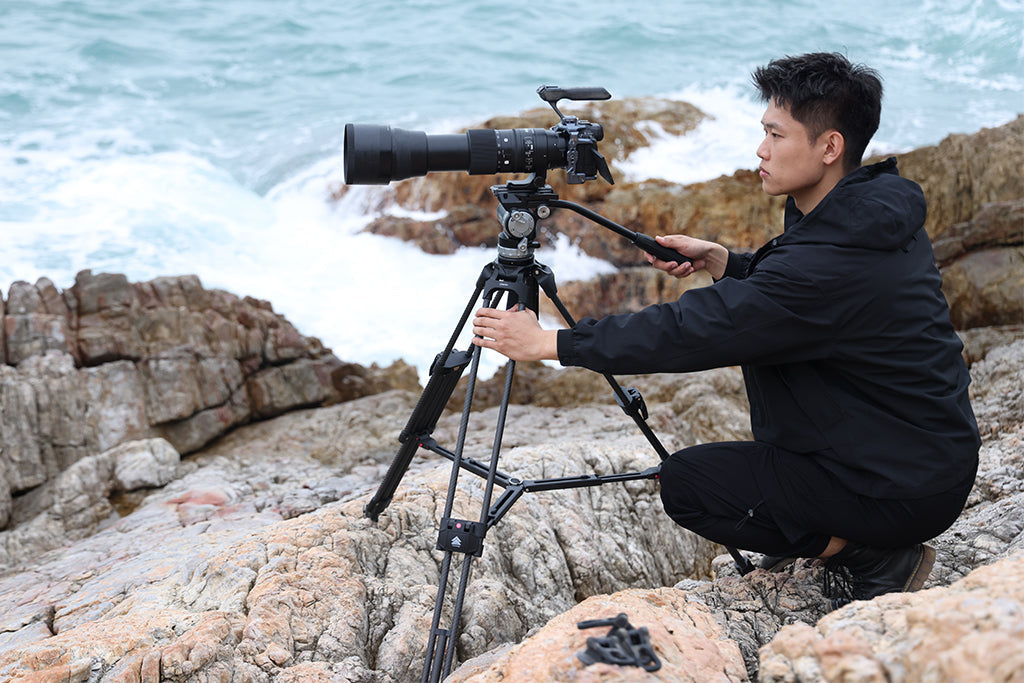
In muddy conditions, the challenge shifts. Mud acts as a "false bedding," filling the gaps between the clamp and the rail. While rubber pads are usually superior for grip, on an irregular, muddy rail, serrated metal jaws may actually outperform smooth rubber. As noted in technical discussions on Serration, the teeth of a serrated jaw can cut through soft contaminants to achieve direct metal-on-metal contact, whereas mud compromises the uniform adhesion required for rubber to function.
Biomechanical Analysis: The "Wrist Torque" Factor
When we mount a heavy cinema rig, we often focus on the total weight. However, the true enemy of a secure mount is leverage. In handheld or gimbal-mounted workflows, the distance between the camera’s center of gravity and the mounting point creates torque that can easily overcome a clamp's friction.
The Torque Formula
We can model this risk using the standard calculation for Torque ($\tau$): $$\tau = m \times g \times L$$
- $m$: Mass of the rig (kg)
- $g$: Gravity ($\approx 9.8 m/s^2$)
- $L$: Lever Arm (distance from the pivot point/wrist in meters)
Example Scenario: A professional rig weighing 2.8kg held on a side handle 0.35m away from the mounting point generates approximately 9.61 $N\cdot m$ of torque. Based on biomechanical heuristics, this load represents roughly 60-80% of the Maximum Voluntary Contraction (MVC) for an average adult male. By utilizing a modular ecosystem like the Ulanzi Falcam F22 & F38 & F50 Quick Release Camera Cage V2 for Sony A1/A7 III/A7S III/A7R IV 2635A, users can move accessories like monitors or microphones closer to the center of gravity, effectively reducing the lever arm ($L$) and minimizing the torque that leads to mounting "creep."
The Ecosystem Shift: Engineering for Real Failure Modes
As highlighted in The 2026 Creator Infrastructure Report: Engineering Standards, Workflow Compliance, and the Ecosystem Shift, the transition from isolated gadgets to integrated "workflow infrastructure" requires a higher standard of engineering discipline. For Ulanzi, this means moving beyond generic load ratings toward specific, transparent performance metrics.
Vertical Static Load vs. Dynamic Payload
A common point of confusion is the "80kg load capacity" often cited for systems like the F38. It is critical to distinguish between Vertical Static Load (a lab-tested result where weight is applied directly downward in a stable environment) and Dynamic Payload.
For real-world handheld or off-road vehicle mounting, the dynamic forces—including engine harmonics and terrain shocks—can exceed the static rating. If you are working with a heavy cinema rig (over 3kg) in a high-vibration environment, we recommend upgrading to the F50 system or utilizing F38 Anti-Deflection plates. These are precision-machined from Aluminum Alloy (6061 or 7075), providing the necessary rigidity and machining tolerance to prevent "play" that could lead to catastrophic failure.
Correction on Materials: While some manufacturers use carbon fiber for tripod legs to aid in vibration damping, quick-release plates must remain aluminum. Aluminum provides the necessary hardness to maintain the ISO 1222:2010 tripod connection standards and ensures the Arca-Swiss dovetail dimensions remain within tolerance.
Environmental Hazards: Corrosion and Thermal Shock
Outdoor rigging isn't just about friction; it's about the long-term survival of the hardware. Two often-overlooked factors are galvanic corrosion and thermal shock.
The Saltwater Trap
In marine environments, high clamping force on a wet aluminum-to-steel interface can actually be detrimental. According to research on Aluminum Corrosion in Saltwater, the presence of an electrolyte (saltwater) completes a circuit between dissimilar metals. High pressure can strip away protective oxide layers, accelerating galvanic corrosion by over 10 times. Always rinse your Ulanzi F38 Quick Release Fluid Video Head E004GBA1 with fresh water after coastal shoots to prevent hidden structural degradation.
Preventing Thermal Shock
Aluminum quick-release plates act as a "thermal bridge." In extreme cold, they conduct heat away from the camera body and toward the frozen mounting rail, which can accelerate battery depletion.
- Pro Tip: Attach your aluminum QR plates to the camera indoors before heading out. This minimizes the "metal-to-skin" shock during setup and allows the plate to maintain a slightly higher temperature, protecting the camera's internal battery chemistry for a few extra minutes of runtime.

Workflow ROI: The Value of Speed in the Field
Investing in a unified quick-release system is often framed as a luxury, but for the professional, it is a logistical necessity. When working in rain or mud, every second the camera is exposed is a second of risk.
The Time-Saving Calculation
- Traditional Thread Mounting: ~40 seconds per swap.
- Quick Release (F38/F22): ~3 seconds per swap.
For a professional creator performing 60 swaps per shoot across 80 shoots a year, this system saves approximately 49 hours annually. At a professional rate of $120/hr, this translates to a $5,900+ value in recovered time. This efficiency allows you to keep your gear safely tucked inside a Ulanzi BP04 Hard Shell Camera Backpack 25L Works with Apple Find My B121 until the exact moment of the shot, reducing environmental exposure.
The Professional "Wet Rail" Protocol
To maximize security when mounting on wet or muddy surfaces, we recommend a two-stage protocol derived from the patterns observed in high-end outdoor cinematography:
- Decontamination: Clean the rail with isopropyl alcohol and a microfiber cloth. This removes invisible oils and biofilms that reduce friction.
- Interface Enhancement: Apply a thin, high-tack rubber pad between the clamp jaw and the rail. These pads must be replaced frequently; once they compress and lose elasticity, their ability to displace water is compromised.
- Lateral Security: Remember that on a wet surface, the clamp’s contact surface area is more critical than sheer clamping force. A wider jaw with textured, non-absorbent silicone often outperforms a narrow metal jaw.
The Pre-Shoot Safety Checklist
Before releasing your hand from the camera, always perform these three checks:
- Audible: Did you hear the distinct "Click" of the locking mechanism?
- Tactile: Perform the "Tug Test." Pull firmly on the rig in two different directions to ensure the plate is fully seated.
- Visual: Check the locking pin status. Ensure the indicator (often orange or silver) is in the locked position.
Finally, always use a secondary safety tether rated for the full weight of the rig. Attach it to a separate anchor point. In freezing conditions, ice can form between the metal interfaces, causing a clamp to fail catastrophically without warning. A tether is your only insurance against a total loss.
Logistics and Data Management in the Field
A ruggedized workflow extends beyond the mount. Once the shot is secured in harsh conditions, the data must be protected. Using a Ulanzi CRC10 3-in-1 Card Reader Case C078GBB1 ensures that your media is shielded from the same mud and moisture that challenged your mounting rig.
By treating your mounting system as "creator infrastructure" rather than a set of disposable accessories, you build a foundation of trust that allows you to focus on the creative process, even when the environment is working against you.
Disclaimer: This article is for informational purposes only. Mounting heavy equipment in outdoor environments involves inherent risks. Always consult the specific load ratings of your gear and perform regular safety inspections. Ulanzi is not responsible for equipment damage resulting from improper use or environmental failure.


