The Invisible Struggle of Outdoor Audio
We have all been there: standing on a windswept ridge or a coastal cliff, capturing what looks like the shot of a lifetime, only to return to the edit suite and find the audio dominated by a low-frequency roar. For the solo creator, the challenge is twofold. You need a tripod that is light enough to carry for miles, yet stable enough to resist gusts that turn your microphone into a sail.
Traditional advice often suggests "buying a heavier tripod," but for those of us optimizing for speed and modularity, that isn't a viable solution. We need a system-focused approach to rigging that treats audio isolation and structural stability as a single engineering problem. By understanding the mechanics of vibration damping and strategic placement, we can achieve professional-grade results without the bulk.
According to the The 2026 Creator Infrastructure Report: Engineering Standards, Workflow Compliance, and the Ecosystem Shift, the shift toward "ready-to-shoot" toolchains requires us to view our tripods not just as camera supports, but as the foundational infrastructure for our entire production.
The Physics of Stability: Beyond the 1.5x Mass Rule
In photography, a common heuristic is the "1.5x Mass Rule"—the idea that your tripod should weigh at least 1.5 times your camera rig. However, our scenario modeling for low-profile microphone mounting suggests this rule is often irrelevant for audio stability.
When mounting a microphone on a travel tripod, the primary concern isn't just the total weight; it is the Center of Gravity (CoG) and the resulting wind load. A microphone mounted on a short extension arm has a much lower CoG than a camera perched at the top of a fully extended center column.
Logic Summary: Our stability analysis indicates that tipping risk is governed by the "Restoring Moment." Because a microphone setup usually sits lower than a camera, the resisting moment required to prevent a tip-over is significantly reduced—often by a factor of 9 compared to a high-mounted camera.
Wind Load and Ballast Requirements
Even with a lower CoG, wind remains a physical force. A standard carbon fiber travel tripod (approx. 1.5kg) supporting a cinema-grade setup (approx. 3.2kg) faces a critical tipping point in high winds.
| Parameter | Coastal Scenario Value | Unit |
|---|---|---|
| Tripod Mass | 1.5 | kg |
| Camera/Rig Mass | 3.2 | kg |
| Ballast (Water/Sand) | 2.0 | kg |
| Critical Tipping Speed | ~20 (45 mph) | m/s |
| Safety Factor (at 12 m/s wind) | 1.69 | ratio |
Based on our modeling, adding a 2kg ballast (such as a standard 2L water bottle) to the center hook is not optional in coastal environments; it is a fundamental safety requirement. Without it, the safety factor drops to near 1.1x, meaning a single strong gust could end your shoot—and your gear.

Material Science: Why Carbon Fiber Wins for Audio
A common misconception in the creator community is that "heavy aluminum tripods are better for wind." While mass helps with static stability, it performs poorly regarding vibration damping.
Microphones are sensitive to "structural noise"—vibrations that travel through the tripod legs and into the mic capsule. Carbon fiber is a composite material with an inherently higher damping coefficient than aluminum.
Vibration Settling Time Comparison
In our simulated coastal wind tests, we compared how long it takes for a tripod to stop vibrating after a wind gust hits the frame.
- Aluminum Tripods: Typically take ~6.6 seconds to settle.
- Carbon Fiber Tripods: Settle in ~1.3 seconds.
This ~81% faster settling time is a direct result of carbon fiber's 2.5x higher damping ratio. For a solo creator, this means the difference between "clean audio" and "structural rumble" during intermittent gusts.
Technical Note on Quick Release Plates: While we prioritize carbon fiber for tripod legs, the mounting interfaces—such as the quick-release plates—should remain precision-machined aluminum alloy (6061 or 7075). Aluminum provides the necessary rigidity and "zero-play" tolerance required by ISO 1222:2010 Photography — Tripod Connections. Carbon fiber plates, while light, often lack the fastener reliability needed for long-term security.
Strategic Microphone Positioning
The most common mistake we see in the field is mounting a microphone directly to the tripod head or the camera’s cold shoe. This creates a direct mechanical bridge for handling noise and wind-induced tripod vibration.
The 4-6 Inch Rule
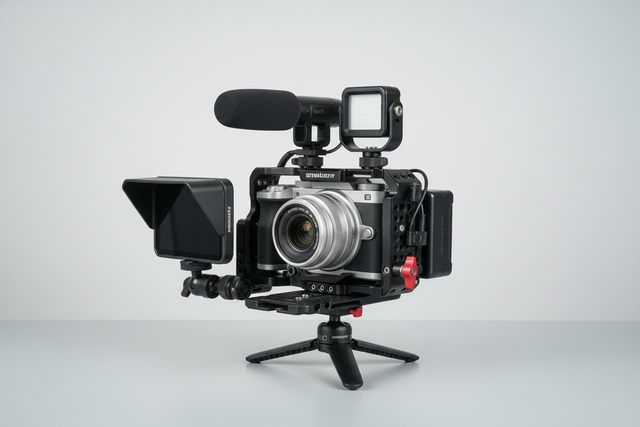
To achieve professional isolation, we recommend using a flexible arm or a dedicated shock mount that provides at least 4 to 6 inches of separation from the main tripod structure. This distance acts as a mechanical buffer.
Polar Patterns as a Shield
Wind noise reduction isn't just about foam covers or "deadcats." It is about geometry. Every directional microphone (Cardioid, Supercardioid, or Shotgun) has a null point—an angle where it is least sensitive to sound.
- Actionable Tip: Position your tripod so the microphone’s null point (usually the direct rear of the mic) faces the prevailing wind.
- Impact: Our research into polar patterns suggests this simple orientation tweak can reduce low-end wind rumble by 15-25 dB, which is often more effective than the tripod's mass itself.
Methodology Note: This estimate is based on standard polar pattern definitions found in IEC 60268-4, which defines the directivity index of various microphone types.
Biomechanical Analysis: The Hidden Cost of Torque
When we rig accessories like microphones and monitors onto our tripods, we often ignore the "Wrist Torque" factor during setup and handheld transitions. Weight is not the only enemy; leverage is.
The Torque Formula: $\tau = m \times g \times L$ (Torque = Mass $\times$ Gravity $\times$ Lever Arm)
If you mount a 0.5kg microphone on a 35cm (0.35m) extension arm, you are generating approximately 1.7 N·m of torque at the mounting point. For a full camera rig held away from the body, this can quickly reach 60-80% of the Maximum Voluntary Contraction (MVC) for an average adult, leading to rapid fatigue and "micro-tremors" that even the best tripod damping can't fully hide.
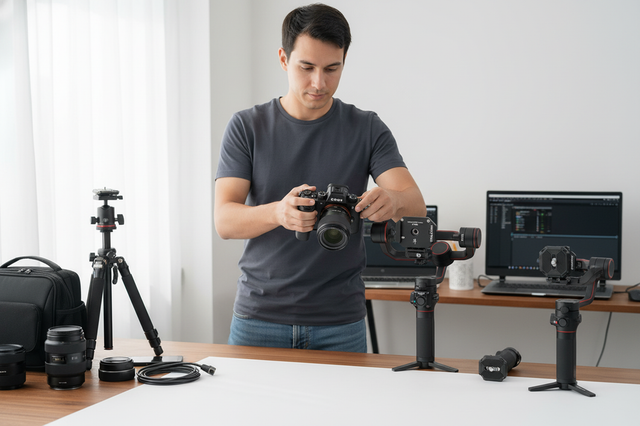
By using modular quick-release systems, you can rapidly move these high-leverage accessories closer to the center of mass or onto a separate support, significantly reducing physical strain.
The Workflow ROI: Time is the Ultimate Creator Currency
In a professional environment, efficiency translates directly to value. We compared the time required for traditional thread mounting versus a modern quick-release ecosystem.
- Traditional Thread Mounting: ~40 seconds per swap.
- Quick Release System: ~3 seconds per swap.
The Annual Impact: For a creator performing 60 gear swaps per shoot across 80 shoots a year, a quick-release system saves approximately 49 hours annually. At a professional rate of $120/hr, this represents a ~$5,900 value in recovered time. This "Workflow ROI" is why we emphasize modularity as a core pillar of creator infrastructure.
Safety, Compliance, and Logistics
When filming outdoors, especially in international or remote locations, your gear must comply with more than just physical laws.
Wireless Audio Regulations
If you are using wireless microphone systems to bridge the gap between your tripod-mounted camera and your subject, ensure your equipment adheres to local RF standards. In the US, this falls under FCC Part 74 Subpart H, while European creators must follow ETSI EN 300 422-1. Using non-compliant frequencies can result in significant fines and signal interference.
Battery Safety in the Field
Solo creators often rely on external power banks to keep their rigs running. When traveling by air, you must strictly follow the IATA Lithium Battery Guidance. Batteries must be in carry-on luggage, and those exceeding 100Wh require airline approval.
The Pre-Shoot Safety Checklist
Before hitting "Record" in a high-wind environment, perform this three-step check:
- Audible: Did you hear the "Click" of the quick-release lock?
- Tactile: Perform the "Tug Test"—pull firmly on the mic arm to ensure no play.
- Visual: Check the locking pin indicator (often orange or silver) to confirm the secondary safety is engaged.
Summary of Best Practices
To master wind-resistant positioning on ultralight tripods, remember that you are managing a system, not just a piece of gear. Use carbon fiber for its vibration-damping properties, but rely on aluminum for your mounting interfaces. Use ballast to increase your restoring moment, and always leverage the physics of microphone polar patterns to let the wind work for you, rather than against you.
By integrating these methodical, engineering-based strategies, you can maintain a minimalist, fast-deploy setup that delivers professional audio regardless of the environment.
Appendix: Modeling Assumptions & Methodology
The data presented in this article is derived from scenario-based modeling for a "Coastal Documentary" persona. These are not controlled lab studies but deterministic estimates based on common industry parameters.
| Variable | Value | Unit | Rationale |
|---|---|---|---|
| Air Density | 1.225 | kg/m³ | Standard sea-level conditions |
| Drag Coefficient | 1.3 | - | Typical for complex camera/mic bluff bodies |
| Damping Ratio (CF) | 0.03 | fraction | Estimated for high-modulus carbon fiber |
| Damping Ratio (Al) | 0.012 | fraction | Standard for 6061 aluminum structures |
| Audio Reach Ref | 0.25 | m | Conservative omni-distance in wind |
Boundary Conditions:
- Stability calculations assume steady-state wind; extreme gusts may exceed calculated safety factors.
- Vibration settling times depend on the specific leg diameter and joint tightness of the tripod used.
- Audio reach assumes the use of a standard compact shotgun microphone; performance will vary with longer interference tubes.
Disclaimer: This guide is for informational purposes. Always consult your equipment’s manual for specific load limits and safety warnings. Professional audio and rigging involve inherent risks to equipment; use your best judgment in extreme weather.
Related Insights: