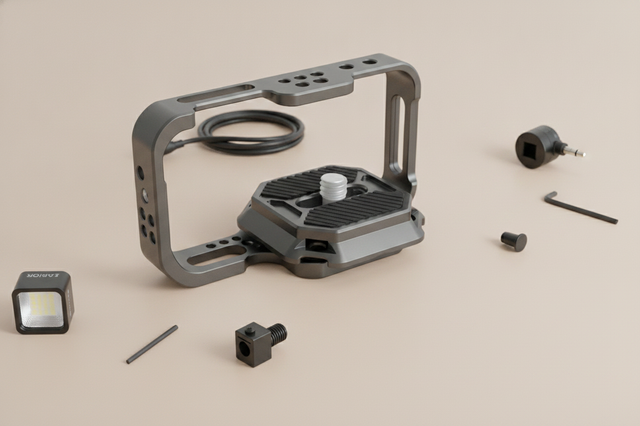
The Solo Creator’s Dilemma: Speed vs. Security
For the solo operator, time is the most expensive line item on the production budget. Every minute spent fumbling with a hex key to adjust a monitor arm or swap a camera plate is a minute lost to creative flow. This friction has fueled the industry-wide shift toward tool-less fasteners—thumb screws, cam levers, and quick-release ecosystems.
However, as rigs grow heavier with the addition of V-mount batteries, external monitors, and wireless transmitters, a critical question emerges: Is the speed of a tool-less transition worth the risk of a structural failure?
In this analysis, we evaluate the trade-offs between manual adjustments and the long-term security required for heavy handheld setups. By aligning our engineering approach with The 2026 Creator Infrastructure Report, we aim to move beyond "quick fixes" and toward a methodical system of reliability.
Logic Summary: Our evaluation of fastener efficiency assumes a high-frequency adjustment environment typical of "run-and-gun" solo production. These insights are based on scenario modeling of common rigging patterns and customer support feedback regarding mechanical wear (not a controlled lab study).

The Fastener Spectrum: Tool-Less vs. Hex-Key
The choice between a thumb screw and a hex-key (Allen) bolt isn't just about convenience; it is a choice between two different engineering philosophies.
The Tool-Less Speed Myth
Conventional wisdom suggests that tool-less fasteners are inherently faster for solo work. However, manufacturing data indicates that while tool-less designs can reduce "fastener engagement time" by 40–60%, the total assembly time often only improves by 5–15% (based on standard assembly modeling). This is because the time spent handling, aligning, and verifying the connection remains constant regardless of the drive type.
For a solo creator, the perceived speed gain is real, but it must be weighed against the ergonomic cost. The maximum recommended torque for a typical M6 knurled thumb screw is approximately 2–3 Nm. Exceeding this requires a palmar grip that can lead to repetitive strain or fatigue over a long shoot day.
The Hex-Key Benchmark
Hex-key fasteners are often viewed as the benchmark for security. While they allow for higher torque, their reliability in the field is heavily dependent on user skill. We have observed that a hand-tightened hex key often delivers inconsistent torque—frequently only 50–70% of the target—if the operator is rushing between setups.
| Fastener Type | Typical Torque Range | Best Use Case | Primary Risk |
|---|---|---|---|
| Thumb Screw | 1–3 Nm | Secondary accessories (mics, lights) | Gradual loosening from vibration |
| Cam Lever | 3–5 Nm | Quick-release plates, rail clamps | Mechanical wear of the cam surface |
| Hex-Key Bolt | 4–10+ Nm | Primary load paths, camera cages | Over-torquing/Stripping threads |
| Quick-Release | N/A (Positive Lock) | Camera-to-tripod, Camera-to-gimbal | Incomplete engagement (User error) |
Biomechanical Analysis: The "Wrist Torque" Factor
When evaluating fastener security, we must look beyond the weight of the camera. The real enemy of a solo operator is leverage.
The Formula of Fatigue
The torque ($\tau$) exerted on your wrist and your rig's fasteners can be calculated as: $$\tau = m \times g \times L$$ (Where $m$ is mass, $g$ is gravity $\approx 9.8 m/s^2$, and $L$ is the lever arm or distance from the pivot point.)
Scenario Modeling: Imagine a 2.8kg cinema rig. If you mount a heavy external monitor 0.35m away from the central handle to improve visibility, that setup generates approximately 9.61 Nm of torque.
For an average adult, this load represents roughly 60–80% of their Maximum Voluntary Contraction (MVC). In this high-leverage scenario, a hand-tightened thumb screw on a monitor mount is likely to "creep" or tilt downward under the stress of movement. This is why we recommend moving heavy accessories to modular quick-release systems like the FALCAM F22 series, which use positive-locking interfaces rather than relying solely on friction.
The 1.5kg Rule: When to Reach for the Tool
Based on common patterns from professional rigging environments and repair bench observations, we utilize a specific heuristic for fastener selection: The 1.5kg Threshold.
For any primary load path supporting over 1.5kg, hand-tightening rarely achieves the consistent 3–4 Nm of torque required to prevent "creep" during active handheld movement.
Understanding Micro-Vibrations
The failure mode for an under-torqued fastener is rarely an immediate snap. Instead, it is a gradual loosening caused by high-frequency micro-vibrations—the kind generated by walking with a rig or operating a gimbal. These vibrations act as a "micro-wrench," slowly backing the screw out of the thread.
To combat this, experienced riggers often use hex-key fasteners for the "bones" of the rig (cages, baseplates) and save tool-less fasteners for "limbs" (monitor arms, side handles) that require frequent repositioning.
Preventing Thread Galling
A frequent issue with aluminum rigging components is thread galling—where the metal surfaces essentially "cold weld" together under pressure.
- Pro Tip: Apply a minimal amount of anti-seize compound to the first few threads (not the tip) of your primary fasteners. This prevents binding and ensures consistent torque application over hundreds of cycles. Avoid over-lubrication, as it can attract grit that acts as an abrasive.
Workflow ROI: Calculating the Value of Speed
If tool-less transitions are slightly less secure than bolted ones, why do professionals use them? The answer lies in the Return on Investment (ROI).
The Calculation:
- Traditional Thread Mounting: ~40 seconds per swap.
- Quick-Release (F38/F22): ~3 seconds per swap.
- Time Saved: 37 seconds per transition.
For a professional creator performing 60 swaps per shoot (e.g., switching from tripod to handheld, moving a monitor, swapping a battery plate) over 80 shoots a year, this saves approximately 49 hours annually. At a professional rate of $120/hr, this represents a ~$5,900 value. This efficiency justifies the investment in a high-quality modular ecosystem, provided the system is engineered for reliability.
Logistics and the "Visual Weight" Advantage
For the traveling solo creator, the fastener system also impacts logistical friction. Compact, modular systems like the Arca-Swiss standard (aligned with Arca-Swiss Dovetail Technical Dimensions) have a lower "Visual Weight" than bulky cinema plates.
A rig that looks streamlined and integrated is less likely to be flagged by airline gate agents for weighing or gate-checking. Furthermore, by standardizing on interfaces that comply with ISO 1222:2010 Photography — Tripod Connections, you ensure that your gear remains compatible with rental house equipment and global standards, reducing the risk of a "lost tool" stalling your production.
Trust & Safety Sidebar: When flying with modern rigs, remember that integrated batteries must comply with IATA Lithium Battery Guidance. Ensure your rig can be quickly stripped of its power sources for security inspections.
The Professional Maintenance Protocol
To bridge the gap between tool-less speed and hex-key security, we recommend a "Ready-to-Shoot" maintenance protocol.
1. The Pre-Shoot Safety Checklist
Before every production, perform these three checks:
- Audible: Listen for the "Click" when engaging quick-release plates.
- Tactile: Perform the "Tug Test." Pull firmly on the mounted accessory to ensure the locking pin is fully seated.
- Visual: Check the locking indicator (usually an orange or silver pin status).
2. Thermal Shock Prevention
Aluminum quick-release plates act as a thermal bridge. In extreme cold, they can conduct heat away from the camera base, accelerating battery drain.
- Workflow Hack: Attach your aluminum plates to your cameras indoors before heading into the cold. This minimizes "metal-to-skin" shock and allows the components to stabilize in temperature together, reducing the risk of condensation forming in the mounting interface.
3. Vibration Resistance
Security is more a function of thread-locking design than the drive type. Look for fasteners with integrated nylon-insert patches or prevailing torque threads. These maintain their clamp load under vibration even when hand-tightened, offering a "best of both worlds" solution for solo operators.
Building a Trusted Ecosystem
The transition from a "bag of parts" to a "rigging system" requires a shift in mindset. As noted in our guide on Interface Integrity, the goal is to eliminate friction without compromising the safety of your investment.
By understanding the biomechanical limits of your own hands and the mechanical limits of your fasteners, you can build a workflow that is both fast and fail-safe. Whether you choose the absolute security of a hex-key or the rapid ROI of a tool-less quick-release, the key is consistency and methodical verification.
Disclaimer: This article is for informational purposes only. Mechanical rigging involves inherent risks to equipment. Always consult your gear's specific load ratings and perform safety checks before use. For high-risk or overhead rigging, consult a certified grip or structural engineer.