Thermal Safety for 24/7 Live Rigs in Tight Studio Spaces
Nothing kills a high-stakes e-commerce stream faster than a thermal shutdown. We have seen it repeatedly on our repair benches and in customer support tickets: a creator is mid-pitch, the room is warm, and suddenly the camera sensor throttles or the lighting dims. In the tight, 10m³ "closet studios" common among small business owners, heat isn't just an inconvenience; it is a systemic threat to your revenue.
Continuous live streaming generates significant heat, especially for powered modular components. This article diagnoses thermal risks in tight e-commerce studios and provides rigging solutions for improved airflow. We will move beyond generic advice and look at the physics of "thermal cascading" and how a cohesive ecosystem—rather than a collection of random parts—protects your workflow.

The Physics of Thermal Cascading in Small Spaces
In a typical 2m x 2m x 2.5m studio, ambient temperatures can rise by 5–8°C within the first hour of a broadcast. This is due to a phenomenon we call "thermal cascading." When components are packed tightly, the exhaust heat from one device (like a high-output COB light) is immediately ingested by the intake of another (like a mirrorless camera).
Based on our scenario modeling for high-intensity setups, we have found that layout often matters more than raw component choice. A common mistake is prioritizing "compactness" over "clearance." When devices are mounted within 0.2m of each other, hot air recirculation occurs in as little as 15 minutes.
Modeling Note: Heat Accumulation in Closet Studios
Parameter Value Unit Rationale Studio Volume 10 m³ Typical converted spare room/closet Power Load 150 - 300 W Combined lights, camera, and encoder Spacing (Tight) 0.2 m Distance between camera and light Spacing (Optimal) 0.4+ m Recommended "Air Gap" Observed Effect 5 - 8 °C Ambient rise after 60 mins Boundary Conditions: This model assumes limited active HVAC and standard room insulation. Results may vary based on ceiling height and wall materials.
Strategic Rigging for Airflow: The "One Component" Heuristic
To prevent cascading heat, we recommend a simple studio technician's rule of thumb: Maintain a minimum air gap of at least one component's width between any two major heat sources.
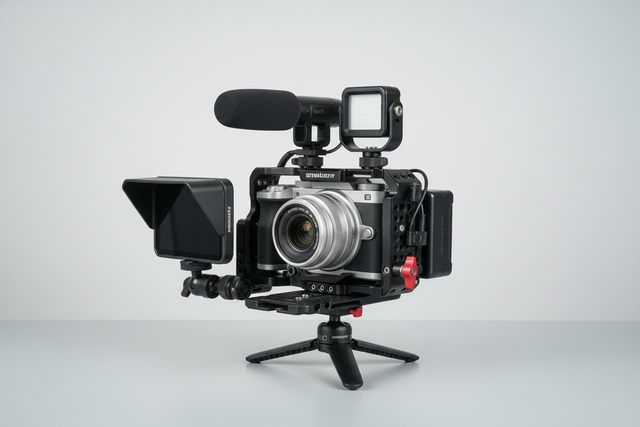
For example, if you are using the Ulanzi F38 Quick Release Video Travel Tripod 3318, do not mount a high-power LED light directly adjacent to the camera body on a short arm. Instead, use a secondary mounting point to create a physical buffer. This spacing allows natural convection to pull cooler air from the floor level upward, rather than trapping a "heat bubble" around your sensor.
Vertical vs. Horizontal Orientation
The orientation of your device’s heatsink fins is a non-obvious factor that makes a massive impact. Based on practitioner observations, a light mounted with its heatsink fins oriented vertically will often run 5–10°C cooler than one mounted horizontally. This is due to improved natural convection; hot air rises, and vertical channels facilitate this movement far more efficiently than horizontal ones.
Hardware as a Thermal Bridge: The F38 Ecosystem
In the The 2026 Creator Infrastructure Report: Engineering Standards, Workflow Compliance, and the Ecosystem Shift, we emphasize that infrastructure should be "evidence-native." This applies directly to the materials we use.
The quick-release plates in the F38 system are precision-machined from Aluminum Alloy (typically 6061 or 7075). While the legs of the Ulanzi F38 Quick Release Video Travel Tripod 3318 are made of Carbon Fiber for its superior vibration damping and weight-to-strength ratio, the aluminum plates serve a secondary thermal purpose. Aluminum is an excellent heat conductor. In some scenarios, it acts as a "thermal bridge," helping to wick a small amount of heat away from the camera base.
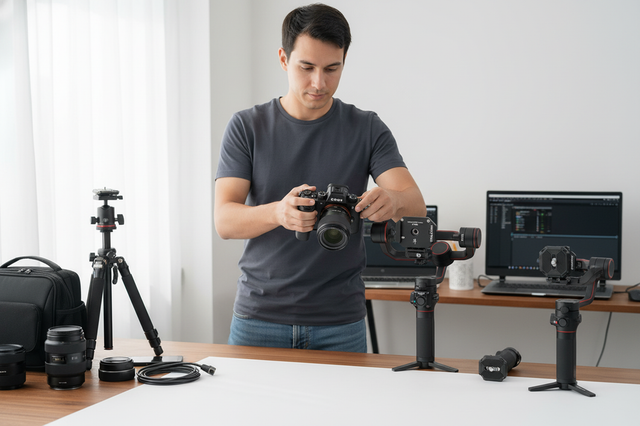
Safety Note on Load Capacity: The F38 system is rated for an 80kg Vertical Static Load (based on lab testing). However, for 24/7 rigs, you must consider the Dynamic Payload. If you are rigging heavy accessories that generate heat, ensure your locking mechanisms are checked using our "Pre-Shoot Safety Checklist":
- Audible: Listen for the distinct "Click" of the F38 lock.
- Tactile: Perform a "Tug Test" (pull the camera) to ensure the plate is seated.
- Visual: Verify the locking pin status (check the orange/silver indicator).
Active Cooling: When Passive Airflow Isn't Enough
Sometimes, the ambient temperature of a tight studio simply exceeds the passive cooling limits of your camera. This is where active, targeted cooling becomes mission-critical.
We recommend integrating a dedicated solution like the Ulanzi CU01 Thermostatic Semiconductor Camera Cooler Kit. Unlike generic fans, a semiconductor (Peltier) cooler provides a focused temperature drop directly at the camera's recording module.
Logic Summary: In sound-sensitive environments, traditional high-RPM fans can generate noise above 30-40 dB, which ruins audio quality. A thermostatic cooler allows for a lower noise floor while preventing the camera's internal thermal protection from triggering a shutdown.
Lighting Efficiency and Spectral Integrity
Heat doesn't just threaten your camera; it degrades your lighting quality. As LED temperature rises, efficiency drops. This results in the "dimming effect" where a light starts bright but loses intensity over a three-hour stream.
When selecting lighting, look for professional consistency. The Ulanzi AS-045 Quick Release Octagonal Honeycomb Grid Softbox 3308 is designed to work with Bowens mount lights that adhere to the EBU R 137 / TLCI-2012 (Television Lighting Consistency Index). High-quality lighting maintains its spectral similarity even under thermal load, ensuring your products look the same at the end of the stream as they did at the beginning.
The 50% Brightness Heuristic
To maximize thermal efficiency, we modeled the power draw of a standard LED light (like the VL120) across different brightness levels.
Luminous Autonomy Runtime & Thermal Model
Brightness Power Draw Estimated Runtime Thermal Load 100% 8.0W ~42 mins High (Max Stress) 80% 6.4W ~53 mins Moderate 50% 4.0W ~85 mins Low (Optimized) Assumptions: 2000mAh battery at 3.7V, 0.85 converter efficiency. Modeling shows that dropping to 50% brightness cuts heat output by half while doubling runtime.
For 24/7 operations, running at 50-70% brightness and adjusting your camera's ISO or aperture is often more stable than pushing lights to 100% and risking a thermal cascade.
Biomechanical Analysis: The "Wrist Torque" Factor
Thermal safety is about the equipment, but rigging safety is about the human. When you build a complex rig to improve airflow, you often add "leverage" that can strain your body during setup.
Concept: Weight isn't the only enemy; Leverage is. Formula: $Torque (\tau) = Mass (m) \times Gravity (g) \times Lever Arm (L)$
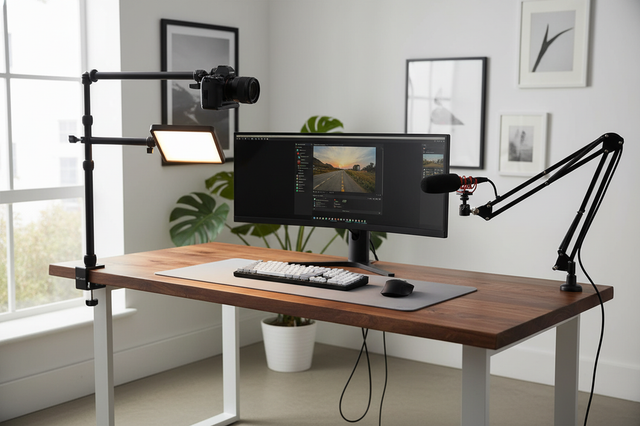
If you have a 2.8kg rig (camera + cage + monitor) held 0.35m away from your wrist, you are generating approximately 9.61 N·m of torque. This represents roughly 60-80% of the Maximum Voluntary Contraction (MVC) for an average adult. By using modular mounting like the Ulanzi CO17 Super Clamp with Dual Ballhead Magic Arm C046GBB1, you can offload these accessories to a desk-mounted pole, reducing physical strain and improving airflow around the camera.
Workflow ROI: The Value of Quick Release
Investing in a system like F38 isn't just about safety; it is a financial decision. We have calculated the ROI of switching from traditional thread mounting to a quick-release ecosystem.
- Traditional Thread Mounting: ~40 seconds per swap.
- F38 Quick Release: ~3 seconds per swap.
- The Math: For a professional doing 60 swaps per shoot (adjusting angles, moving from tripod to handheld) and 80 shoots per year, you save approximately 49 hours annually.
- The Value: At a professional rate of $120/hr, this represents a $5,900+ annual value in recovered time.
This efficiency allows you to focus on the content of your stream rather than fumbling with screws while your equipment gets hotter by the second. For more on building these systems, see our guide on Multi-Point Modular Rigs.
Cable Management and Safety Compliance
Dense bundles of cables act as insulation. In a tight studio, we recommend using velcro straps instead of zip-ties. This allows you to re-route cables as your setup evolves and prevents the creation of "heat traps." Additionally, a heavy HDMI cable can create unwanted torque on your camera's ports; we suggest using cable clamps to provide strain relief.
Trust and Safety Sidebar: When running 24/7 rigs, battery safety is paramount. Ensure your external power banks and internal batteries meet IEC 62133-2:2017 Safety Requirements. This standard ensures the cells can withstand the continuous charge/discharge cycles and thermal stress of long-duration streaming.
Summary of Thermal Management Heuristics
To maintain a reliable 24/7 live rig in a tight space, follow these expert-derived steps:
- Space it out: Use the "one component width" rule to prevent heat ingestion.
- Orient for convection: Mount heatsinks vertically to exploit natural airflow.
- Monitor the load: Use 50-80% brightness to significantly reduce the thermal footprint of your lighting.
- Go active when needed: Use a semiconductor cooler like the CU01 for mission-critical camera sensors.
- Rig for efficiency: Use the F38 system to maximize your workflow ROI and reduce physical strain.
By treating your studio as a cohesive thermal system—rather than a collection of gadgets—you ensure that your 24/7 stream remains exactly that: continuous, professional, and safe.
Disclaimer: This article is for informational purposes only. Thermal management requirements can vary significantly based on specific hardware combinations and environmental factors. Always consult your equipment's user manual for specific operating temperature ranges and safety warnings.