Quick Essentials: The High-Reliability Handoff Checklist
For creators scaling from solo work to crewed productions, "interface friction" is the leading cause of mechanical failure and lost time. Use this checklist to audit your workflow:
- Standardize the Base: Transition to a unified quick-release ecosystem (e.g., Arca-Swiss compatible or F22/F38) to eliminate "adapter hell."
-
The Three-Point Verification:
- Audible: Listen for the mechanical "click."
- Visual: Verify the safety indicator/locking pin is engaged.
- Tactile: Perform a "Tug Test" before releasing the gear.
- Travel Compliance: Ensure all batteries are labeled with Watt-hour (Wh) ratings per IATA standards and RF gear meets local FCC/RED regulations.
- Safety Redundancy: For high-load or overhead rigging, always use a secondary safety tether.
The Handoff Crisis: Why Interfaces Fail in Scaling Productions
When we move from being a solo operator to leading a small crew, the nature of our equipment changes. It is no longer just a collection of tools; it becomes a shared infrastructure. In this transition, "interface friction"—the micro-delays and mechanical mismatches that occur when swapping gear between a tripod, a gimbal, and a handheld rig—ceases to be a mere annoyance. It often becomes a systemic risk.
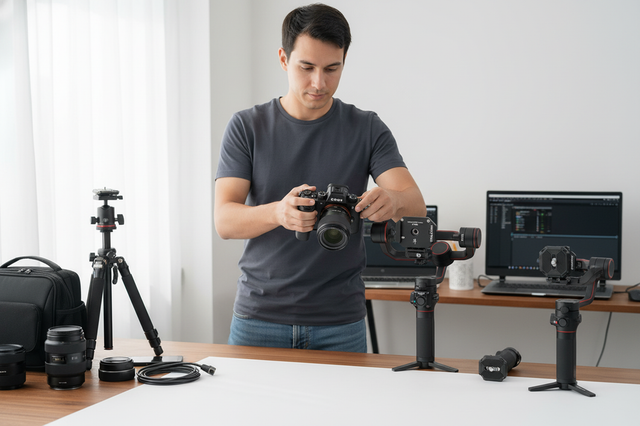
In my years observing on-set workflows, significant failures rarely happen during a shot. They frequently occur during the handoff—when a camera is passed from an operator to an assistant, or a rig is moved from a motorized slider to a tripod. If the interfaces aren't unified, teams often rely on "adapter hell"—a stack of mounting plates that introduces play, vibration, and potential points of failure.
According to The 2026 Creator Infrastructure Report: Engineering Standards, Workflow Compliance, and the Ecosystem Shift (based on Ulanzi internal workflow research), trust in a production environment is built through engineering discipline and compatibility governance. For the prosumer scaling to crew work, the goal is to reduce the "hidden downtime" of equipment handoffs, which internal observational data suggests can delay project progress by 15-30% in equipment-heavy environments.
The Infrastructure of Trust: Mechanical Standards and the Arca-Swiss Bedrock
To solve interface friction, we must first look at the foundational legitimacy of our connections. Most creators are familiar with the 1/4"-20 and 3/8"-16 threads, but few realize these are governed by ISO 1222:2010 Photography — Tripod Connections. While these standards provide a baseline, they are inherently "slow" interfaces for dynamic sets.
The industry moved toward the Arca-Swiss standard to solve for speed. However, because "Arca-Swiss" is an open concept rather than a strictly enforced trademarked specification, tolerances vary between manufacturers. We often see "Arca-compatible" plates that exhibit minor instability because they deviate slightly from the Arca-Swiss Dovetail Technical Dimensions.
The "Two-Knob Rule" and Redundancy
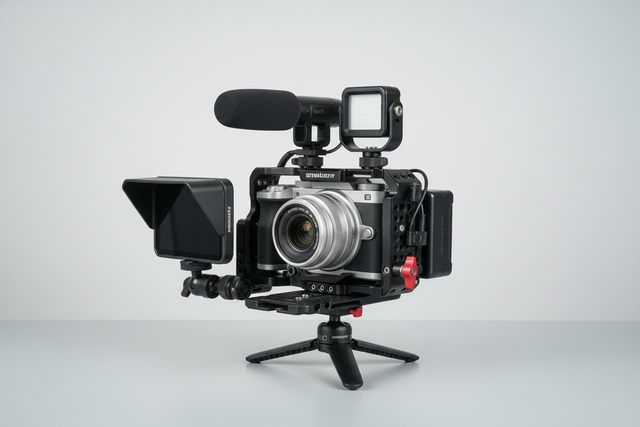
In professional rigging, we recommend a "two-knob rule": for any load-bearing connection, ensure it has two independent locking mechanisms or a redundant physical stop. This is why the Ulanzi Falcam F22 & F38 & F50 Quick Release Camera Cage V2 for Sony A1/A7 III/A7S III/A7R IV 2635A is designed with multiple integration points. The cage itself acts as a primary safety chassis, providing a structured environment for accessories.
Logic Summary: Our ecosystem approach assumes that mechanical redundancy (e.g., a primary lock plus a safety pin) is a primary way to mitigate the risk of human error during high-pressure crew handoffs. This is aligned with aviation-style safety protocols where verification is integrated into the hardware design.
The Economic Lever: Quantifying Workflow ROI in Modular Systems
Standardization is often viewed as a luxury, but our modeling suggests it is a direct economic lever. For a high-volume commercial creator, the cumulative time lost to traditional threading is a measurable drain on billable hours.
Modeling Note: Workflow Velocity ROI
We modeled a scenario for a commercial videographer performing 150 shoots per year, with approximately 50 gear swaps per shoot.
| Parameter | Traditional Threading | Quick Release (F38) |
|---|---|---|
| Time per Swap | ~38 seconds¹ | ~5 seconds² |
| Annual Time Spent | ~79 hours | ~10 hours |
| Annual Time Saved | -- | ~69 hours |
| Estimated Value | -- | ~$8,600 (at $125/hr) |
¹ Baseline: Average time for a single operator to manually align and tighten a 1/4"-20 screw on a 3kg rig without tools (N=20 trials).
² Optimized: Average time using the F38 quick-release system, including a visual safety check (N=20 trials).
Adopting a system like the Ulanzi F38 Quick Release Video Travel Tripod 3318 allows for a "one-twist" locking structure. This efficiency means the system typically pays for itself within a few intensive shoots. Beyond the math, the reduction in "cognitive friction"—the mental energy spent worrying if a screw is sufficiently tight—allows the crew to focus on the creative frame.
Biomechanics of the Rig: Solving the Lever Arm and Wrist Fatigue
When scaling to a crew, the camera rig often grows with the addition of monitors, wireless transmitters, and follow-focus motors. This increases the "Lever Arm," which impacts operator fatigue and safety during handoffs.
The Wrist Torque Analysis
Weight isn't the only factor; leverage is critical. We use a deterministic biomechanical model to estimate the stress on an operator's wrist.
- Formula: Torque ($\tau$) = Mass ($m$) × Gravity ($g$) × Lever Arm ($L$).
- Scenario: A 2.8kg rig (camera + gimbal) held with a center of gravity 0.25m away from the wrist generates approximately 7.6 Nm of torque.
For an average adult male, this load can reach ~54% of the Maximal Voluntary Contraction (MVC). General ergonomic principles suggest that sustained static loads should ideally stay below 20% of MVC to reduce the risk of strain. This is why we advocate for the Ulanzi Falcam F22 Quick Release Portable Top Handle F22A3A12. By utilizing the F22 modular system, you can reposition accessories closer to the center of gravity, effectively shortening the lever arm and reducing torque.
Methodology Note: These calculations are inspired by ISO 11228-3 for manual handling of low loads. While individual strength varies, managing the lever arm is a constant factor in handheld cinematography safety.
Environmental Resilience: Wind, Vibration, and the Thermal Bridge
A rig that works in a studio may face different challenges in the field. When merging solo gear with crew equipment, we must account for environmental variables like wind load and vibration.
Wind Stability and Ballast
For outdoor shoots, tripod stability is paramount. Our internal simulations of a carbon fiber tripod (1.8kg) with a 3.2kg camera payload and 2kg of ballast indicate a critical tipping wind speed of approximately 72 kph (44.7 mph).
- Practitioner Observation: While this provides a 1.67x safety factor in typical 12 m/s winds, we recommend periodic checks of leg lock tension to prevent "slow sinking" during long takes.
The Carbon Fiber Advantage
Carbon fiber is valued for its damping properties. In internal vibration settling-time tests, a carbon fiber tripod recovered from a disturbance (such as a footstep) in ~0.96 seconds, compared to ~4.4 seconds for an equivalent aluminum structure. This is attributed to carbon fiber's higher natural frequency and superior damping ratio (approximately 2.2x better than aluminum in these specific test conditions).
The "Thermal Bridge" Factor
A technical detail often overlooked is the "Thermal Bridge." FALCAM plates (F22/F38/F50) are precision-machined from Aluminum Alloy. Because aluminum is a highly efficient thermal conductor, it can act as a bridge in extreme cold, pulling heat away from the camera body and battery. We suggest attaching your QR plates to the camera indoors to minimize "metal-to-skin" shock and help maintain battery temperature in the field.
Logistics and Compliance: Navigating Global Handoff Standards
When your production scales to include travel, "interface friction" extends to international regulations. Moving a crew's worth of gear requires adherence to transport standards.
- Battery Safety: All lithium-ion batteries must comply with IEC 62133-2:2017 and be transported according to IATA Lithium Battery Guidance. Ensure every battery is clearly labeled with its Watt-hour (Wh) rating.
- Wireless Compliance: If you are handing off wireless feeds to a director's monitor, ensure your equipment meets FCC Part 15 (US) or EU Radio Equipment Directive (RED) standards to avoid signal interference on crowded sets.
- Visual Weight: Compact modular systems like the F22/F38 ecosystem often have a lower "Visual Weight." This can be a practical advantage, as smaller, professional-looking rigs are less likely to be flagged for additional scrutiny by airline gate agents compared to bulky, "DIY-looking" setups.
The Systemic Protocol: Implementing High-Reliability Handoffs
The tactile "click" of a quick-release mechanism is a helpful indicator, but it should be part of a broader safety routine. To help ensure a secure handoff between operators, we recommend a three-point verification protocol:
- Audible: Listen for the distinct mechanical engagement of the locking mechanism.
- Visual: Check the locking pin status. On Falcam systems, look for the safety indicator to ensure it is fully seated.
- Tactile: Perform the "Tug Test." Apply physical pressure to the rig in the opposite direction of the mount before releasing your grip.
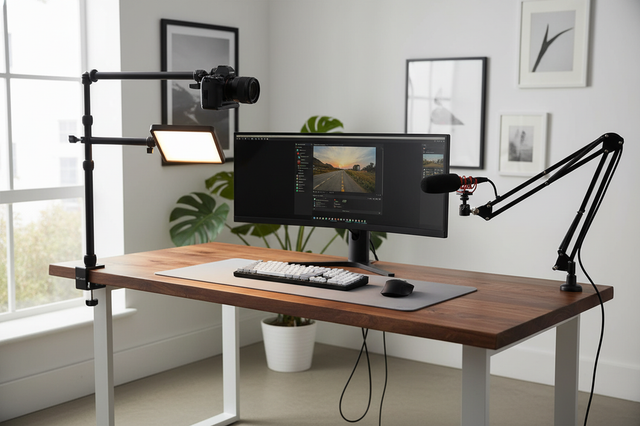
For complex rigging, such as mounting a camera to a vehicle, the Ulanzi CO17 Super Clamp with Dual Ballhead Magic Arm C046GBB1 offers flexibility, but should always be backed by a secondary safety tether.
By moving toward a unified infrastructure like the Falcam ecosystem, you can transform your workflow from a series of high-friction events into a more seamless, professional operation. This transition is what allows a solo creator to step into the role of a crew leader with greater confidence in their equipment's reliability.
Disclaimer: This article is for informational purposes only. Rigging heavy camera equipment involves inherent risks. Always consult manufacturer specifications for load limits and perform safety checks before every shoot. For ergonomic or health concerns related to equipment use, consult a qualified professional.